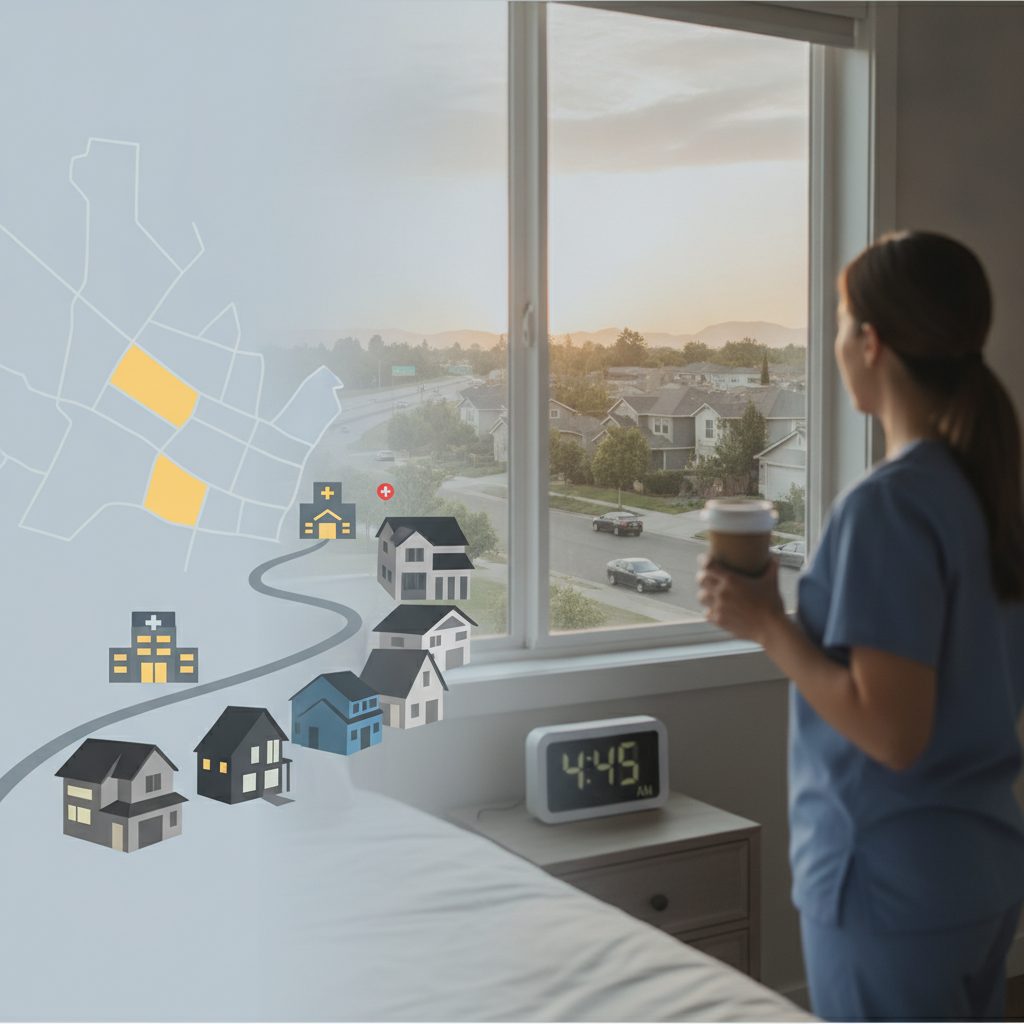
Commute Corridors and Hospital Shift Patterns
Hospital schedules rarely match the standard eight-to-five commute, but shift turnover brings distinct traffic pinches. A day shift starting at 06:45 requires arriving by 06:30, placing your drive right alongside early commuters heading north toward downtown Sacramento. Leaving a night shift at 07:15 points you directly into southbound morning congestion if your path bottlenecks near major highway exits.For staff based at local facilities like Kaiser Permanente Elk Grove Promenade, Sutter Health Elk Grove on Laguna Springs Drive, or Dignity Health Methodist Hospital on Bruceville Road, surface arteries often matter more than freeways. Living west of Highway 99 along Laguna Boulevard or Big Horn Boulevard provides direct cross-town access without entering packed highway interchanges. If your post is at UC Davis Medical Center in Elmhurst, Sutter Medical Center in Midtown, or Mercy General in East Sacramento, freeway selection dictates your commute duration.- Interstate 5 Corridor: Best for staff traveling to downtown medical centers or UC Davis Health via the Capital City Freeway. Neighborhood enclaves like Laguna West, Lakeside, and Stonelake offer direct access at Laguna Boulevard and Elk Grove Boulevard, bypassing Highway 99 entirely.
- Highway 99 Corridor: The primary route to Methodist Hospital, Kaiser South Sacramento, and central Sacramento health systems. Neighborhood communities along Bond Road, Sheldon Road, and Calvine Road grant quick access, though Highway 99 backs up quickly during peak hours.
- East-West Surface Arteries: Roads like Laguna Boulevard and Elk Grove Boulevard carry heavy local school traffic between 07:30 and 08:30. If your shift ends during morning drop-off, select a pocket with secondary access streets to avoid delays.
Designing for Daytime Rest and Acoustic Insulation
Night-shift nurses, respiratory therapists, and on-call surgeons face a reality standard buyers rarely contemplate: sleeping soundly while the neighborhood operates at full volume. A street that feels tranquil during a Saturday open house can turn chaotic on Tuesday morning when trash collectors, delivery trucks, and lawn crews work the block.Evaluate bedroom placement within the floor plan on every property tour. Primary bedrooms situated at the front of the house sit directly across from vehicle headlights, engine starts, and walking foot traffic. A rear-facing bedroom in a single-story layout, or an upstairs space buffered by bathrooms and closets, provides far better sound separation. Solar exposure also influences rest quality. Summer temperatures in the Sacramento Valley often pass 100 degrees Fahrenheit. An unshaded west-facing bedroom captures intense afternoon heat, forcing air conditioning units to run hard during primary sleeping hours.Notice how close a property sits to community focal points. Homes bordering elementary schools, community parks with lit sports complexes, or busy neighborhood cut-through roads generate sustained daytime noise. Focus on properties deep inside loop roads or cul-de-sacs where through-traffic is minimal. Pay close attention to window performance. Homes constructed before the mid-1990s often retain older single-pane windows or worn aluminum casings that leak outside sound, whereas modern dual-pane vinyl windows provide solid sound blocking.Property Types and Maintenance Demands
Housing structure controls how many off-duty hours go toward property upkeep. Medical jobs demand physical stamina and mental clarity, making manageable home maintenance an essential consideration. Elk Grove features three main property formats, each carrying practical trade-offs.- Single-Family Detached Homes: The predominant residential style across Elk Grove. They give you complete control over your home environment with zero shared walls. You control your yard, schedules, and repairs, but bear full responsibility for lawn care and exterior maintenance, which can feel draining after multiple consecutive twelve-hour shifts.
- Townhomes and Halfplexes: Grouped primarily around planned districts such as Laguna Ridge. These builds reduce exterior chores because associations handle roof upkeep, paint, and community green spaces. The trade-off lies in shared wall sound transfer and association regulations.
- Condominiums: These offer minimal exterior chores, sparing clinical staff from yard upkeep and roof repairs. However, condominium inventory in Elk Grove is modest, and monthly association fees must fit directly into your monthly purchase calculations.
Evaluating Elk Grove Neighborhood Enclaves
Elk Grove is not a uniform suburb. It features distinct zones developed across separate decades, each offering practical advantages for medical households.Laguna West and Lakeside sit along the western edge of the city next to Interstate 5. Built during the 1990s and early 2000s, these master-planned areas include mature shade trees, pedestrian pathways, and artificial lakes. For clinicians heading north toward UC Davis Health or central clinics, immediate access to Interstate 5 makes this the shortest regional drive. Active associations keep community conditions tidy, though floor plans commonly include smaller guest bedrooms.Madeira and Laguna Ridge form the core of modern growth in southwest Elk Grove. Bordered by Whitelock Parkway and Big Horn Boulevard, these areas sit adjacent to the District56 civic center and expanding medical facilities. Properties here date largely from 2010 onward and provide modern wall insulation, tankless water heaters, dual-zone air systems, and open layouts. These mechanical features help keep electric bills in check during hot daytime rest hours. Buyers should note Mello-Roos infrastructure taxes, which raise annual property tax bills relative to older subdivisions.East Elk Grove and Old Town deliver a slower feel. Positioned east of Highway 99 along historic Elk Grove Boulevard, this area contains larger parcels, custom homes, and older architecture. Homeowners associations are uncommon, providing leeway for personal vehicle parking and exterior storage. The setting is quiet, but getting to either freeway requires navigating surface streets, adding transit time.Sheldon provides expansive living on the eastern periphery. Parcels run from one to five acres, creating generous acoustic space away from neighbors. For critical-care workers needing absolute decompression, rural tranquility is unmatched. However, private wells, septic tanks, and longer drives to basic grocers demand intentional commitment.Comparing Elk Grove with Nearby Sacramento Areas
Healthcare professionals often weigh Elk Grove against established neighborhoods inside Sacramento city borders. Weighing everyday trade-offs helps identify which location supports your schedule.- Pocket-Greenhaven: Situated north along the Sacramento River, Pocket offers an effortless drive to downtown hospitals and UC Davis Health via Interstate 5. Housing consists mostly of 1970s and 1980s single-story homes. Prices match Elk Grove closely, though shopping centers and dining spots reflect older construction.
- Tahoe Park and Elmhurst: Highly popular among UC Davis Medical Center staff due to direct bike and walking access. However, homes are primarily older bungalows with modest square footage, single-car garages, older plumbing, and thinner acoustic insulation.
- Natomas: Positioned north of Sacramento, Natomas allows rapid access to Interstate 5, but commuting south toward East Sacramento medical campuses requires driving through downtown highway interchanges that clog during morning and evening rush hours.
- Elk Grove Balance: Buyers gain newer construction, larger layouts, multi-car garages, proximity to Elk Grove Unified School District facilities, and modern retail hubs along Laguna Boulevard, accepting a longer physical distance to downtown medical centers.
Healthcare Homebuyer Evaluation Checklist
Before submitting an offer on an Elk Grove home, use this targeted evaluation checklist to verify that the property fits your work schedule:- Drive the Actual Shift Window: Travel your commute route at 06:15 or 18:30, and make the trip home at 07:30. Never rely on mapping tools during midday hours to judge real travel times.
- Conduct a Daytime Noise Check: Walk the prospective neighborhood block at 11:00 on a Tuesday. Check for landscape blowers, delivery vans, construction crews, and barking dogs that could disrupt sleep.
- Evaluate Bedroom Location: Check that the primary bedroom does not share an exterior wall with the street or sit over a garage door that family members use during your sleep hours.
- Examine Windows and HVAC Controls: Look for dual-pane windows with tight perimeter seals. Confirm that the cooling system features dual-zone settings so you can cool sleeping quarters without chilling the entire house.
- Review Association Rules: Search community bylaws for rules on work vehicles, driveway parking restrictions, and daytime exterior maintenance noise rules.
- Confirm Essential Amenity Access: Identify services within a five-minute drive, including late-night pharmacies, quick grocery stops like Trader Joe's or Nugget Markets, fitness gyms, and paved walking paths for post-shift unwinding.