
History ALWAYS Repeats Itself: The mortgage comeback Sacramento should watch before 2027.

Leia Baraza · 7 min read
History ALWAYS Repeats Itself: The mortgage comeback Sacramento should watch before 2027.
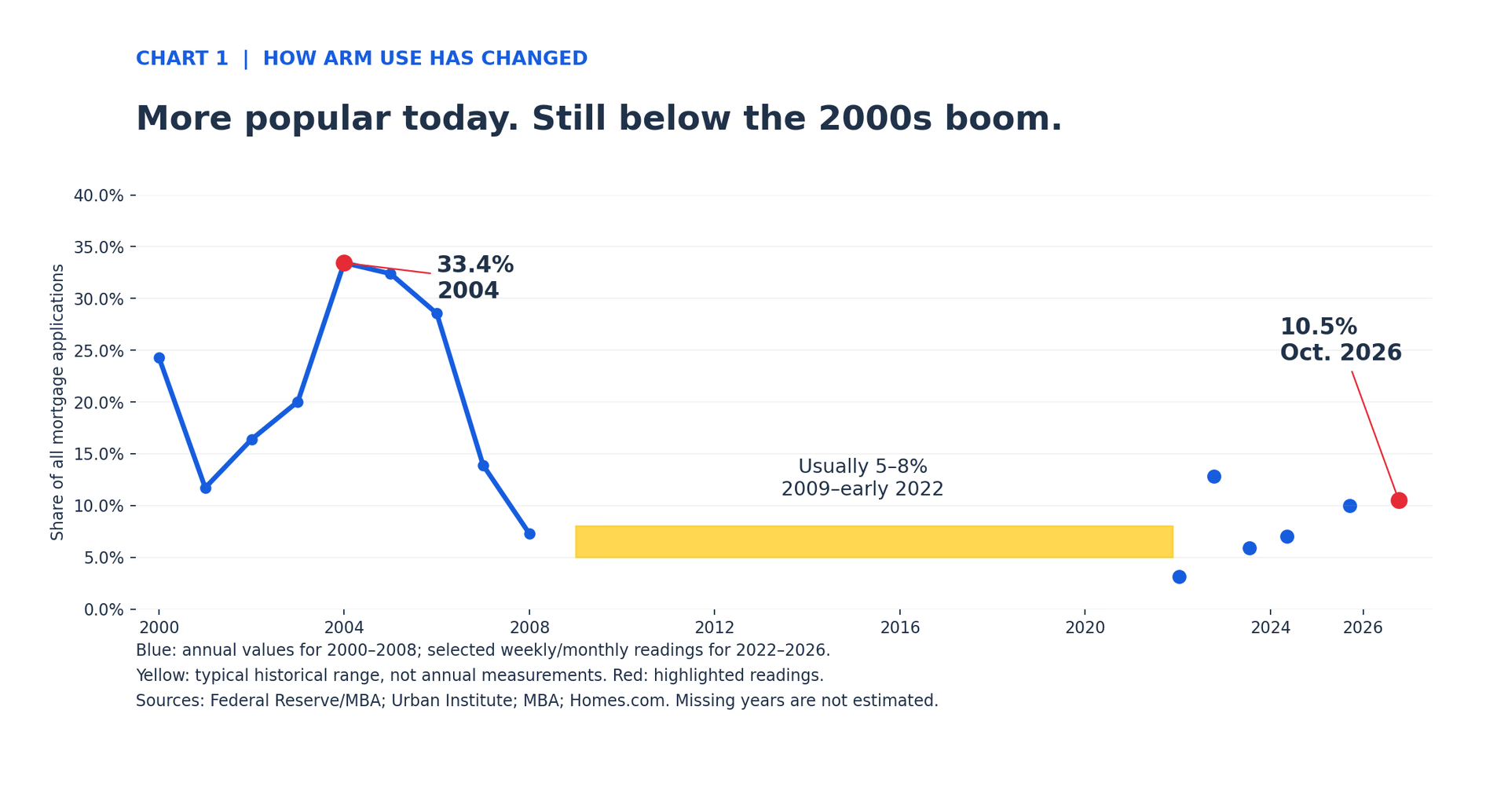
ARMs recently reached 10.5% of mortgage applications, which is roughly one in ten applications. Homes.com reports that this is the highest share since October 2025.[1][13] Buyers are looking for an upfront lower monthly payment. Some are choosing a mortgage whose rate can change later. These loans are called adjustable-rate mortgages, or ARMs. The rate usually stays fixed for an introductory period, then adjusts on a schedule set by the loan.  Today, Adjustable-rate loans are gaining more attention.
History ALWAYS Repeats Itself: The mortgage comeback Sacramento should watch before 2027.
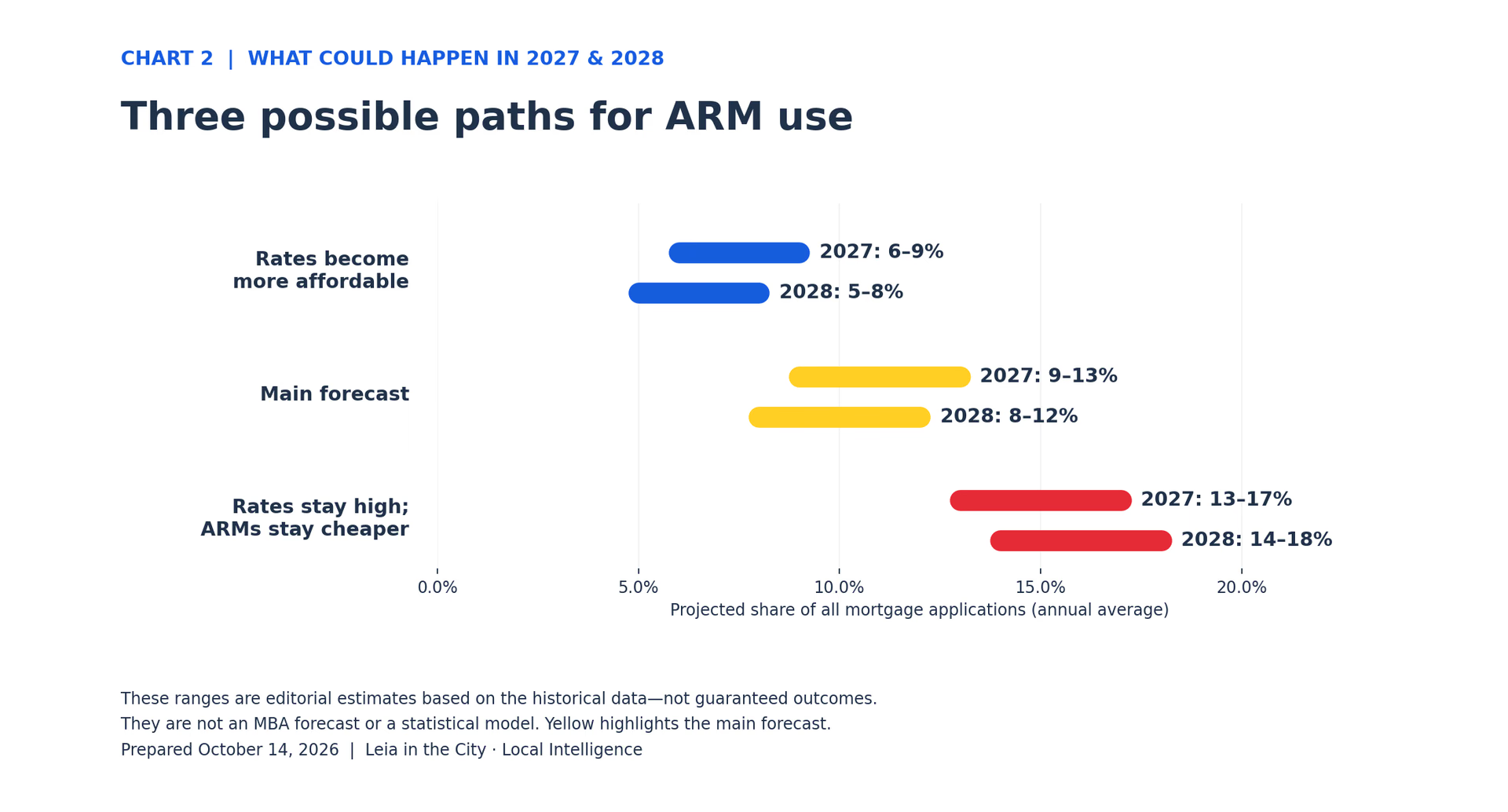
The bigger story here is WHY are adjustable-rate mortgages making a comeback—and what Sacramento buyers and investors must pay attention to before choosing an ARM loan.Could this be the start of more mortgage defaults as buyers take on payments they may no longer be able to afford when their rates adjust? Could it be a warning sign of another housing crash?Maybe. Maybe not. Either way, I believe this topic deserves serious attention.If more buyers take on loans they cannot afford after their rates adjust, that could increase defaults and contribute to a housing downturn. But rising ARM use alone does not establish a high likelihood of another housing crash.My warning is simple: being able to afford the starting payment does not mean you can afford the loan long term. Based on my 20+years of real estate market experience, I foresee this as a history repeat in the same way it occurred in 2004 before the 2008 housing crisis...and quite frankly, if the economy continues like it is, this won't end well for these types of buyers, getting these types of loans.We have seen this before but on a much larger scale. In 2004, ARMs made up about one-third of mortgage applications. By 2008, that annual share had fallen to about 7%.[5]  ARM use generally stayed low for years. It rose again in 2022 as borrowing became more expensive, then moved up and down as loan pricing changed.[7] I believe ARM use remained low after 2008 because many borrowers had lost their homes after taking out loans with low introductory rates. When those rates adjusted upward, their monthly payments rose beyond what they could afford. Buyers entering the market after 2008 had witnessed those consequences, making many more cautious about choosing an adjustable-rate mortgage, therefore causing decrease of ARM loans.The attraction is simple: a lower starting payment. In September 2026, the average 30-year fixed rate was 7.1%, compared with 6.2% for a five-year ARM, according to NAHB’s analysis of MBA data.[9]  That lower starting rate can make a purchase easier to afford. The trade-off comes later: the rate and payment can change after the fixed period ends.There is an important difference between then and now. The Consumer Financial Protection Bureau explains that modern ARMs generally have longer introductory fixed periods and stronger repayment safeguards than many loans offered before the housing crisis. That makes a direct repeat of 2008 less straightforward—but it does not eliminate the risk of higher payments.My forecast for 2027 and 2028. I expect ARMs to remain an option buyers consider when fixed-rate payments feel too expensive. My main forecast is a 9%–13% average share of applications in 2027 and 8%–12% in 2028. This assumes payment pressure continues in 2027, followed by some improvement in fixed-rate affordability in 2028. If fixed loans become more attractive sooner, ARM use could fall. If fixed rates stay high and ARMs keep offering lower starting rates, their share could rise.
History ALWAYS Repeats Itself: The mortgage comeback Sacramento should watch before 2027.
An adjustment does not automatically mean a higher payment. The result depends on market rates and the loan’s terms. Borrowers should know when their rate changes, how much it can rise and whether the new payment fits their budget.[11][12]  “I’ll refinance later” needs a backup plan. A future refinance depends on qualifying for a new loan and finding acceptable terms.My final local intelligence input:For buyers and investors, the question is straightforward: Does this purchase still work if the payment increases? Buyers please beware. Think about the payment increase in a year, or in 2 years or in 3 years. Is it something you will be able to afford. Read the very fine lines when considering an ARM loan. Relocating? Allow for the possibility that you stay longer than planned. Investing? Test the payment alongside maintenance costs and months without rental income. Monthly payments will keep shaping buying decisions in 2027 and 2028. Understanding the loan will matter just as much as choosing the property. If you can’t qualify for a fixed-rate mortgage at today’s payment, I strongly encourage you to think carefully before choosing an ARM loan.Based on my 20-plus years of real estate market experience, the renewed interest in adjustable-rate mortgages brings back uncomfortable memories of the years leading up to the 2008 housing crisis.I watched families lose their homes. I remember the appeal of a lower starting payment—and the financial strain when that payment became more than a household could afford. I believe those experiences left many buyers cautious about ARMs for years afterward. Today, my concern is familiar: are buyers choosing a loan they understand and can afford long term, or choosing the starting payment because it makes the purchase possible?My experience tells me to take this risk seriously. If household finances weaken and buyers cannot manage their adjusted payments, I worry that this could end badly for those who stretched too far.For Sacramento buyers and investors, my warning is clear: do not build your purchase around the assumption that you can refinance later. Understand the adjustment date, the payment limits, and whether your budget can handle the increase.The goal is more than getting the keys. It is being able to keep them.Move in Faith with Local Intelligence.

Sources and simple chart notes

Chart 1 combines annual MBA observations for 2000–2008, the Urban Institute’s typical historical range, and selected later readings. The later points are January and October 2022, July 2023, May 2024, September 2025 (monthly average) and October 9, 2026 (weekly). A complete annual series was not obtained; missing values are not filled in. All shares include purchase and refinance applications.Chart 2 shows judgment-based ranges for annual averages. The main forecast stays near recent levels, then assumes modest relief. The other paths show how lower or persistently high borrowing costs could change demand. These ranges have not been statistically tested and are not confidence intervals.The 6.39% figure in Trading Economics describes a historical ARM interest rate, not loan demand. Its underlying Freddie Mac series ended in 2022, so it cannot prove a record remained unbroken through 2025. HSH explains the market rates used to adjust loans; it does not count ARM applications. Both resources are retained below for background.Research cutoff: October 14, 2026. National data; not a Sacramento-specific forecast.

References

homes.comhttps://www.homes.com/news/arm-demand-hits-highest-level-in-a-year-as-mortgage-rates-climb/2066538922/
tradingeconomics.comhttps://tradingeconomics.com/united-states/5-1-year-adjustable-rate-mortgage-average-in-the-united-states-percent-w-na-fed-data.html
https://Freddie Mac via FRED — MORTGAGE5UShttps://Freddie Mac via FRED — MORTGAGE5US
hsh.comhttps://www.hsh.com/idxhst.html
federalreserve.govhttps://www.federalreserve.gov/pubs/feds/2011/201121/accessible_version.html
federalreserve.govhttps://www.federalreserve.gov/pubs/feds/2011/201121/index.html
urban.orghttps://www.urban.org/sites/default/files/2024-05/Housing-Finance-At-A-Glance-Monthly-Chartbook-May-2024.pdf
newslink.mba.orghttps://newslink.mba.org/servicing-newslink/2025/october/mba-servicing-newslink-tuesday-oct-21-2025/chart-of-the-week-arm-applications-level-and-share/
eyeonhousing.orghttps://eyeonhousing.org/2026/10/arm-share-increased-as-mortgage-rates-spiked/
bankingjournal.aba.comhttps://bankingjournal.aba.com/2026/01/aba-databank-arms-are-noticeable-but-niche/
consumerfinance.govhttps://www.consumerfinance.gov/ask-cfpb/for-an-adjustable-rate-mortgage-arm-what-are-the-index-and-margin-and-how-do-they-work-en-1949/
consumerfinance.govhttps://www.consumerfinance.gov/ask-cfpb/if-i-am-considering-an-adjustable-rate-mortgage-arm-what-should-i-look-out-for-in-the-fine-print-en-1947/
floordaily.nethttps://www.floordaily.net/flooring-news/mortgage-applications-down-2-7-in-week-ending-october-9/
homes.comhttp://Homes.com
fred.stlouisfed.orghttps://fred.stlouisfed.org/series/MORTGAGE5US
#RealEstate#RealEstateAgent#MarketUpdate#HomeBuying#Investment#Mortgage#Neighborhood#LuxuryHomes#local#localintelligence#leiainthecity#sacramento