

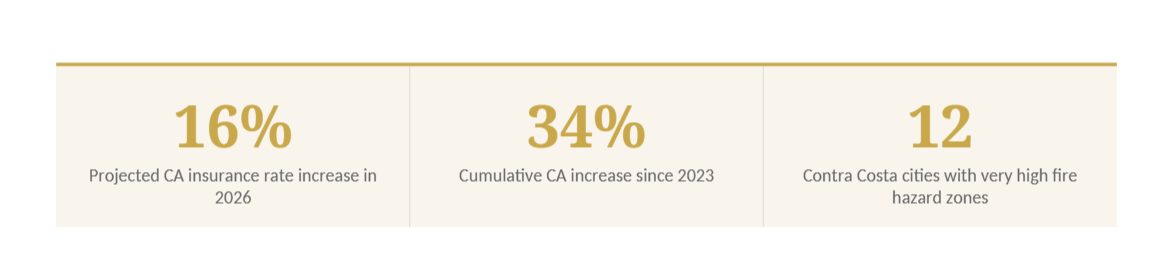
California homeowners are looking at the steepest insurance rate increase in the country. A 16% projected hike in 2026 follows a 16% climb since 2023, meaning the cumulative increase is closing in on 34% over roughly three years. This is not background noise. It is a cost that buyers are calculating before they make offers, and it is already changing how deals move through escrow across the state.
The driver is straightforward. The January 2025 Los Angeles wildfires generated an estimated $41 billion in insured losses. Insurers are now pricing that risk into policies statewide, not just in the fire corridors of Southern California. In a market where Prop 103 had long kept rate increases in check, the regulatory dam has effectively broken. Major carriers that spent years quietly limiting new policies in California are now pushing through the increases they could not get approved before.
"Insurance was never really thought of as one of the first things to consider. That is no longer the case."
Why the East Bay Is in the Middle of This
The East Bay is not Southern California, but it is not insulated either. State fire maps updated in early 2025 designated parts of Danville, Concord, and Pinole as very high fire hazard severity zones. The hillside edges of Walnut Creek and Pleasant Hill carry moderate to high ratings. Hercules and San Ramon have zones that fall into scrutiny depending on where in the city a property sits.
What this means practically: a buyer making an offer in 2026 is not just calculating mortgage payments and property taxes. They are calling insurance companies and finding out whether they can get a policy at all, and at what price. In some cases buyers are discovering mid-escrow that coverage options are limited or significantly more expensive than they budgeted for. Across California, insurance-related transaction cancellations nearly doubled between 2023 and 2024. That pattern is showing up here.
The California FAIR Plan, the state's insurer of last resort, has seen its enrollment climb 43% in 15 months. FAIR Plan premiums are projected to increase 29% by 2027. This is not a backstop that buyers feel good about. It is a signal that the private market is retreating, and buyers feel that uncertainty when they are deciding what to offer and what to walk away from.
What This Means If You Are Thinking About Selling
The window to sell a well-located East Bay home before insurance costs fully filter into buyer psychology is narrowing. Right now, demand from higher-income buyers, particularly those in tech and professional services who have settled across Walnut Creek, San Ramon, Danville, and Pleasant Hill, is still absorbing higher carrying costs. But that group is not immune to insurance uncertainty, and they are paying attention to it.
Sellers who move in the next few months are working with an inventory that remains relatively tight. That limits buyer leverage. But sellers who wait may be selling into a market where buyers are factoring an extra $300 to $500 or more per month in insurance premiums into their affordability math. That changes the number buyers are willing to put on paper.
Where the Opportunity Is for Sellers
Homes with low or moderate fire hazard zone designations are more attractive to insurers and easier for buyers to underwrite
Properties with recent hardening improvements, fire-resistant roofing, updated electrical, defensible space, can command a pricing premium as insurance becomes a buying criterion
Sellers in dense, flat, urban pockets of Concord, Pleasant Hill, Hercules, and Pinole, away from hillside exposure, sit in a stronger position relative to hillside or wildland-interface properties
Move-up buyers looking to leave higher-risk hillside homes are entering the market, creating a buyer pool that understands and accepts current pricing
Listing now, before another round of insurer announcements or rate approvals, positions sellers ahead of potential buyer caution that builds through late 2026
The Honest Picture
This is not a crisis for every East Bay homeowner. If you own in a lower-risk zone, are priced appropriately, and present a home that is easy to insure, you are in a reasonable market. But the broader trend is real, and pretending insurance costs are a footnote right now is not accurate.
What I am seeing with buyers is a shift in the order of questions. Insurance is now asked about early, often before inspections are even scheduled. Listings that come with information about current policies, existing coverage options, or fire hardening work are easier to sell. Listings that have no documentation and sit in ambiguous zone territory take longer.
If you have been sitting on a decision to sell, this is a reasonable moment to get a clear picture of what your home is worth and how it would be positioned in the current market. The fundamentals in the East Bay are still solid. But costs are rising on the buyer's side, and that eventually works its way into values if it is not already factored in.
Find Out What Your Home Is Worth Right Now
Get a straight answer. No pressure, no pitch. I have been doing this in the East Bay for 20 years and I can tell you exactly where your home stands in this market.