
If I had to describe transportation in Burlingame in one word, it would be choice. You have so many ways to get where you're going that on most days, you don't even think about it. The day one option is broken, you have five backups. That's the quiet luxury of living here, and it took me years to fully appreciate it.
Let me walk you through what that actually looks like.
The freeways. We have two: 101 and 280. From most Burlingame addresses, you're roughly 5 minutes from a freeway on-ramp. If 101 is jammed, you take 280. If both are jammed, you can drop down to El Camino and pick up 92 to head east across the San Mateo Bridge. People always ask me how proximity to two major freeways affects daily life, and my honest answer is: it's just choice. If one is congested, you have another one. You stop arranging your day around traffic the way you do in cities with only one route.
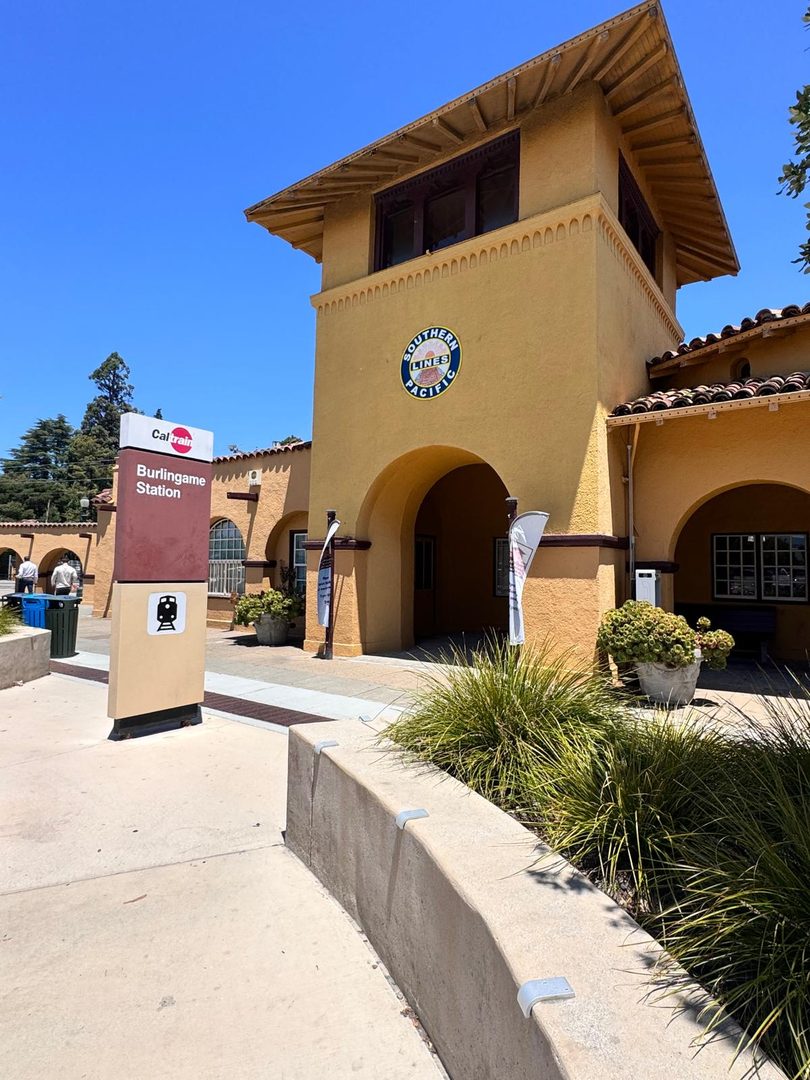
Caltrain. Burlingame has two Caltrain stations: Burlingame Avenue and Broadway. Two stations in a three-mile-radius city is real coverage. The train runs frequently on weekdays and gets you to San Francisco in about 30 to 35 minutes or down to Palo Alto, Mountain View, and Menlo Park in 20 to 45 minutes depending on the stop. Baby Bullet express trains are faster than the locals. For many of my clients who work in SF, Caltrain isn't the backup, it's the default.
BART. We don't have a BART station inside Burlingame, but Millbrae is the neighboring town, and the Millbrae BART station is a 10 to 15 minute drive depending on traffic. There's also a shuttle from Burlingame to Millbrae BART, which makes it accessible without a car. Millbrae is a major BART/Caltrain transfer station, so once you're there, you can reach almost anywhere in the Bay Area.
SFO. The airport is 8 minutes from my house. I tell people this all the time, and they nod politely until they live here for six months and then they get it. Eight minutes to a gate is a daily-life superpower. Long-layover travelers know this works the other way too. Visitors with a few hours to kill regularly come into Burlingame Ave to shop and eat. I've talked to plenty of out-of-town visitors at restaurants here who say, "I had four hours, I asked the hotel concierge where to go, and they sent me here."
Rideshare. Uber and Lyft both have strong coverage in Burlingame. On a good night, you can be in San Francisco in about 20 minutes. Rideshares to and from SFO are quick and frequent given the proximity. For evenings when you want a dinner in the city without dealing with parking, the math has quietly become: a 20-minute Uber, and you're there. Coming home from SFO at midnight, you're in your bed in under 20 minutes.
Walking. This is the one I came around to slowly. I came from a place where I needed my car for everything. Within a few months of moving to Burlingame, I noticed I was driving less. A year in, I realized I could go a whole Saturday without getting in my car. Burlingame is a car-optional city, not a car-free one, but the option to walk to a grocery store, a coffee shop, a pharmacy, a gym, a restaurant, a Caltrain station, and a park is real, and it changes how you live.
One change that made walking even better: California Drive used to be four lanes of fast traffic cutting through town. The city redesigned it down to two lanes a few years back. People drive slower now. The street feels safer to cross. The whole corridor feels more like a neighborhood and less like a highway. That's the kind of investment a city makes when it takes walkability seriously, and we did.
There's a phrase I use with clients about Peninsula life: you're stuck in the bubble. That sounds negative, and it's not meant to be. What I mean is that once you live here, you almost never need to leave the Peninsula for anything. Drive 10 minutes and you're at a Target. Drive 10 minutes another direction and you're at 99 Ranch, an Asian specialty grocery. Indian specialty groceries, Whole Foods, Costco, every category of store you might need, all within a short drive. If you don't want to drive, the train takes you up and down the Peninsula. You can spend weeks at a time without crossing a bridge. We're very blessed here in that way.
Now, the honest part. Traffic has grown. There's no getting around it. As more business has moved into Burlingame and the surrounding area has built up (Topgolf, the new Meta facilities going up across the bay, renovated hotels, more daytime visitors), there's a lot more traffic than there was even ten years ago. A lot more people come in and out of here every day, and it causes traffic for residents on certain routes at certain hours. It hasn't taken away from what makes Burlingame work, but I'd be doing you a disservice if I painted a picture where traffic doesn't exist. It does. The choices and the alternatives are how residents manage around it.
What I want buyers to understand: when you live in Burlingame, the question isn't usually "how do I get there?" It's "which of my five options do I want to use today?" Driving in the rain, take 280. Going to a meeting in SF and want to read on the way, take Caltrain. Going to dinner in the city on a Friday, take an Uber. Hitting SFO for a 7 a.m. flight, drive yourself. Going to Whole Foods, walk if you live close, drive if you don't. After 20 years here, I still notice how much that optionality matters. You don't realize how much it matters until you live somewhere that doesn't have it.
Common questions about transportation in Burlingame
Does Burlingame have a BART station? No, but the Millbrae BART station is in the neighboring town, about 10 to 15 minutes by car or accessible by SamTrans bus and shuttle. Millbrae is a major BART/Caltrain transfer station, which gives Burlingame residents reasonable access to East Bay destinations.
How many Caltrain stations does Burlingame have? Two: Burlingame Avenue and Broadway. Two stations in a city of roughly three square miles is unusually good coverage, and it puts a Caltrain station within walking distance for many neighborhoods.
Which freeways serve Burlingame? 101 and 280. Most Burlingame addresses are within about 5 minutes of an on-ramp. El Camino Real also runs through the city and connects to Highway 92, which provides access to the San Mateo Bridge and the East Bay.
How do residents get to SFO from Burlingame? Most Burlingame addresses are roughly 8 minutes from SFO by car. Uber, Lyft, taxi, and SamTrans buses also serve the airport, and the BART station at Millbrae provides AirTrain connection inside SFO.
What kinds of shopping can I reach without leaving the Peninsula? From most Burlingame addresses, you can reach Target, Costco, Whole Foods, Trader Joe's, Safeway, Mollie Stone's, 99 Ranch (Asian specialty grocery), Indian specialty groceries, and a full range of national and independent retail within roughly 10 to 15 minutes. Many residents go weeks at a time without crossing a bridge or leaving the Peninsula.
Is traffic a problem in Burlingame? Traffic has grown noticeably as more business has moved into Burlingame and the surrounding area has developed. Peak commute hours on 101, certain stretches near Burlingame Ave on weekends, and routes near major employers can be heavy. Residents typically manage by rotating among the available alternatives (Caltrain, 280, El Camino) depending on the time and destination.
Can I get around Burlingame without a car? Yes, more than in most Bay Area cities, but not entirely. Within the downtown core and most flats neighborhoods, you can reach groceries, restaurants, coffee, a gym, a Caltrain station, and a park on foot. You'll still want a car for trips outside the downtown footprint, sports tournaments, weekend recreation, and most trips east of 101. Here is a link to my other article on "How walkable is Burlingame, really?