

Across the East Bay, a quiet transition is underway. Parents who bought homes in Walnut Creek, Danville, or Pleasant Hill in the 1980s and 90s, back when a starter home ran well under six figures, are now in their seventies and eighties. Many are downsizing into smaller units or senior communities. The question that follows almost every one of those moves is the same one: what happens to the house?
The instinct is usually to hand it straight to the kids. That instinct is understandable, but it can be expensive if it's done without a plan. There are two separate tax systems at play, one federal and one purely Californian, and they pull in opposite directions. Getting the order and timing wrong can cost a family tens of thousands of dollars, sometimes more.
Two different tax problems, not one
Families tend to think of "the tax hit" as a single thing. It isn't. A property transfer between parents and children touches two entirely separate systems, and each one rewards a different strategy.
Federal · Capital Gains
This is about what the kids owe if they ever sell. It depends on cost basis, meaning what the property is considered to have "cost" for tax purposes.
State · Property Tax
This is about the annual tax bill on the home going forward. It depends on whether the transfer triggers a reassessment under Proposition 19.
A strategy that helps with one of these can quietly hurt the other. That's the tension every family in this situation needs to understand before signing anything.
The step up in basis: why waiting can be worth more than giving
Cost basis is the number the IRS uses to calculate capital gains when a property sells. Under normal circumstances, basis is what you paid for something. If a parent bought a Danville home in 1988 for $180,000 and it's worth $1.6 million today, that $1.42 million of appreciation is a taxable gain waiting to happen.
Here's where the strategy splits into two very different outcomes.
Gifting the house while the parent is alive
If a parent deeds the house to a child during their lifetime, the child generally inherits the parent's original cost basis, that same $180,000 in the example above. If the child later sells the home for $1.6 million, they could owe capital gains tax on roughly $1.42 million of appreciation. At a combined federal and California rate that can run 30 to 37 percent depending on income, that is a six figure tax bill on a gift that was meant to help.
Inheriting the house after the parent passes
If the same house instead passes to the child through the parent's estate, whether by will, trust, or simply by being the surviving owner, the child typically receives what's called a step up in basis. The cost basis resets to the property's fair market value as of the date of the parent's death. In the example above, basis resets to roughly $1.6 million. If the child sells shortly after, there may be little to no capital gains tax at all.
Why this matters
From a pure income tax standpoint, an outright lifetime gift is almost always the more expensive path for appreciated real estate. Waiting for the transfer to happen at death, through a properly structured trust, is usually what preserves the most value for the next generation.
This is not a universal rule and there are exceptions worth a conversation with a CPA, including community property step up rules for married couples, gift tax reporting requirements, and situations where a family needs liquidity or control transferred sooner rather than later. But as a general default, patience on the capital gains side pays.
Prop 19 complicates the picture: the property tax side
If the capital gains story were the whole picture, the advice would be simple: wait. But California's Proposition 19, in effect since February 2021, changes the calculus on the property tax side, and it rewards speed and specific conditions rather than patience.
Before Prop 19, a parent could transfer a primary residence to a child of any value without the county reassessing it for property tax purposes. That old rule is gone. Under current law, a child who receives a parent's primary residence keeps the parent's low assessed value only if they move into the home as their own primary residence within one year of the transfer, and only up to a capped amount of appreciation above the parent's assessed value.

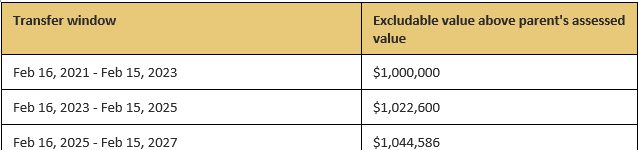
That current cap of $1,044,586 is set by the State Board of Equalization and adjusts every two years for inflation. Here's what it means in practice: take the parent's assessed value, add $1,044,586 to it, and compare that total to the home's fair market value at transfer. Anything above that combined number gets added to the child's new assessed value and taxed accordingly.
A Danville example
A home assessed at $300,000 with a current market value of $1.6 million falls well within the cap ($300,000 + $1,044,586 = $1,344,586, which exceeds $1.6 million only slightly). The difference of roughly $255,000 gets added to the child's assessed value, landing the new taxable value around $555,000. That's a meaningfully higher bill than the parent paid, but far less than a full reassessment to $1.6 million would produce.
Two conditions matter most, and missing either one is where families lose the benefit entirely:
- The home must have been the parent's primary residence. Rental properties, vacation homes, and investment property do not qualify for any parent-child exclusion under current law, full stop.
- The child must move in within one year and file for the homeowners' exemption. Intending to move in doesn't count. Starting the process doesn't count. The assessor looks for actual evidence: voter registration, driver's license address, utility bills in the child's name.
If there are multiple children on title, only one needs to occupy the home to preserve the exclusion for the full property, which opens some flexibility for families with more than one heir.
So which comes first, the trust or the transfer?
This is where the two systems create real tension, and where a generic answer does families a disservice. A revocable living trust does not, by itself, avoid Prop 19 reassessment. Property held in a trust is treated as the parent's property during their lifetime, and when it passes to a child through the trust after death, the same parent-child rules and the same $1,044,586 cap apply as if the transfer happened outside a trust.
What a properly drafted trust does accomplish is avoiding probate, which is a separate and often more painful problem for East Bay families holding real estate worth well over the small estate threshold. It also gives the family control over how and when the transfer happens, rather than leaving it to default intestacy rules if there's no will at all.
The honest answer, and the one worth sitting with, is that most families are better served letting the transfer happen at death rather than during life, specifically because it captures the step up in basis on the federal side while still giving the child a shot at the Prop 19 exclusion if they're willing to move in. Lifetime gifting mainly makes sense when the family needs the child to have control now, when there's a strong non-tax reason to transfer early, or when a parent is trying to get a home out of their estate for reasons unrelated to this specific home.
Where this creates opportunity for East Bay sellers
For homeowners across the East Bay, this dynamic is showing up as a wave of adult children inheriting or receiving parental homes that don't fit their own lives. A single family ranch house that made sense for a retired couple in 1990 often isn't what a working family with a different commute needs today.
In Danville and San Ramon, where assessed values are frequently decades behind current market value, the math above becomes especially consequential. A child who doesn't move in faces a full reassessment and a property tax bill that can be three to five times what the parents were paying, which changes the economics of keeping versus selling almost overnight.
In Hercules and Pinole, where entry-level buyers are often priced out of the broader East Bay, inherited or gifted homes represent a different kind of opportunity: a chance for a family to sell into continued demand from buyers who've been squeezed out of Walnut Creek and Pleasant Hill price points, often netting proceeds the original purchase price could never have suggested.
In every case, the decision to sell, rent, or move in isn't just a lifestyle question. It's a tax question with a real dollar answer, and it needs to be run before the transfer happens, not after.
What to actually do about it
- Talk to a CPA before any deed changes hands. Get the actual cost basis, the actual current assessed value, and a real projection of both capital gains and property tax exposure under each scenario.
- Loop in an estate planning attorney on the trust. A trust solves probate, not Prop 19. Make sure the family understands what it does and doesn't accomplish.
- Decide, honestly, whether a child will actually move in. If the answer is no, the Prop 19 exclusion isn't on the table regardless of how the transfer is structured, and that should shape the whole plan.
- Get a current value opinion on the home before deciding anything. Every one of these calculations depends on an accurate market value at the time of transfer, not a guess.

Get Your Free Home Value Estimate
This article is for general informational purposes and reflects California property tax and federal tax rules as of July 2026, including the Proposition 19 exclusion cap of $1,044,586 set by the California State Board of Equalization for transfers occurring between February 16, 2025 and February 15, 2027. Tax law is fact specific and subject to change, a repeal effort targeting the November 2026 ballot is currently circulating. Nothing here is legal or tax advice. Every family should consult a licensed CPA and estate planning attorney before transferring real property.
