
The short version
Here's the quick breakdown:- We score signals, not busywork. We threw out questions about how often you post. Instead, we look for a licensed page under your own name, a Google Business Profile, and more than one kind of source describing you.
- Two engines, two very different scores. ChatGPT relied on professional and brokerage sites for 54% of its citations, while Google AI used them only 16% of the time. A single combined score would hide that gap.
- Backup is everything (corroboration). Up to 20 of your 100 points come from having two or more different kinds of source backing you up. This was our most consistent research finding.
- It tracks real outcomes. When we applied it to just over 200 Catchouse real estate agents, those scoring 40 and up were recommended by AI about four times as often as those scoring under 20.
Why we ditched the usual checklist
Most AI visibility self-tests take about a minute, don't require an email, and return a score from 0 to 100. We kept that simple format, but we replaced almost all the standard questions. The usual checklists measure the effort you put in; we only care about the signals our data shows actually matter.- Instead of just asking if people can find you by name and city, we test your organic search presence. Among the agents we tested, organic findability was the strongest single signal linked to being named by Google AI.
- Instead of vaguely asking for evidence of your track record, we look specifically for a named, licensed person on a webpage they actually control.
- Instead of asking if you publish local insights every week, we look at how much you've published in total and where it lives. We score volume and location, not your posting cadence.
The 7 questions
These questions apply to any licensed or credentialed professional, though our current scoring weights are calibrated on real estate. For each question, a full "A" answer gets full points, a partial "B" answer gets partial credit (0.4 or 0.5), and a "C" gets zero.- The license check. Is there a page under your own name that shows your professional license or credential number? Full points if it's a page you control; half if it has your name but no license number; zero for just a firm roster page.
- The Google profile. Do you have a Google Business Profile in your own name, complete with your service area and recent reviews? Full points if it's been updated in the last 3 months; half if it's incomplete or neglected; zero if you only have your firm's.
- The industry reviews. Do you have reviews under your own name on directories like Yelp, Avvo, Healthgrades or Zillow? Full points for two or more sites; half for one; zero for none.
- Third-party mentions. Has another credible site, such as local news, an association or a podcast, described you by name? Full points if it's happened more than once in the past year; half if once, or a while ago.
- Local expertise. Do you publish articles that answer specific questions local clients ask? Full points for five or more articles; partial credit (0.4) for a few; zero for none. Promotions and just-closed announcements don't count.
- The content home. Where do you post that expertise most often? Full points for your own website or profile; half for a mix of site and social; zero if it's mostly Instagram or other social.
- The vanity search. Search Google for your name and city. Does a page you control show up near the top of the first page? Full points if yes; partial credit (0.4) if it's lower down or only a directory listing.
Why two scores make sense
ChatGPT and Google AI build their answers from very different sources. You could look like a rockstar to one and be practically invisible to the other.- ChatGPT rewards who you verifiably are. It relies heavily on professional and brokerage sites (54% of its citations) and Google Maps listings (43%).
- Google AI rewards where you show up on the web. It pulls heavily from its own result panels (49%), directories like Zillow and Yelp (21%), and organic search.
How the scoring actually works
We score you out of 100 for each engine: 80 points come from your answers to the seven questions, and 20 points come from a corroboration bonus.Here's what carries the most weight:- Google Business Profile (Q2). The heaviest single question across both engines: 25 points for ChatGPT and 20 for Google AI.
- The corroboration bonus. Up to 20 points for having two or more kinds of source behind you. In our research, that kind of agreement added 13 to 16 points to the chance of being named again, more than any single source did.
- A licensed page you control (Q1). Crucial for ChatGPT (25 points), since professional sites make up 54% of its citations, but less critical for Google AI (10 points).
- Organic findability (Q7). A bigger driver for Google AI (15 points) than for ChatGPT (10 points).
- Reviews and directories (Q3). Worth 15 points for Google AI, but only 5 for ChatGPT.
- 75 to 100: Well corroborated
- 45 to 74: Room to improve
- 0 to 44: Hard to find
Busting SEO myths: what we left out
If you've read generic AI optimization guides, you might wonder why we didn't ask about schema markup or FAQs. We tested them, and they don't separate the named professionals from the ignored ones.- JSON-LD schema and FAQ markup. We found these on ignored pages just as often as on cited pages.
- Social media. Facebook and Instagram accounted for less than 3% of AI citations, which is why relying mostly on social media scores a zero on Question 6.
- Posting frequency. We score your total volume of published articles, not your posting cadence. Agents with five or more articles were named more often: 7 points higher on ChatGPT and 14 points higher on Google AI.
Does it actually work?
So far, yes. We scored just over 200 Catchouse real estate agents in California based on the sources we could observe. Agents who scored 40 and up were named about 4 times as often by ChatGPT, and 4.5 times as often by Google AI, as agents scoring under 20.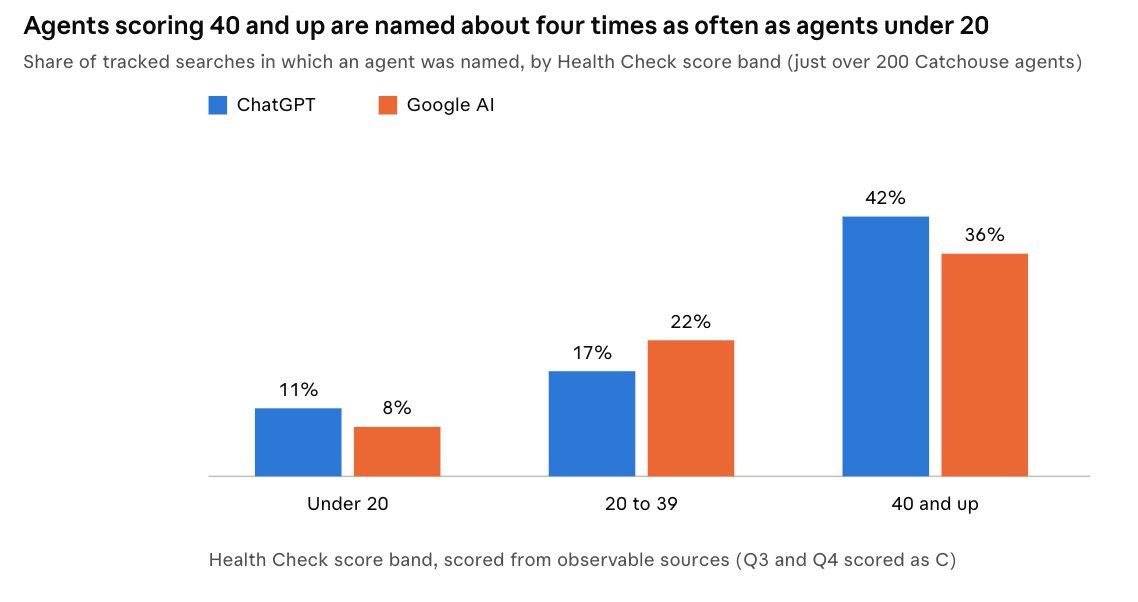
Honest limits and what's next
We want to be transparent about what this test can and can't do:- Associations, not causes. The test reflects what highly visible professionals have in common. We can't guarantee that fixing an answer will get you named.
- One field, one region. The scoring is currently calibrated for California residential real estate. We won't release scores for other professions until we have citation data to back them up.
- A small validation set. Our first test used just over 200 agents, and our scoring weights are informed judgment calls (version 1, November 2026), not a fitted model.
Sources
- Why AI assistants name some local professionals and ignore others: what 3,209 cited pages have in common, July 30 to September 8, 2026.
- It isn't reviews, credentials or content. It's corroboration., July 30 to October 17, 2026.
- Catchouse roster analysis, November 14, 2026.