

- **Most named professionals have no source about them in the answer.** Only 22.8% of the times someone was named came with a cited page about that person.
- **No single kind of source wins.** A review profile, a brokerage page or a personal website each adds 1 to 4 points to the chance of being named again.
- **Two or more kinds of source add 13 to 16 points.** On ChatGPT, professionals backed by two or more kinds of source were named again 44.3% of the time, against 28.1% for those with none.
- **Credentials on their own did almost nothing.** ChatGPT cited government and professional-body pages 11,525 times; only 2.9% of those citations were about anyone it named in that answer.
What we measured
The data comes from Catchouse's AI answer monitoring between July 30 and October 17, 2026. Each run asks an assistant to recommend a professional for one market and specialty, such as a fix-and-flip investor agent in Morgan Hill, CA. Each prompt is sampled five times per run, and we record who is named and which pages are cited.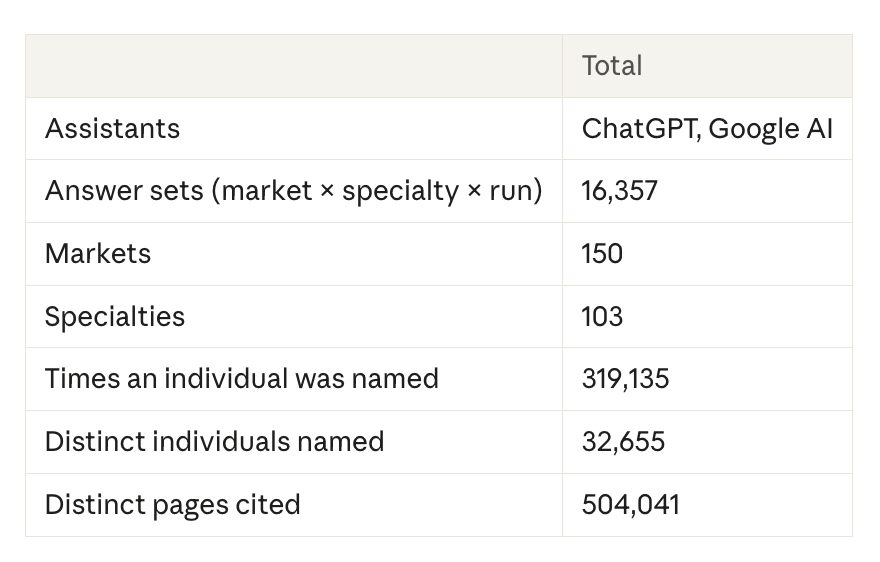
- **Reviews and directories:** Zillow, real estate agent.com, Yelp, Homes.com, FastExpert, HomeLight and similar.
- **Brokerage and credentials:** brokerage roster pages and licensing or professional bodies.
- **Own site:** a website on the professional's own domain.
- **Social and other:** LinkedIn, Facebook, Instagram, YouTube and other web pages.
Finding 1: most named professionals have no source about them in the answer
Only 22.8% of the times an individual was named came with a cited page about that person. On ChatGPT the figure was 36.8%; on Google AI it was 10.1%.The gap between the two assistants is partly a measurement limit. 81.2% of Google AI's citations (462,901 of 569,938) are Google redirect links that do not show the destination page.ChatGPT's sources are readable, and they tell the same story. Of its 401,206 citations, 80.3% were not about anyone it named in that answer. They were ranked lists, portal search pages, listings and general content. The assistant reads about a market, then decides who to name.Finding 2: no single kind of source wins; two or more kinds do
Take professionals named in one of five answers. On ChatGPT, any single kind of source about them lifted the chance of being named in the next run by 2 to 4 points. Two or more kinds lifted it by 16.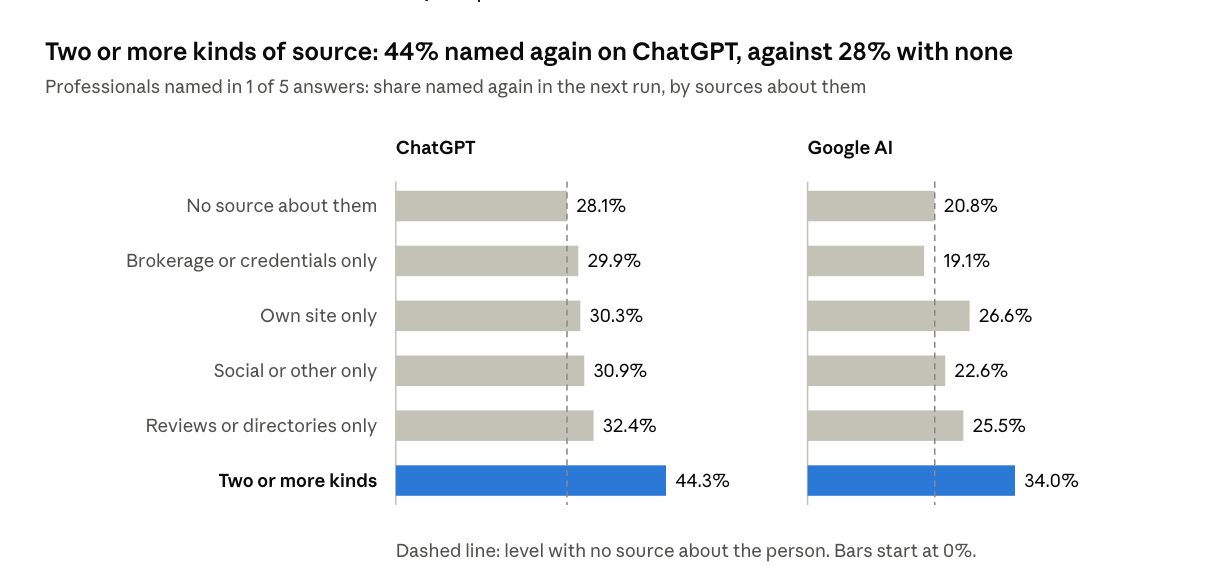
Finding 3: corroboration holds at every level, and moves you up the list
A fair objection: professionals who are already named often have more chances for their pages to be cited. So we compared people who were equally visible to begin with, grouped by how often they were named in the first run.The pattern held in every group. On ChatGPT, among professionals named in 1 of 5 answers, 28.1% with no source about them were named again, against 44.3% with two or more kinds. Among those named in every answer, the figures were 86.2% and 94.5%.Corroborated professionals were also listed higher. Among people named in 1 of 5 answers on Google AI, the average position was 13.0 with no source about them, 8.2 with one kind and 6.8 with two or more. On ChatGPT the same comparison ran 9.7, 9.2 and 8.7.Finding 4: credentials on their own did almost nothing
Assistants do read credential sources. ChatGPT cited government and professional-body pages, such as state licence lookups and real estate agent associations, 11,525 times in this period. But only 340 of those citations, 2.9%, were about anyone it named in that answer. A licence lookup confirms the profession; it rarely points to a person.Brokerage roster pages were the weakest single kind of source. On Google AI, professionals backed only by a roster page were named again 19.1% of the time, slightly below the 20.8% for those with no source at all. A roster page says you work somewhere. It does not say why you are the right choice.What this means for professionals
The usual advice is to pick a channel: collect more reviews, polish your brokerage bio, or start a blog. Our data says the channel matters less than the overlap.- **Be described in at least two different kinds of places.** A review profile and your own site, or your own site and a credited article elsewhere. Each should name you and say what you do and where.
- **Make the descriptions agree.** Use the same name, the same specialty and the same service area everywhere. Agreement is what separates corroboration from noise.
- **Connect them.** Link your profiles to each other, so a reader or an assistant can see they describe the same person.
- **Don't stop at credentials.** A licence and a roster page are necessary, but on their own they barely move the numbers. Points 1 and 4 come straight from the data; points 2 and 3 are our recommendation on how to act on it, and this study did not test them.
How we approach knowledge pages
Our data shows that no single source gets a professional named; agreement across different kinds of sources does. That shaped how we build knowledge pages at Catchouse.- **Several contributors per page.** A page with several local voices reads as a reference about the area, not one professional's marketing. Each contributor also gains an independent context that names them.
- **Credit where the contribution is.** A byline on the article or answer itself, with a one-line credential: specialty, area, licence.
- **The page is one kind of source; the profile connects the rest.** Each contributor's profile points to their own site, brokerage page and review profiles, so the separate sources can be seen to describe the same person.