
Three things we did not expect
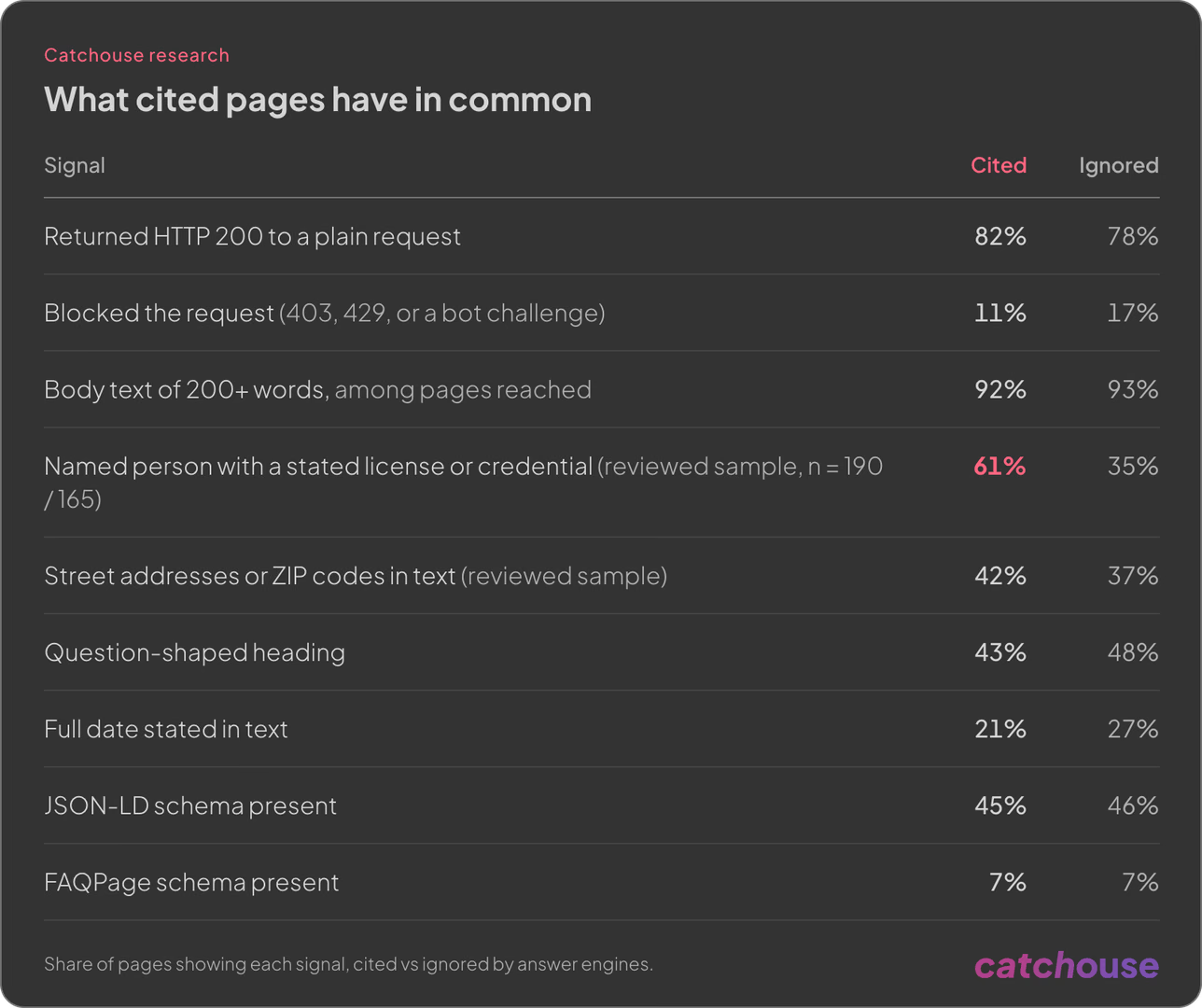
The two assistants source their answers from different places. ChatGPT's citations were 54% individual professional and brokerage websites and 43% Google Maps business listings. Directories such as Zillow and Yelp made up 3%. Google AI inverted that: 49% of its citations pointed to Google's own result panels, 21% to directories, 12% to redirect links that resolve mostly to Zillow, Yelp and FastExpert, and 16% to independent professional sites.Being cited has little to do with ranking in Google. Of the pages ChatGPT cited, 7% appeared in Google's top ten for the equivalent search and 17% appeared anywhere in the top 45. For Google AI the figures were 22% and 41%. Most of what either assistant cites, Google search does not put on page one.Page formatting did not separate cited pages from ignored ones. Question-shaped headings, a stated publication date, JSON-LD schema and FAQ Page markup all appeared at the same rate, or slightly more often, on pages that were never cited. What did separate them was whether the page could be fetched, and whether it named a licensed person.How the study was run
Prompts: 11,367 prompts generated from a locality-by-specialty grid, 103 California localities (Bay Area and Sacramento heavy, with Los Angeles, Orange County and San Diego represented) and 84 specialties. Each prompt was run once per assistant.Assistants: ChatGPT and Google AI, accessed through Catchouse's prompt pipeline. Each run's cited sources were logged with URL and position.Cited set: after removing Google's own Maps listings and result panels, 14,665 distinct pages were cited directly and a further 12,825 were cited through Google AI redirect links. We followed every sampled redirect to its destination. The fetch sample was 5,327 distinct cited pages: 3,761 cited directly and 1,566 recovered from redirects.Control set: Google top-ten organic results, collected in the same window for the same locality and specialty grid, that no assistant cited. 6,399 pages.Fetch: a plain HTTP GET with a non-browser user agent, no JavaScript, 12-second timeout. Pages that refused the research user agent were requested a second time with standard browser headers, still without JavaScript. A page counted as reached only if it returned HTTP 200.Coding: a script coded each page for body text present (at least 200 words in the raw response), named author with a stated credential, street addresses or ZIP codes in the text, question-shaped headings, a full date stated in the text, and JSON-LD schema. For the four judgment-based attributes, 396 reached pages were independently re-coded by a review pass using a language model reading the saved page text. Script and reviewer disagreed on 7% of pages for question headings and 9% for stated dates, so we report those two from the full sample. They disagreed on 36% for author-with-credential and 32% for street-level detail, almost entirely the script over-coding, so we report those two from the reviewed sample only.Classification: pages were sorted into directories and platforms (Zillow, Yelp, Fast Expert, Indeed, LinkedIn, Reddit and similar), brokerage sites, and independent professional pages. The comparisons below are for independent professional pages, because that is the situation a working agent is in.What separated cited professional pages from ignored ones
Independent professional pages: 2,853 cited, 1,973 control.