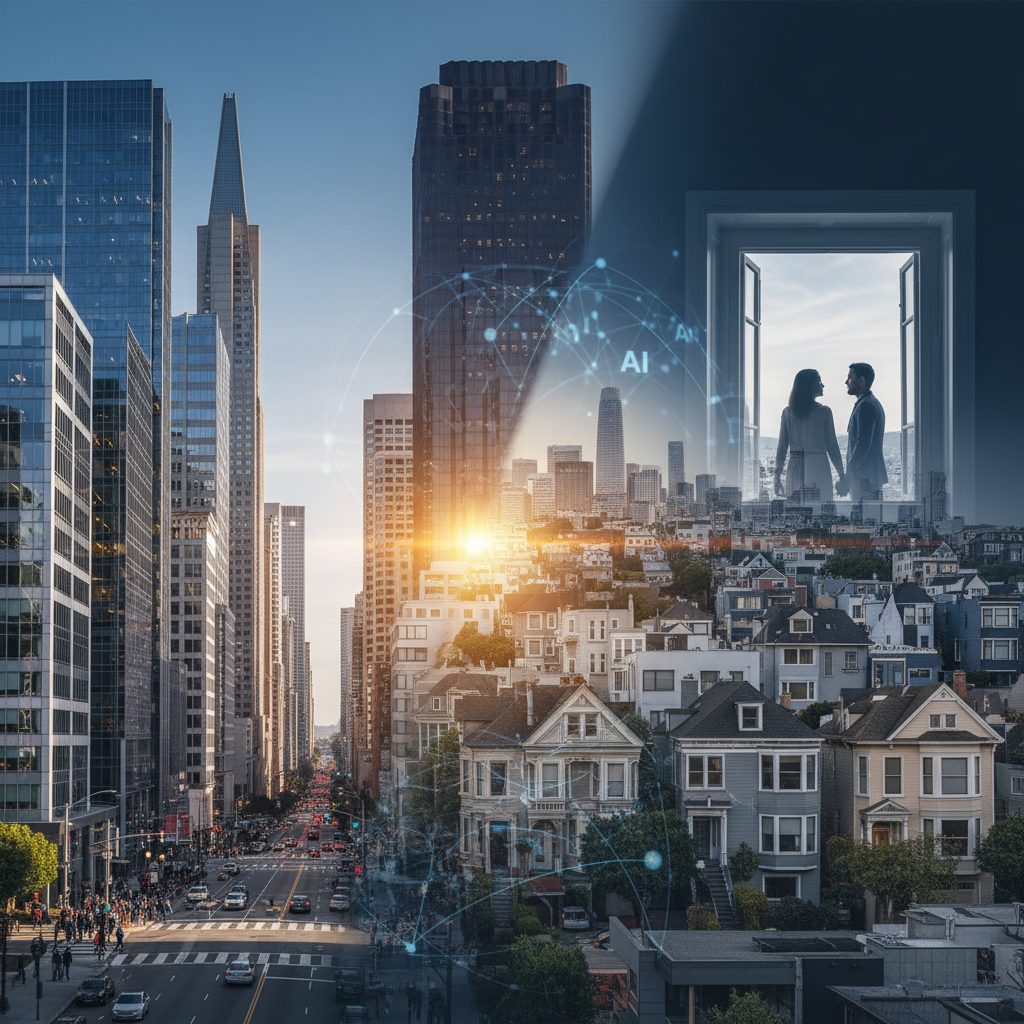
AI Is Booming, But Bay Area Buyers Are Watching Jobs

Austin Cheng
Austin Cheng
Helping Buyers Make Smart, Confident Real Estate Decisions3 min read
AI Is Booming, But Bay Area Buyers Are Watching Jobs

In San Francisco, AI companies are helping bring energy back to the office market. Anthropic recently leased the entire 300 Howard office tower, one of the largest office commitments in the city in years. Databricks also expanded its San Francisco footprint at 1 Sansome Street. More office activity does not automatically mean home prices go up overnight, but it does tell us something important: companies still want to be near Bay Area talent, capital, and innovation.

That matters for housing because job location, commute patterns, and long-term income confidence all affect where people choose to live.

At the higher end of the market, we are already seeing signs of AI wealth showing up in real estate. Redfin recently reported that Bay Area luxury home prices increased 13.4% in the two years after ChatGPT launched, while the most affordable Bay Area zip codes saw prices fall during the same period. This suggests that AI is not lifting every part of the market equally. The biggest impact is showing up among higher-income buyers, stock-heavy households, and luxury neighborhoods.

But this is not a simple “AI is good for everyone” story.

At the same time, recent tech layoffs are making some buyers more cautious. Meta’s latest Bay Area cuts are expected to affect nearly 700 workers across Burlingame, San Francisco, and Fremont. For buyers who work in tech, especially those whose income depends on salary, bonuses, RSUs, or future stock compensation, job security is now part of the housing decision.

What This Means Locally

San Francisco:  The AI boom is helping support demand for office space and bringing more attention back to downtown, SoMa, and the Financial District. For buyers who want to be close to AI companies, venture capital, restaurants, entertainment, and city lifestyle, San Francisco may become more attractive again. This does not mean every neighborhood will move the same way, but it does support the idea that San Francisco is still a major center for innovation and talent.

San Mateo County and the Peninsula:  San Mateo County sits close to major tech employers and high-income buyers. AI wealth, stock compensation, and larger down payments can keep competition strong for desirable homes, especially in premium Peninsula locations. At the same time, layoffs and restructuring at major tech companies show why some buyers in this area may also be more careful with their budget.

Fremont and the East Bay:  Fremont is also part of the AI, robotics, and advanced manufacturing story. Tesla’s Fremont factory has been selected for Optimus robot production, and DoorDash’s autonomous delivery robot, Dot, is manufactured in Fremont and being introduced locally. For many buyers, Fremont offers more space than San Francisco, strong schools, BART access, and a practical location between the Peninsula and South Bay. That can make it attractive for tech and AI workers who want a balance between lifestyle, commute, and long-term value.

My Takeaway

The Bay Area market is not weak. It is becoming more selective. AI is creating new wealth and supporting demand in certain locations and price points, but layoffs and job uncertainty are also making some buyers more careful. That is why the market can feel competitive in one neighborhood and slower in another.

For buyers, the key is not only getting pre-approved. It is understanding your monthly payment, cash reserves, commute, job stability, and long-term plan. For sellers, the key is not assuming every buyer is aggressive just because AI is booming. The right pricing, presentation, and marketing strategy still matter.

My take is simple: AI is not replacing the Bay Area. It is reshaping where people work, where they want to live, and how confident they feel making a real estate decision.