
Why Are You Hearing About the Corporate Transparency Act?
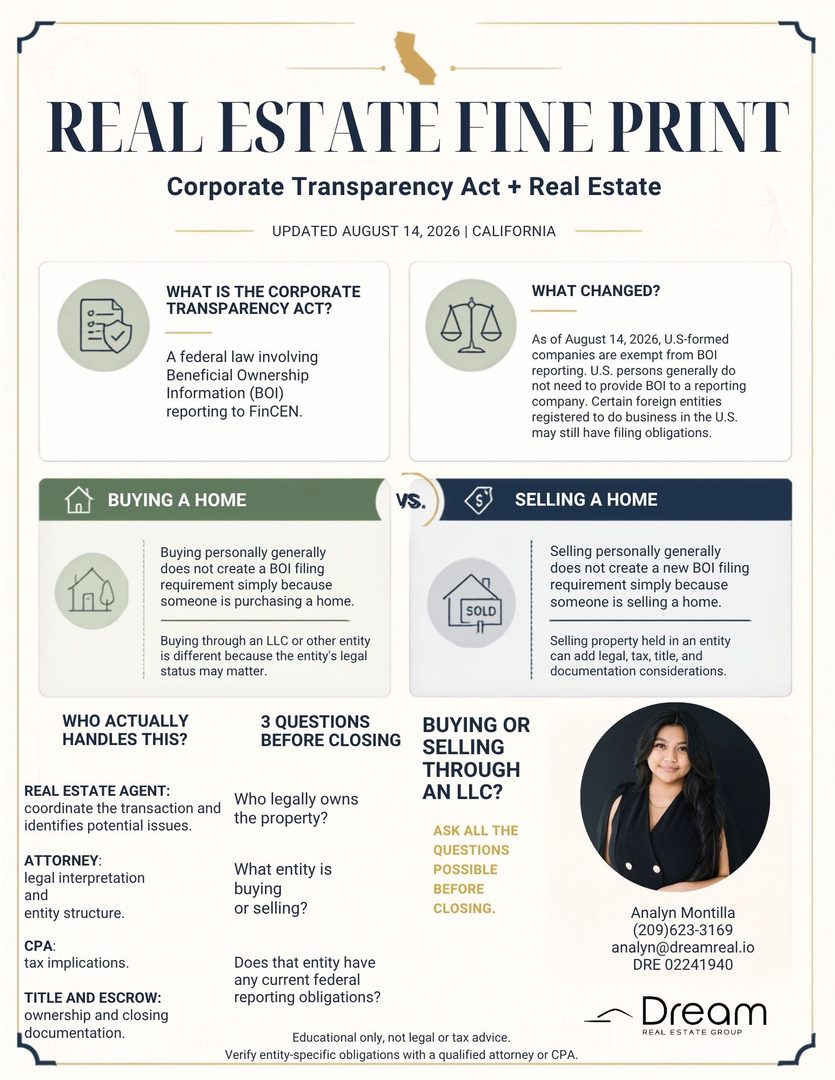
The Corporate Transparency Act was originally enacted to improve the federal government’s ability to identify the individuals behind companies, particularly to combat financial crimes such as money laundering. Under the initial rules, many companies, including LLCs and corporations, were required to report detailed information about their beneficial owners to FinCEN, the Financial Crimes Enforcement Network, a bureau of the U.S. Department of the Treasury.However, these rules have evolved. As of August 11, 2026, companies formed in the United States are exempt from federal BOI reporting requirements. Certain foreign entities doing business in the U.S. may still have reporting obligations, but for many domestic companies, the filing requirement no longer applies. This change means the landscape around BOI reporting has shifted significantly for real estate transactions.Understanding Beneficial Ownership Information (BOI)
"Beneficial ownership" refers to the details about individuals who ultimately own or control a company. Originally, the CTA defined a beneficial owner as someone who owned or controlled at least 25% of a company or exercised substantial control over it.Companies were required to report identifying information such as the individual's legal name, date of birth, residential or business address, and details of identification documents. Today, federal rules have narrowed the scope of who must report, mainly exempting many U.S.-formed entities from these requirements.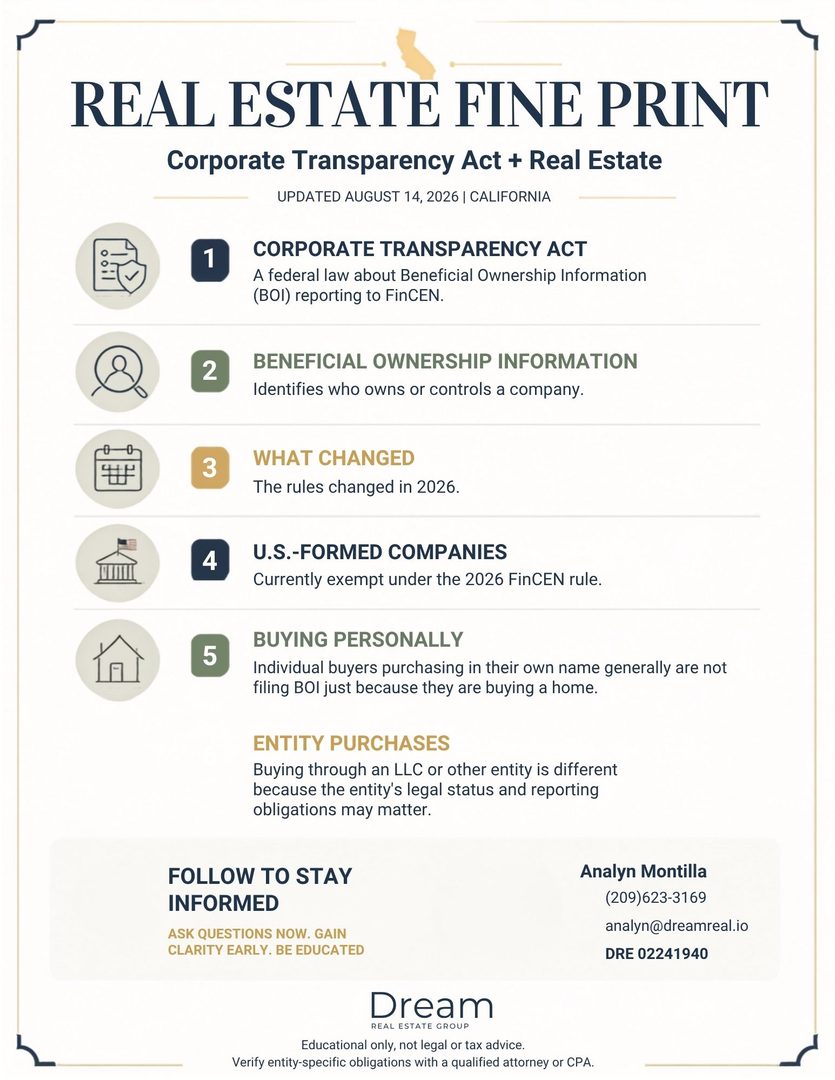
What Does This Mean for California Buyers?
For most individual homebuyers purchasing property in their own name, whether it’s a primary residence or a second home, BOI reporting is generally not a concern. The CTA’s corporate reporting rules do not create a new filing obligation for these buyers.Complications can arise when a property is purchased through an entity such as an LLC, corporation, trust, or other ownership structures. In these cases, whether the entity must file BOI reports depends on specific federal rules and exemptions.Real estate agents should not assume any entity automatically has or lacks a BOI reporting obligation. Instead, the entity’s reporting requirements should be evaluated by qualified professionals such as attorneys or CPAs.- Buying a home personally does not automatically trigger a BOI filing requirement.
- If buying through an entity, consult your attorney or CPA to determine reporting obligations.
- Real estate agents can help identify potential issues but should not provide legal or tax advice.
What Does This Mean for California Sellers?
For most individual homeowners selling their own property, the CTA and BOI rules generally do not create any new federal filing requirements simply because they are selling their home.However, if the property is owned by a business entity such as an LLC, corporation, or trust, the question of BOI reporting can become relevant. The mere existence of an LLC does not automatically mean a BOI report must be filed. Instead, it depends on the entity’s formation, registration status, and whether it falls under current federal requirements.Sellers should work closely with their CPA or attorney to determine if any federal reporting obligations apply. Meanwhile, their real estate agent’s role is to coordinate the transaction and help identify potential issues but not to provide legal or tax counsel.- Selling a home personally does not typically trigger BOI filings.
- Entity-owned properties may require additional review for BOI obligations.
- Consult your CPA or attorney if your property is owned by an LLC or corporation.
What Is FinCEN and Its Role in BOI Reporting?
The Financial Crimes Enforcement Network, or FinCEN, is a bureau within the U.S. Department of the Treasury tasked with administering federal financial transparency laws. FinCEN manages the BOI reporting system established by the Corporate Transparency Act and enforces anti-money laundering regulations.Its role is to collect and maintain information on beneficial ownership to help law enforcement and regulators detect and prevent illicit financial activities.Why Was the Corporate Transparency Act Created?
The CTA was enacted to reduce the ability of individuals to hide behind anonymous companies, which have often been used to facilitate financial crimes. By requiring companies to disclose their true owners, authorities gain better access to information about who controls corporate entities.This measure is particularly relevant in real estate, where properties are frequently bought and held through LLCs or similar entities, sometimes making it harder to trace true ownership.Does Every LLC Have to File BOI?
No. This is a critical point to understand in 2026. Under the current FinCEN rules, U.S.-formed companies are exempt from federal BOI reporting requirements. However, certain foreign entities registered to do business in the United States may still need to file, subject to specific exemptions.Therefore, the statement “I have an LLC, so I must file BOI” is not universally true. Each entity’s circumstances must be carefully evaluated to determine filing obligations.Does the CTA Affect My Ability to Buy or Sell a Home?
For most individual buyers and sellers, the CTA and BOI rules do not impose new general requirements simply because they are participating in a real estate transaction. The regulations specifically address corporate ownership reporting, not personal real estate transactions.That said, property owned by entities may involve additional documentation, verification of ownership, and professional review to ensure compliance with federal rules.What Should You Do If Buying or Selling Through an LLC or Entity?
If your real estate transaction involves an LLC, corporation, trust, or other ownership structure, it is important not to guess on reporting requirements. The best approach is to seek guidance from qualified professionals who can assess the specific situation.- CPA: For tax implications and understanding your business structure.
- Attorney: For legal obligations and entity compliance.
- Escrow or Title Professional: For transaction-specific documentation and ownership verification.
- Real Estate Agent: For coordinating the transaction and flagging potential issues for professional review.