Capital Gains on Your Home

What California Homeowners, Buyers & Sellers Should Know
If you've owned your home for several years, you may have built significant equity.
But there's an important question many homeowners don't ask until they're ready to sell:
"Will I owe capital gains tax when I sell my home?"
The answer depends on several factors, including how much your home has appreciated, how long you've owned and lived in it, and whether you qualify for the federal home-sale capital gains exclusion.
Here's what homeowners should know.
What Is a Capital Gain?
A capital gain is generally the increase in value of an asset between its adjusted cost basis and the amount realized when it is sold.
For example:
You purchased your home for $400,000.
Years later, you sell it for $750,000.
That does NOT automatically mean your taxable capital gain is $350,000.
Your actual gain can be affected by qualifying selling expenses and certain costs and improvements that increase your home's adjusted cost basis.
This is why you should not calculate your potential tax liability simply by subtracting your purchase price from your sale price.
The Primary Residence Exclusion
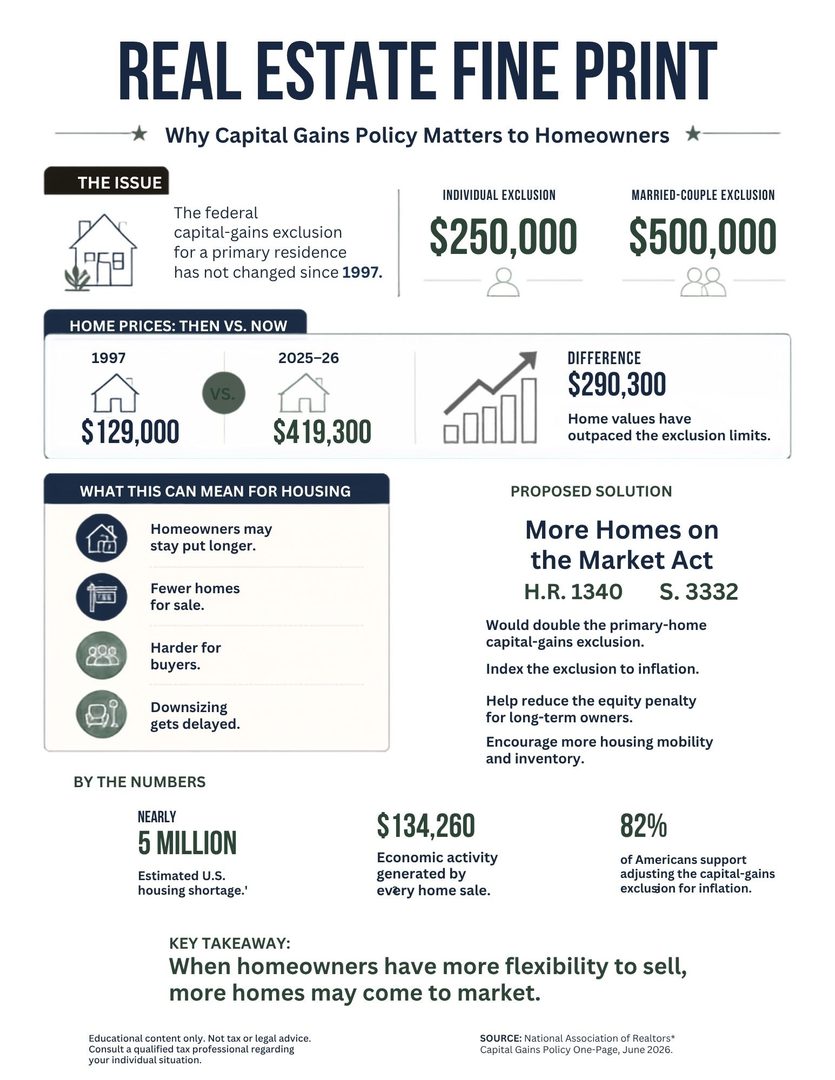
Under current federal law, qualifying homeowners may be able to exclude up to:
$250,000 of gain for an individual taxpayer
or
$500,000 for certain married couples filing jointly.
The exclusion generally applies when the homeowner meets the applicable ownership and use requirements for the home.
One key rule is the 2-out-of-5-year test:
You generally must have owned and lived in the property as your principal residence for at least two of the five years before the sale.
There are additional rules, exceptions and special circumstances, so homeowners should consult a qualified tax professional about their specific situation.
Here's Why This Is Becoming a Bigger Conversation
The current federal exclusion amounts were established in 1997.
They have not been adjusted for inflation.
Meanwhile, home values have increased substantially.
According to the NAR one-pager, the median existing single-family home price increased from approximately $129,000 in 1997 to $419,300 in 2025–26, an increase of approximately 225%.
That means the same $250,000/$500,000 exclusion covers a much smaller portion of the appreciation that some long-term homeowners may experience today.
A Simple Example
Imagine someone purchased a home decades ago for $200,000.
Today, the home is worth $800,000.
That homeowner has experienced substantial appreciation.
But the homeowner shouldn't automatically assume the entire $600,000 difference is taxable.
The calculation can involve the home's adjusted cost basis, qualifying improvements, selling expenses and the applicable exclusion.
If the homeowner qualifies for a $500,000 exclusion, the amount of gain potentially subject to federal capital-gains tax could be very different from the headline $600,000 appreciation.
This is why a tax professional should calculate the actual gain before you make a decision based on taxes.
Why Does NAR Say This Affects Housing Inventory?
This is the bigger policy argument behind the NAR one-pager.
NAR argues that some homeowners with substantial accumulated equity may hesitate to sell because selling could create a significant capital-gains tax liability.
That can discourage homeowners from moving.
For example:
An empty-nester may want to move from a larger family home into something smaller.
A growing family may want that larger home.
But if the existing homeowner is concerned about the tax consequences of selling, they may decide to stay.
The result can be fewer existing homes entering the market.
NAR describes this as a form of "lock-in" that can reduce housing mobility and contribute to constrained inventory.
What Is the More Homes on the Market Act?
The NAR one-pager promotes the More Homes on the Market Act (H.R. 1340 / S. 3332).
The proposal would:
Double the capital-gains exclusion for qualifying primary-home sales and index the exclusion to inflation.
The purpose would be to update the exclusion so that it better reflects today's home prices and purchasing power.
NAR argues that this could encourage more long-term homeowners to sell, potentially increasing housing inventory and improving mobility.
Important: This Is a Proposal, Not Current Law
This distinction matters.
The proposed legislation should not be presented to clients as though homeowners currently receive a $500,000 individual exclusion or a $1 million married-couple exclusion.
Under current federal law, the commonly cited exclusion remains:
$250,000 for qualifying individual taxpayers
$500,000 for qualifying married couples filing jointly
The proposed legislation would change those amounts if enacted.
What Does This Mean for SELLERS?
If you're thinking about selling a home you've owned for many years, don't wait until you're in escrow to investigate the potential tax consequences.
Consider discussing these questions with your tax professional:
• How much is my estimated capital gain?
• Do I qualify for the primary-residence exclusion?
• What is my adjusted cost basis?
• Which home improvements may increase my cost basis?
• Which selling expenses can affect the calculation?
• Could depreciation or previous use of the property affect my tax treatment?
• Are there California state tax considerations in addition to federal taxes?
Your real estate agent can help you understand the real estate side of the transaction, but your CPA or tax professional should determine your individual tax liability.
What Does This Mean for BUYERS?
For buyers, this issue matters because capital-gains policy can affect housing inventory.
If fewer existing homeowners sell because of tax concerns, fewer homes become available for buyers.
NAR argues that modernizing the exclusion could encourage more homeowners to sell, potentially creating more opportunities for first-time buyers and families looking for their next home.
However, this is a policy argument—not a guarantee that changing the exclusion will immediately make homes more affordable.
What About California?
Federal capital-gains rules are only part of the conversation.
California has its own state income-tax system, and the tax treatment of a home sale can depend on the homeowner's individual circumstances.
That means a homeowner should not assume:
"I'm under the federal exclusion, so I won't owe any taxes."
Your federal and California tax situations should be reviewed separately by a qualified tax professional.
The Biggest Takeaway for Homeowners
Don't let the fear of capital-gains taxes stop you from asking whether moving makes sense.
And don't assume you'll owe a huge tax bill simply because your home has appreciated significantly.
The actual calculation can be much more complicated than:
Sale Price − Purchase Price = Taxable Gain
Your purchase costs, qualifying improvements, selling expenses, ownership/use history and applicable exclusions can all matter.
Before making a major decision, get the numbers from a qualified tax professional.
The real estate agents Role
Your real estate agent can help you understand:
Current market value
Estimated selling costs
Potential net proceeds
Comparable properties
Market conditions
Timing considerations
Your CPA or tax professional can help determine:
Capital gain
Adjusted cost basis
Federal tax implications
California tax implications
Potential deductions or exclusions
The best decisions happen when your real estate and tax professionals are working from the same set of facts.
Bottom Line
Your home may be your largest financial asset.
Before selling, don't only ask:
"What can I sell my house for?"
Also ask:
"How much will I actually walk away with after selling costs and any applicable taxes?"
Understanding your potential capital-gains exposure before listing can help you make a much more informed decision.
Educational information only. This is not tax, legal or financial advice. Tax laws and proposed legislation can change. Consult your CPA, tax attorney or other qualified tax professional regarding your individual circumstances.
