How Buyers Decide: What MBTI Personality Type Taught Me About Showing Homes

How Buyers Decide: What Personality Type Taught Me About Showing Homes

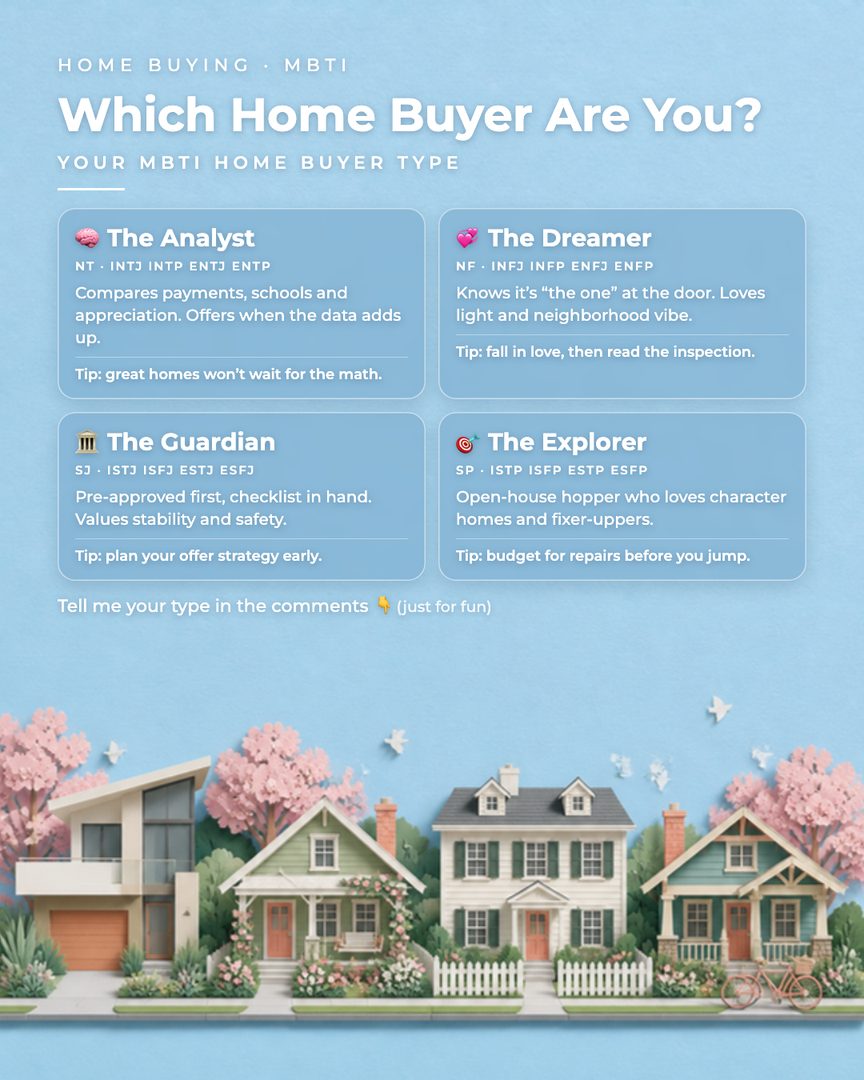
Every buyer I work with brings a decision-making style, whether or not they know it. Over the years I’ve noticed that the same house can land very differently depending on who walks through the door. Some of that comes down to budget and taste, but a lot of it comes down to how people think, and the Myers-Briggs framework gave me a useful way to name what I was seeing.I’m not offering MBTI as a precise diagnosis. Think of it as a shorthand for patterns that show up again and again. Here’s what I’ve found.
How Buyers Decide: What MBTI Personality Type Taught Me About Showing Homes

The analytical buyer: the number is the number

Analytical buyers often arrive with a spreadsheet. They know their price range before we’ve looked at a single listing, and that range is a boundary, not a suggestion. A home even slightly above it is off the table, no matter how beautiful it is.What works with this buyer is precision. Send them a shortlist that fits the range, with comparable sales, days on market, and a clear explanation of why each property is priced where it is. Don’t oversell. Give them the data and let them decide. Once they trust your numbers, they become some of the most decisive clients you’ll ever have.

The feeling buyer: they’re already living there

Feeling-oriented buyers picture their future life long before they make an offer. They’re drawn to homes that feel finished, which is why they often gravitate toward fully staged properties. Staging helps them see the dining table with friends and the morning light in the kitchen.These buyers also tend to stretch. Sometimes they’ll go a little over budget to get the home that fits the life they’ve imagined. My job here isn’t to talk them out of the feeling. It’s to make sure the stretch is one they can carry, and to help them see the numbers clearly enough to decide with their eyes open.

Showing styles: spontaneous vs. planned

Some buyers are happy to browse. They’ll look at open houses on weekends, scroll listings on their phone, and drop in when something catches their eye. They like flexibility and discovery.Others plan. They want to schedule private tours in advance and see every qualifying home for the week in one efficient run. If you know which style you’re working with, you can build the search around it. Spontaneous buyers need alerts and open-house recommendations. Planned buyers need a tight itinerary and a clear sense of what’s coming up.

How people like to be reached

Communication preference is one of the easiest things to get right and one of the easiest to get wrong. Some people want a phone call. Others would rather get a text they can answer on their own schedule. Calling someone who prefers text can feel intrusive, and texting someone who wants a conversation can feel like you’re avoiding them.Ask early: “What’s the best way to reach you?” It’s a simple question, and the answer tells you a lot about how the relationship will work.

The takeaway

Buyers aren’t a single type, and no single approach works for all of them. Paying attention to how someone decides, how they want to search, and how they want to be contacted turns a transaction into a relationship. That’s the difference between a closed deal and a client who comes back and refers their friends.
#BuyersDecideMbti#Buyers#Decide#Personality#Taught#Showing#Homes#MarketUpdate#JustSold#HomeBuying#HomeSelling#OpenHouse