

The short answer
Moving from Texas to the Bay Area usually means paying about four times more for a house, adding a state income tax of 1% to 13.3%, and paying about $2.50 more per gallon of gas. In return, you get higher Bay Area salaries, a lower property tax rate, and mild weather year-round. Texas is the single largest source of new Californians: about 45,400 Texans moved to California in 2024.This guide covers the real numbers on housing, taxes, and daily costs, plus where Texans tend to settle and what to do in your first 20 days.How many Texans move to the Bay Area?
Texas sends more people to California than any other state. Census data shows about 45,400 people moved from Texas to California in 2024, ahead of Arizona (28,200) and Washington (27,000) (USAFacts, from Census ACS).The flow runs both ways. About 77,200 Californians moved to Texas the same year, so for every 10 Californians heading to Texas, roughly 6 Texans come west.For the Bay Area specifically, Texas ranks fifth among states sending U-Haul customers to the San Jose/San Francisco/Oakland area, and Dallas–Fort Worth and Austin both make the top 10 origin metros (U-Haul). Common reasons include a job offer in tech, biotech, or healthcare, or moving closer to family.Home prices: Texas vs. the Bay Area
A typical Bay Area house costs about four times a typical Texas house, and even the Bay Area's cheapest county is pricier than Austin.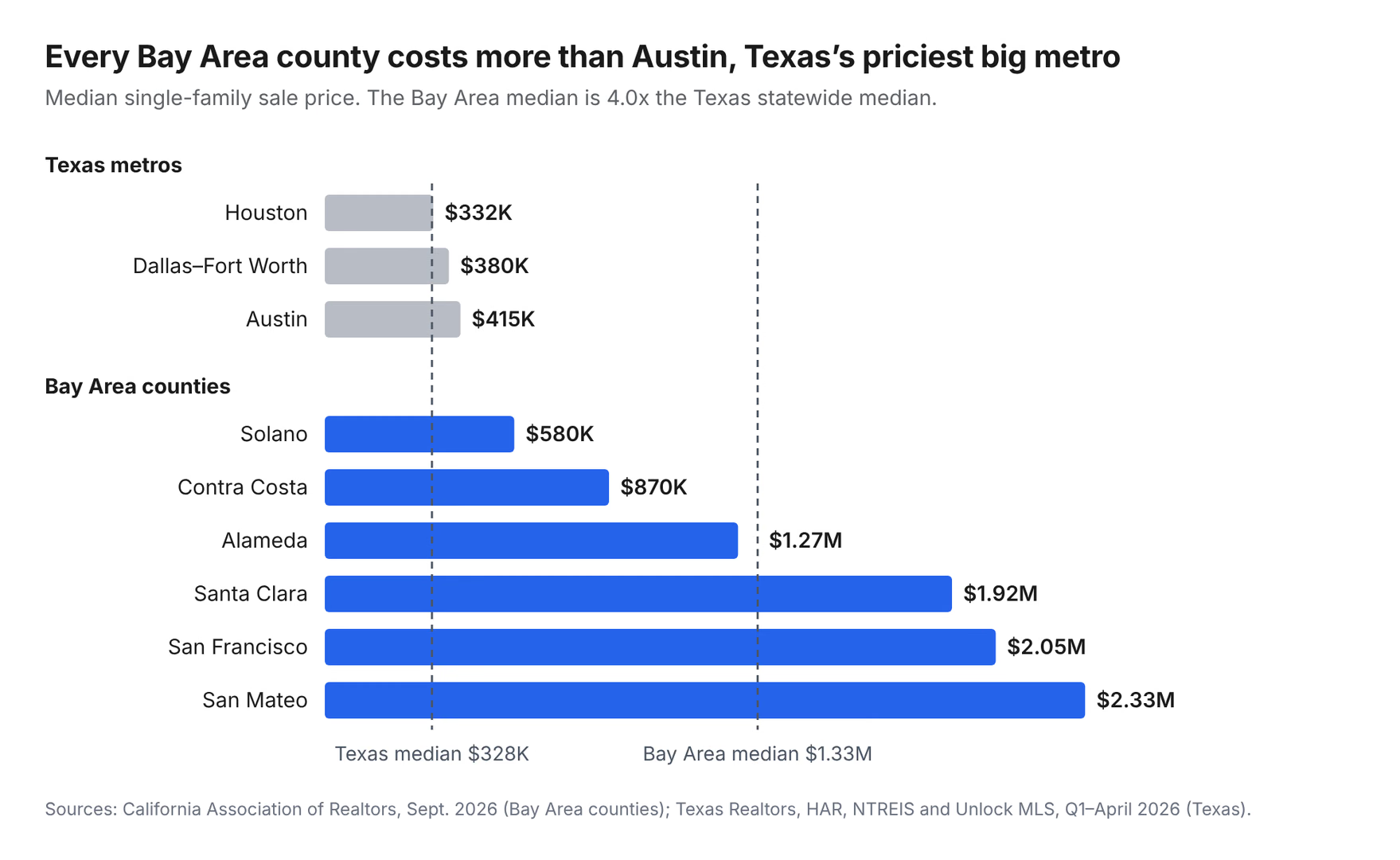
Taxes: what changes when you leave Texas
The biggest tax change is state income tax: Texas has none, and California charges 1% to 12.3%, plus 1% on income over $1 million. Property tax works the other way, with California's rate lower than most Texas cities.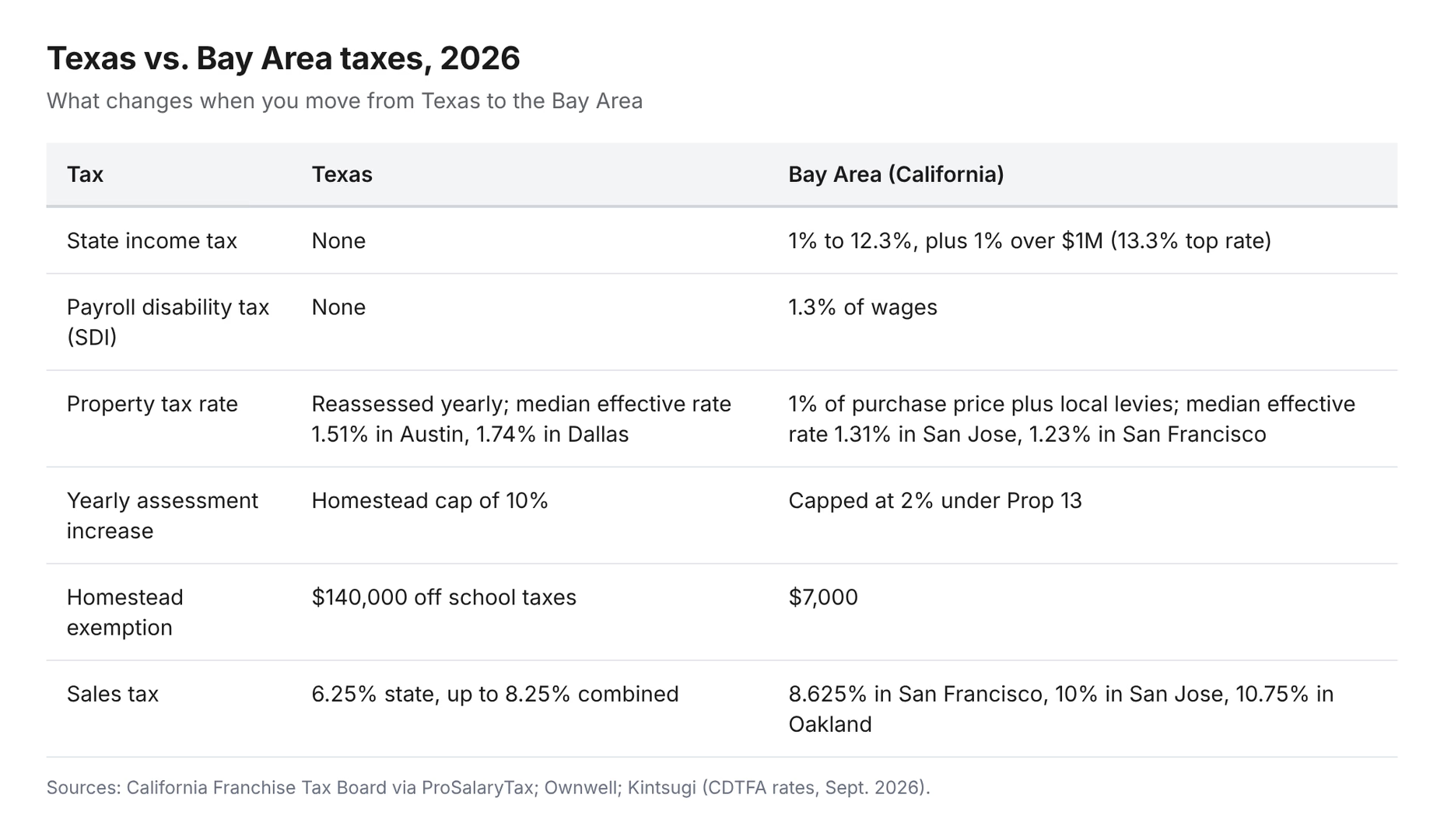
- On a $150,000 salary, take-home pay is about $11,700 a year lower in California.
- On a $200,000 salary, the gap is about $17,000 a year (ProSalaryTax).
- On a median home, the lower California rate doesn't save you money because the price is so much higher. A $1.92 million Santa Clara County home at San Jose's 1.31% rate runs about $25,200 a year in property tax. A $415,300 Austin home at 1.51% runs about $6,300.
Jobs and salaries
Bay Area households earn about 72% more than Texas households, but home prices are four times higher, so your paycheck stretches less. The median Bay Area household made $137,100 in 2024, and Santa Clara County led at $167,200 (MTC Vital Signs). The Texas median was $79,721 (Texas Tribune, from Census data).The affordability gap is the number to watch. A median Bay Area home costs about 9.7 times the median household income. In Texas, it's about 4.1 times.If you work in tech, the pay premium is real. Large tech employers with Austin offices typically pay about 85% to 90% of what the same role pays in the Bay Area (ProSalaryTax). Before accepting an offer, compare your take-home pay after California taxes and housing, not just the base salary.Weather, gas, and getting around
Expect cooler summers, pricier gas, and more transit options than you had in Texas.- Weather. The Bay Area trades Texas heat and humidity for mild, dry summers and a rainy season from roughly November to April. Temperatures vary a lot by microclimate: San Francisco can be foggy and cool in July while San Jose and the East Bay inland valleys are sunny and warm. Pack layers.
- Natural hazards. You leave hurricanes, hail, and ice storms behind, but earthquakes and wildfire smoke are part of life here. Standard homeowners policies don't cover earthquake damage, so price a separate policy when you buy.
- Gas. California regular averaged $6.30 a gallon in mid-October 2026, versus $3.82 in Texas, according to AAA (FOX 7 Austin). That's about $37 more per 15-gallon fill-up.
- Transit. Unlike most Texas metros, many Bay Area commuters can skip driving. BART connects San Francisco, Oakland, and the East Bay; Caltrain runs down the Peninsula to San Jose; VTA serves Santa Clara County. Living near a station can change which neighborhoods work for you.
Where Texans tend to feel at home
The closest match to Texas suburban living is the East Bay's outer suburbs, where newer subdivisions and bigger lots cost a fraction of Silicon Valley prices. Use this as a starting point, matched to the kind of Texas neighborhood you're leaving.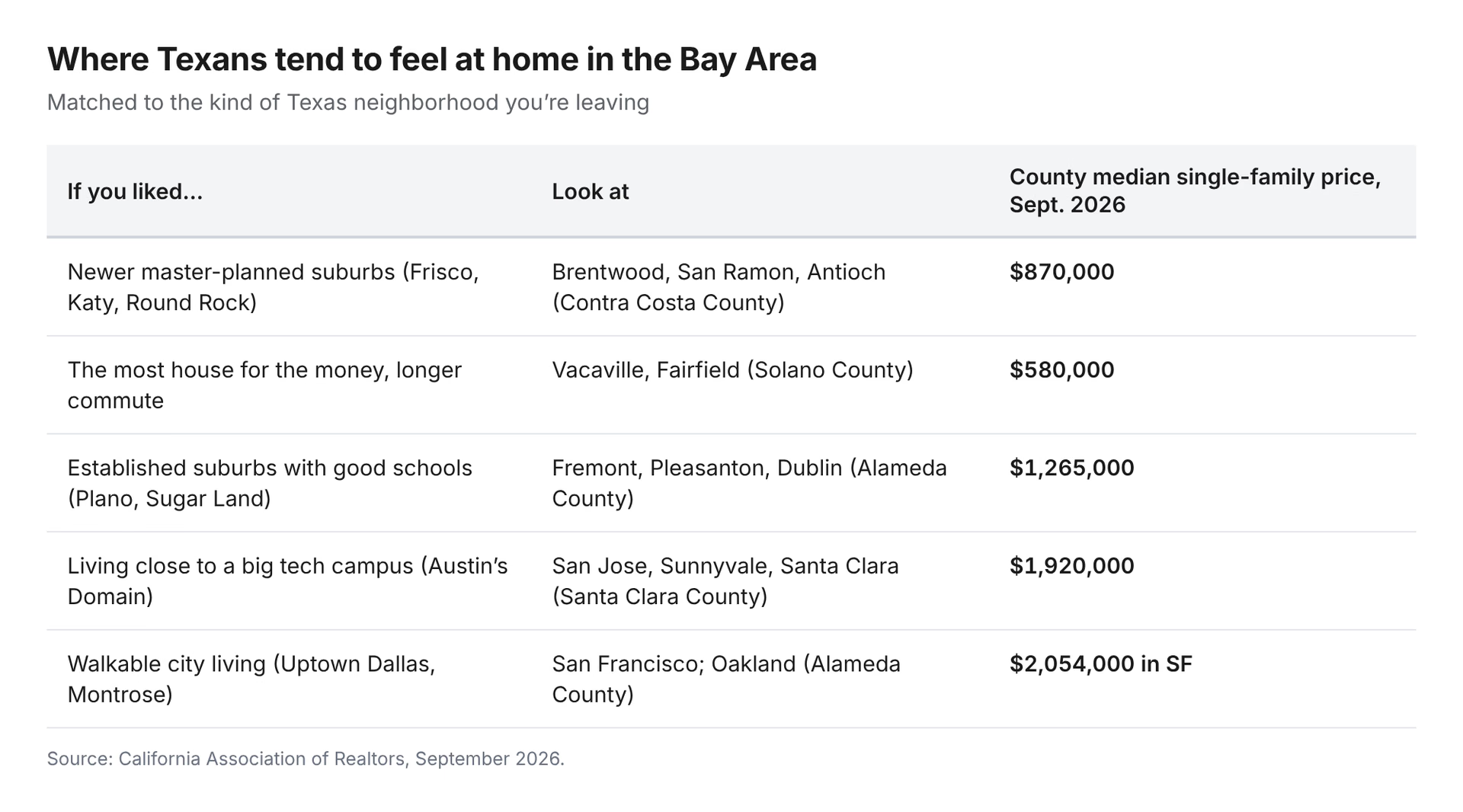
Your first 20 days: the Texas-to-California checklist
California gives new residents 10 days to get a driver's license and 20 days to register a car (ABC10; California DMV). DMV appointments can book up weeks ahead, so schedule before you arrive.- Book a DMV appointment before moving day. First-time California applicants apply in person at a field office.
- Get your California driver's license within 10 days of establishing residency. Bring your Texas license and proof of your new address, and check the DMV site for whether you'll need a knowledge test.
- Register your car within 20 days. Bring your Texas title and registration. Most vehicles also need a California smog check, and the DMV can't register a car that doesn't meet California emissions rules.
- Update your car insurance to a California policy.
- Register to vote at your new address.
- Plan for your first California tax return. You'll likely file as a part-year resident for the year you move, and California will tax income you earn after you arrive.
- If you buy a home, file the $7,000 homeowners' exemption with your county assessor and get a quote for earthquake insurance.
Frequently asked questions
How much more expensive is the Bay Area than Texas?
Housing is about four times more expensive. The Bay Area median single-family home sold for $1,325,000 in September 2026, compared with a Texas statewide median of $328,000 in early 2026.How much state income tax will I pay in California?
California's rates run from 1% to 12.3%, plus 1% on income over $1 million. A single filer earning $100,000 takes home about $6,400 less per year in California than in Texas.Are property taxes lower in California than in Texas?
The rate is lower, but the bill is usually higher. San Jose's median effective rate is 1.31%, versus 1.51% in Austin and 1.74% in Dallas, but Bay Area homes cost so much more that annual bills are typically several times larger.How long do I have to get a California driver's license after moving from Texas?
You have 10 days after becoming a California resident to get a driver's license and 20 days to register your vehicle.What is the most affordable part of the Bay Area?
Solano County, with a median single-family price of $580,000 in September 2026, followed by Contra Costa County at $870,000. Both trade lower prices for longer commutes to San Francisco and Silicon Valley.Do many Texans move to California?
Yes. Texas was the top source of new California residents in 2024, with about 45,400 people moving from Texas to California.Is gas more expensive in the Bay Area than in Texas?
Yes, by about $2.50 a gallon. California regular averaged $6.30 in mid-October 2026, versus $3.82 in Texas.Sources
- USAFacts: What states are people in California moving to and from? (2024 Census ACS)
- U-Haul: Migration Trends 2024 Midyear Report
- California Association of REALTORS®: September 2026 home sales and price report
- Harbert Group: Texas Real Estate Market Update for Q2 2026 (citing Texas REALTORS®, HAR, NTREIS, Unlock MLS)
- ProSalaryTax: California vs Texas tax comparison 2026
- Ownwell: Property taxes in Texas vs. California
- Kintsugi: San Jose sales tax rate, September 2026
- MTC Vital Signs: Bay Area household income
- Texas Tribune via inkl: The cost of owning a home in Texas is on the rise
- FOX 7 Austin: Texas gas prices, October 12, 2026 (AAA data)
- California DMV Driver's Handbook: Vehicle registration requirements
- ABC10: New-resident license and registration deadlines
Travis VantVoort
REALTOR®
Area served: Union City, Alameda County, CA, Newark, Alameda County, CA, Fremont, Alameda County, CA, Milpitas, Santa Clara County, CA, Pleasanton, Alameda County, CA, Dublin, Alameda County, CA, Livermore, Alameda County, CA, Hayward, Alameda County, CA, Castro Valley, Alameda County, CA, Sunol, Alameda County, CA
Expertise: Downsizing, First-Time Buyer, Fixer-Uppers, 1031 Exchanges, Historic Homes