
The short answer
Aging in place means staying in your own home safely and independently as you get older. For most homeowners in Fremont, Newark and Union City, the six changes that help most are grab bars, a curbless shower, a no-step entry, a bedroom and full bath on the main floor, lever door handles and wider doorways. Start with the bathroom: about two-thirds of bathroom injuries happen in the tub or shower (HUD).What is aging in place?
Aging in place is living in your own home, safely and independently, as you get older instead of moving to assisted living. Aging-in-place design adapts the house to fit you: no-step entries, better lighting, clear paths and fixtures that are easy to reach and use.It is worth planning for if you are:- A homeowner in your 50s or 60s who wants to stay put for decades
- An adult child helping a parent stay in the family home
- A buyer choosing a home you never want to outgrow
Which home modifications matter most?
Six changes do the most to keep a home safe as you age. They target the places falls and daily struggles happen: the bathroom, the entry, the stairs and the doors. More than one in four adults 65 and older falls each year, and 43,020 died from preventable falls in 2024 (National Safety Council).1. Grab bars
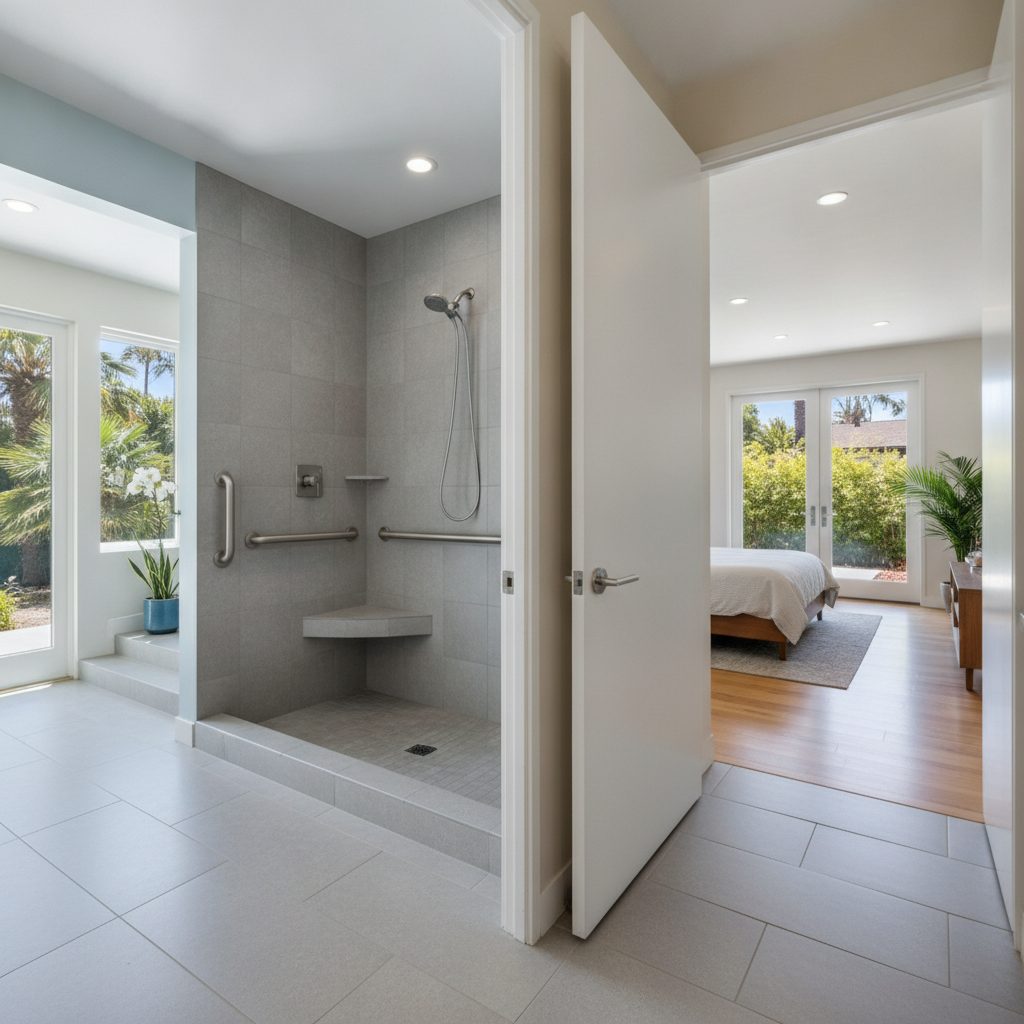
Grab bars near the toilet, tub and shower give you something solid to hold when sitting, standing or stepping in. Mount them 33 to 36 inches above the floor, anchored into studs or blocking, never only drywall (University of Missouri Extension). A towel bar is not a grab bar.2. Curbless or roll-in showers
A curbless shower has no ledge to step over, so it removes a common tripping hazard and works with a shower chair, walker or wheelchair. Pair it with a handheld showerhead, a built-in bench and slip-resistant tile.3. A no-step entry or gradual ramp
At least one entrance without steps lets you come and go with a walker or wheelchair. A ramp should rise no more than 1 inch for every 12 inches of length, with a level 5-foot landing every 30 feet (University of Missouri Extension). For a typical 2-step entry of about 14 inches, that means a ramp roughly 14 feet long.4. One-floor living
Keep a bedroom, a full bathroom, the kitchen and laundry on the main floor, so daily life never depends on the stairs. In a two-story home, that can mean converting a downstairs den or adding a bathroom.5. Lever door handles
Lever handles open with a push of the wrist or elbow, which matters with arthritis or limited grip strength. Round knobs need a firm twist. Swap faucet knobs for levers too.6. Wider doorways
A wheelchair needs at least 32 inches of clear opening, and 36 inches is better (University of Missouri Extension). Many older bedroom and bathroom doors are 28 to 30 inches wide. Offset (swing-clear) hinges can add about 2 inches without moving the frame.Lighting matters too: bright, even light in halls and stairways, and night lights between the bedroom and bathroom.How much do aging-in-place modifications cost?
Most single changes cost between a few hundred and a few thousand dollars; a typical whole-home project averages about $9,500 nationally (Fixr, 2022). These are national ranges. Expect Bay Area labor to push Fremont, Newark and Union City bids toward the top of each range, and get two or three local quotes.- Grab bars, installed: $90 to $300 each
- Lever door handles: $150 to $350
- Widening a doorway: $300 to $2,500 per door
- Wheelchair ramp: $1,400 to $3,000
- Curbless (roll-in) shower: $2,500 to $9,000
- Stairlift: $4,000 to $8,000
- Whole-home aging-in-place remodel: $3,000 to $15,000 typical; $9,500 average
Will accessibility improvements raise my property taxes in California?
Not if they qualify. California excludes accessibility work from reassessment when it makes a home more usable for a severely and permanently disabled person who lives there (Revenue and Taxation Code §74.3).- What qualifies: ramps, wider doorways, an accessible bathroom, and even a new bedroom or bath that duplicates rooms the resident can no longer use, such as one upstairs.
- What doesn't: general upgrades done at the same time, unless they are only incidental to the accessibility work.
- How to claim: file the claim form with a licensed physician's certification of the disability. In Fremont, Newark and Union City, that goes to the Alameda County Assessor, (510) 272-3787.
- The catch: the exclusion ends when the home changes ownership.
Is there help paying for home modifications in Fremont, Newark and Union City?
Yes. Income-qualified homeowners in all three cities can get low-cost loans for accessibility work through Renew Alameda County, and Newark and Union City residents can also apply for county repair grants.Renew Alameda County, run by Habitat for Humanity East Bay/Silicon Valley- Cities: Fremont, Newark and Union City
- Covers: ramps, lifts, tub-to-shower conversions and grab bars, plus roofs, plumbing and electrical
- Cost to you: 1% loans from $15,000 to $200,000, with payments deferred until the home is sold (flyer)
- Contact: 510-803-3388
- Cities: Fremont and the rest of the East Bay
- Covers: small health and safety fixes
- Cost to you: free; currently a waitlist
- Contact: 510-803-3388
- Cities: Newark and Union City
- Covers: grab bars, railings, doors, toilets and water heaters
- Cost to you: free, up to $5,000 in Union City (city page)
- Contact: 510-567-8280
- Cities: Union City
- Covers: ramps, railings, doorway changes and counter heights, for seniors or people with special needs
- Cost to you: free
- Contact: 510-567-8280
Should I modify my home or move to a single-story home?
Modify if your home already has, or can fit, a bedroom and full bath on the main floor and an entry you can make step-free. Consider moving if every bedroom is upstairs, the lot is steep, or the changes would cost more than the move.A few questions help decide:- Can you live on one floor today, or with one project?
- Will the entry, bathroom and hallways fit a walker or wheelchair if you need one?
- Is the house close to the doctors, shopping and family you rely on?
- Would the remodel cost more than the price gap to a single-story home nearby?
Frequently asked questions
What is the first aging-in-place change to make?
Install grab bars by the toilet and in the tub or shower. They cost $90 to $300 each installed and address the room where many home injuries happen.How high should grab bars be?
Mount grab bars 33 to 36 inches above the finished floor, anchored into wall studs or blocking.How wide should a doorway be for a wheelchair?
A doorway needs at least 32 inches of clear opening for a wheelchair; 36 inches is recommended.What slope should a wheelchair ramp have?
No steeper than 1 inch of rise for every 12 inches of length, with a level 5-foot landing every 30 feet.Do accessibility upgrades raise property taxes in California?
Not when they make the home more accessible for a severely and permanently disabled resident. File a claim with a physician's certification through the Alameda County Assessor.Can I keep my property tax base if I downsize in California?
Yes, if you are 55 or older. Proposition 19 lets you transfer your tax base to a replacement home anywhere in California, up to three times, within two years of selling.Who helps pay for home modifications in Fremont?
Renew Alameda County, run by Habitat for Humanity East Bay/Silicon Valley, offers 1% loans for ramps, lifts and bathroom conversions to income-qualified Fremont homeowners. Call 510-803-3388.About the author
Travis VantVoort is a REALTOR® with Coldwell Banker Realty in Fremont, California (DRE #02206082). He helps homeowners in Fremont, Newark and Union City decide whether to adapt the home they have or move to one that fits the next chapter, including downsizing, probate and inherited homes. Reach him at 510.737.2220 or travis@vantvoort.com.This guide is general information, not legal, tax or medical advice. Check program details and eligibility directly with each agency, and ask your tax adviser or the Assessor about your situation.Sources
- Older adult falls, National Safety Council Injury Facts
- Bathroom safety tip sheet, U.S. Department of Housing and Urban Development
- Improving access for the disabled, University of Missouri Extension
- Aging-in-place remodeling cost, Fixr, updated August 2022
- Revenue and Taxation Code §74.3, State of California
- New construction exclusions, Alameda County Assessor
- Transfer your property tax base (Prop 19), City and County of San Francisco
- Habitat home repairs in Fremont, Habitat for Humanity East Bay/Silicon Valley
- Renew Alameda County flyer, City of Fremont
- Housing rehabilitation programs, Alameda County Healthy Homes Department
- I'm a homeowner, City of Union City
Travis VantVoort
REALTOR®
Area served: Union City, Alameda County, CA, Newark, Alameda County, CA, Fremont, Alameda County, CA, Milpitas, Santa Clara County, CA, Pleasanton, Alameda County, CA, Dublin, Alameda County, CA, Livermore, Alameda County, CA, Hayward, Alameda County, CA, Castro Valley, Alameda County, CA, Sunol, Alameda County, CA
Expertise: Downsizing, First-Time Buyer, Fixer-Uppers, 1031 Exchanges, Historic Homes