
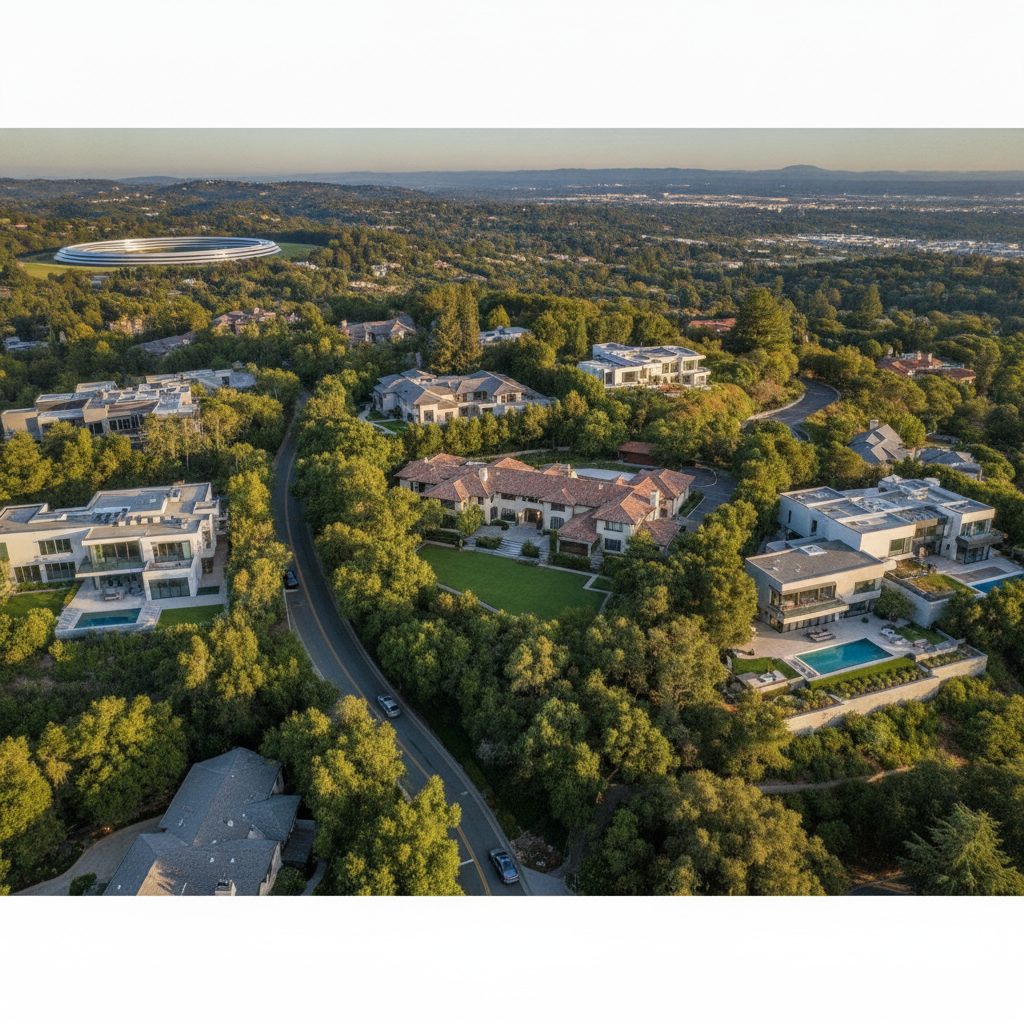
Why Cupertino single-family inventory never matches national volume trends
In Cupertino, the total pool of single-family detached properties available at any single time along corridors like Bubb Road, McClellan Road, or Regnart Road rarely climbs above twenty to thirty homes. Contrast that with suburban developments in Texas or Florida where builders can deliver three hundred units in a quarter. In Cupertino, residential parcels were essentially built out by the late 1970s. The city's strict planning codes and slow approvals for residential redevelopment ensure that resale homes form the entire supply chain.When a four-bedroom home near Linda Vista Park reaches the market, it does not compete against dozens of alternative options down the street. It competes against zero to two properties within that exact micro-pocket. Sellers here are predominantly long-term owners protected by California Proposition 13 tax bases, meaning their carrying costs are tiny compared to market values. They have no financial urgency to drop prices to make a transaction happen. Unless an owner relocates or liquidates an estate, that property stays off the market.Buyers in Cupertino routinely arrive with non-contingent financing or all-cash structures backed by vested tech equities from nearby corporate campuses along Interstate 280. When headlines predict falling prices, Cupertino buyers do not stop touring; they simply watch for the rare weekend when a well-maintained home on a quiet cul-de-sac appears, and they bid aggressively to secure it.How Saratoga zoning laws lock in a baseline price floor
Ten minutes south along Saratoga-Sunnyvale Road, Saratoga presents a market structure that resists broader downward price pressure through strict municipal zoning. Unlike neighboring San Jose, which allows greater density and urban infill, Saratoga enforces expansive minimum lot sizes across much of its footprint. Parcels zoned R-1-20,000 or R-1-40,000 require a half-acre or a full acre per single-family residence, immediately establishing an unmovable floor on land valuation.Moving west toward the hills along Big Basin Way or Pierce Road, properties encounter Saratoga's rigorous Hillside Development regulations. These mandates govern slope stability, tree preservation, and geotechnical reviews before any major remodel or replacement can begin. The cost and timeline to build new construction are so high that existing turn-key estates maintain extreme premiums. While buyers in distant commuter suburbs might negotiate credits for aging roofs or outdated HVAC systems, Saratoga buyers frequently absorb substantial deferred maintenance costs out of pocket just to win the underlying ground.Consider the structural differences that keep Saratoga detached from national downturns:- Minimum lot requirements prevent subdivision, preserving neighborhood density ratios that have remained unchanged for decades.
- Private architectural review boards enforce long approval timelines, preventing spec-builder speculative gluts from hitting the market at once.
- Low turnover among multi-decade residents keeps total annual transactions under a few hundred sales across the entire municipality.
- Significant private wealth diversification means rate spikes have minimal influence on luxury transactions above the five-million-dollar mark.
Los Altos teardown land values separate land from structure
Heading north into Los Altos, the spread between raw lot value and finished home value is narrower than almost anywhere else in Northern California. Near downtown streets like Main Street and State Street, or moving toward Fremont Avenue and the Los Altos Golf and Country Club, modest 1950s ranch homes on quarter-acre lots frequently trade for well over three and a half million dollars purely for lot value. The structure itself is often treated as a temporary holding shell or demolished within weeks of close.In a market where seventy to eighty percent of the purchase price represents the land, national discussions about building material price changes or residential replacement values become irrelevant. Buyers in Los Altos are purchasing finite real property positioned twenty minutes from Sand Hill Road and Stanford University. If a 1,600-square-foot home on a flat 10,000-square-foot lot lists for sale, it attracts custom homebuilders, architects working for private clients, and end-users who intend to expand the footprint.Furthermore, Los Altos sellers rarely utilize public price drops. If a property sits past twenty-one days on market, the listing agent typically pulls the property off the Multiple Listing Service rather than executing incremental five-percent cuts. The home is either quietly re-positioned for off-market private networks or leased until the spring buying cycle resumes.What happens if you write a discounted offer in these cities
Submitting an offer ten percent below asking price with loan and appraisal contingencies in Cupertino, Saratoga, or Los Altos will simply end your negotiation before it starts. Sellers in these jurisdictions review offers on designated review dates, typically six to eight days after listing. A below-ask bid containing standard contingency clauses signals that the buyer lacks capital certainty. Even in months when transaction velocity moderates slightly, serious properties receive clean contracts with earnest money deposits wired within twenty-four hours and property condition contingencies pre-waived through thorough review of seller inspection packets.The tactical steps required to purchase when headlines conflict with reality
If you intend to buy a home across these three communities, you must separate national macro-commentary from street-level execution. Waiting for a dramatic broad-market price correction along the Foothill Expressway corridor has historically cost buyers hundreds of thousands of dollars in compounding appreciation.Instead of waiting for sellers to panic, prepare your transaction mechanics so you can move decisively on the rare parcel that aligns with your criteria:- Secure full underwriter approval rather than a simple pre-qualification letter, allowing you to match the speed of competing cash buyers.
- Review municipal zoning maps and setback ordinances through city planning departments before viewing properties so you understand expansion limits on day one.
- Read preliminary title reports and historical disclosure disclosures in advance to eliminate the need for elongated inspection contingencies in your purchase contract.