
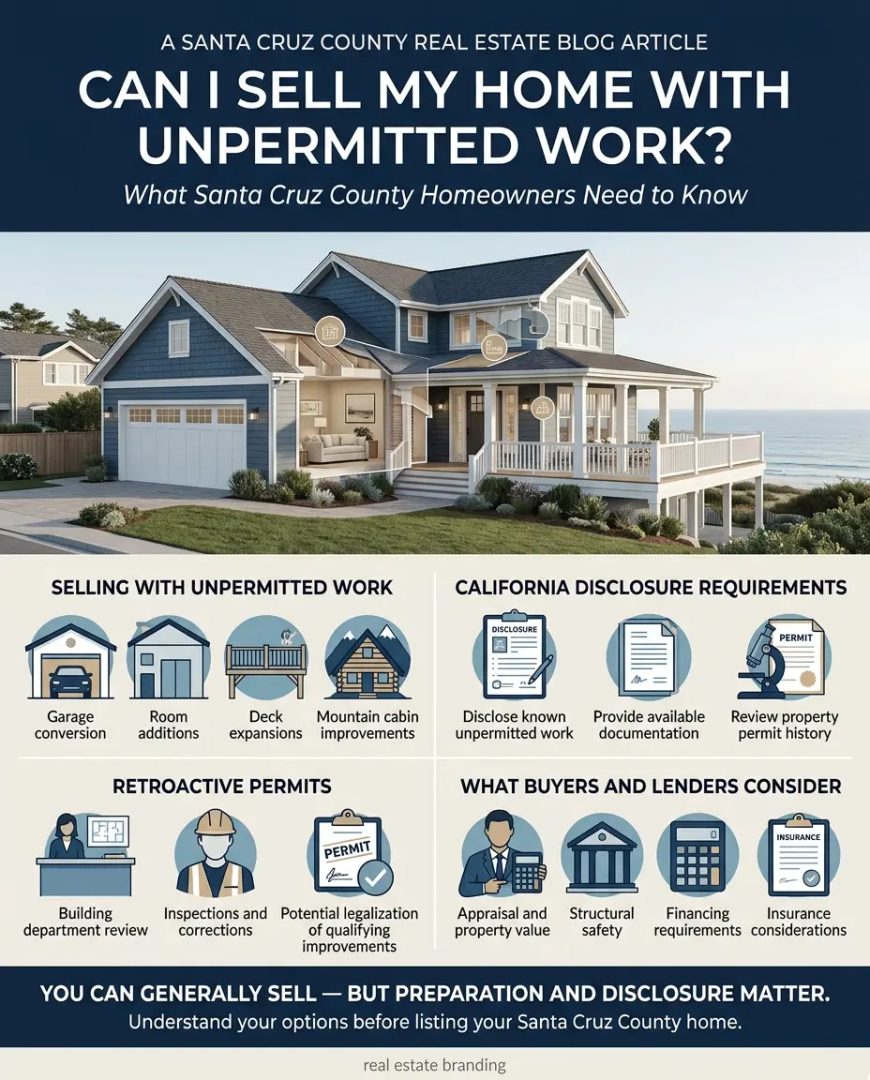
Can You Legally Sell a Home With Unpermitted Work in California?
Yes. California does not generally require every improvement on a residential property to have been permitted before the property can be sold.A home may be transferred to a new owner even when it contains additions, alterations, or other improvements that were constructed without the required permits.However, being able to sell a property does not mean the improvements are legally approved or that the seller is relieved of disclosure responsibilities.Unpermitted work can create several issues:- The buyer may be concerned about construction quality and safety.
- The appraiser may not include the improvement in the home's reported living area.
- The lender may require additional documentation or repairs.
- The homeowner's insurance company may have questions about the improvement.
- The local building department may require permits, corrections, or removal of certain improvements.
- The buyer may request a price reduction or other concessions.
California Seller Disclosure Requirements
California places significant importance on seller disclosures. When selling most residential properties, sellers must complete the applicable Transfer Disclosure Statement (TDS) and other required disclosure documents.The TDS specifically asks whether the seller is aware of:- Room additions, structural modifications, or other alterations or repairs made without necessary permits.
- Room additions, structural modifications, or other alterations or repairs that are not in compliance with applicable codes.
- Other known conditions that may materially affect the property's value or desirability.
California's Additional Disclosure Requirement for Recent Owners
California Assembly Bill 968 added another disclosure requirement for certain sellers.Under Civil Code Section 1102.6h, a seller of a single-family residential property who accepts an offer within 18 months after acquiring title must disclose qualifying room additions, structural modifications, alterations, or repairs performed by contractors since acquiring the property. The law also requires contractor identification and applicable permit information under the conditions specified in the statute.This requirement applies to qualifying transactions with accepted offers on or after July 1, 2024.It is an additional requirement and does not replace the seller's existing disclosure obligations.What Happens If You Don't Know Whether Work Was Permitted?
This situation is particularly common with older Santa Cruz homes.A homeowner may purchase a property that already contains an enclosed patio, converted garage, additional bathroom, or expanded living area. The previous seller may have disclosed the improvement, but no one verified its permit status.In other cases, the improvement may have been completed decades ago, and the current owner has little documentation.The best approach is to investigate the available building records.For properties in unincorporated Santa Cruz County, the County provides access to permit history and parcel research resources. Properties within incorporated cities generally require checking with the applicable city building department.An important distinction: the absence of a permit record does not necessarily establish exactly when an improvement was constructed or whether it was originally exempt from permitting requirements.If the permit history is incomplete, avoid representing an improvement as permitted unless that status can be verified.Can You Obtain Retroactive Building Permits?
In some situations, yes.A property owner may be able to apply for permits after construction has already occurred. This is commonly referred to as obtaining a retroactive or after-the-fact permit.However, the process is not simply a matter of paying a late permit fee.The local building department may require:- A permit application describing the existing work.
- Construction drawings or as-built plans.
- Site plans and property measurements.
- Structural calculations prepared by an appropriate professional.
- Electrical, plumbing, and mechanical documentation.
- Inspections of the existing construction.
- Corrections to work that does not meet applicable requirements.
Why You Should Investigate Before Applying
Before beginning a retroactive permitting process, determine whether the improvement is likely to qualify for approval.This is especially important in Santa Cruz County, where coastal zoning, steep terrain, fire hazards, drainage, and environmental restrictions can affect what may be approved.A preliminary conversation with the appropriate building or planning department, architect, contractor, or engineer can help identify potential obstacles.Also remember that bringing an improvement into compliance may trigger additional requirements that would not necessarily have been imposed simply because the property is being sold.Santa Cruz County's ADU Legalization Programs
Santa Cruz County has specific procedures for addressing certain unpermitted accessory dwelling units (ADUs) and junior accessory dwelling units (JADUs).Two California laws are particularly relevant: Senate Bill 13 and Assembly Bill 2533.AB 2533: Qualifying Older Unpermitted ADUs
Assembly Bill 2533, effective January 1, 2025, establishes a pathway for qualifying unpermitted ADUs and JADUs constructed or converted before January 1, 2020.Santa Cruz County's process requires documentation establishing when the unit was constructed or converted.Potential supporting documentation includes:- County Assessor records.
- Previous escrow documents.
- Earlier building, planning, or code enforcement records.
- Prior real estate transfer disclosures.
- Insurance records.
- Dated photographs.
- Notarized statements from previous owners or tenants.
Why This Matters to Sellers
If your property includes a converted garage, detached living area, or other space that functions as an ADU, it may be worthwhile to determine whether one of these legalization pathways applies.An approved ADU can provide a buyer with more certainty regarding the property's permitted uses, although legalization is not guaranteed and may require substantial work.For additional information, consult the ++Santa Cruz County AB 2533 program++ and the County's building department.Common Unpermitted Improvements That Affect Home Sales
Not all unpermitted work creates the same concerns. A small interior alteration is different from converting a garage into a separate living unit or adding a large deck to a hillside property.Here are several examples frequently encountered in Santa Cruz County.1. Garage Conversions
Garage conversions are among the more significant issues that can arise during a residential sale.A homeowner may have converted a two-car garage into:- A family room.
- A bedroom and bathroom.
- A home office.
- A studio apartment.
- A separate rental unit.
- Proper foundation and floor construction.
- Insulation and energy compliance.
- Electrical wiring and outlets.
- Plumbing and drainage.
- Heating and ventilation.
- Emergency escape and rescue openings where required.
- Fire separation and life-safety requirements.
- Parking and zoning considerations.
2. Decks and Exterior Improvements
Decks are especially common throughout the coastal communities and mountain neighborhoods of Santa Cruz County.Some homeowners expand existing decks, add elevated platforms, install stairs, or build outdoor entertaining areas without obtaining the required permits.The potential concerns depend on the deck's size, height, location, structural design, and applicable local requirements.Elevated decks deserve particular attention because structural connections, footings, guardrails, and overall stability are important safety considerations.In coastal and hillside locations, additional issues may include:- Slope stability.
- Soil erosion.
- Drainage.
- Setbacks.
- Vegetation and environmental restrictions.
- Exposure to moisture and deterioration.