
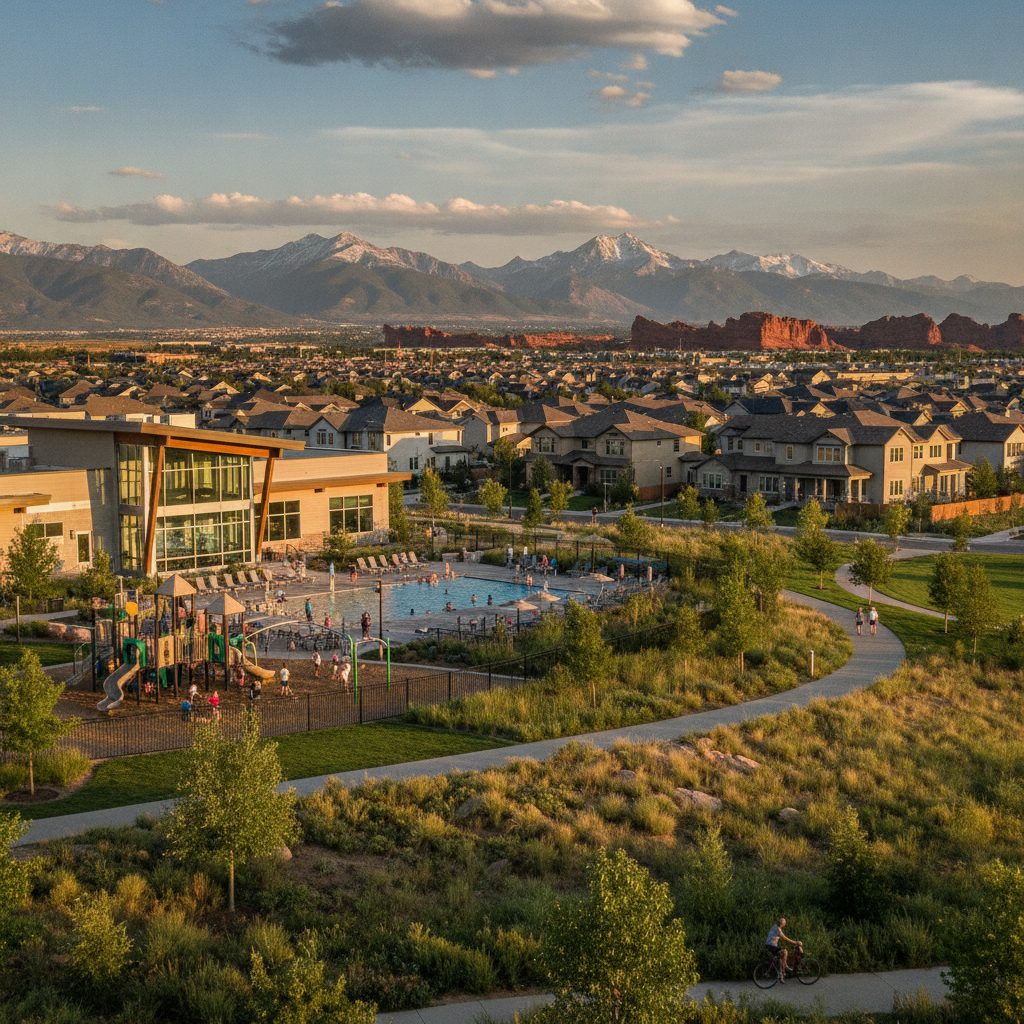
Real Estate Value and Rec Centers in Highlands Ranch

Real Estate Value and Rec Centers in Highlands Ranch
Every residential purchase in Highlands Ranch ties directly to a distinct network of community infrastructure that sets this Douglas County master-planned area apart from surrounding Denver suburbs. When you buy real estate in Highlands Ranch, current association covenants link the property to the Highlands Ranch Community Association (HRCA). Under these recorded governing documents, parcel ownership typically conveys membership privileges to four multi-million-dollar recreation facilities distributed across the township's 22,000 acres. Because specific deed restrictions, fee schedules, and sub-association covenants vary between individual subdivisions, prospective purchasers should always examine the official HOA resale disclosure packet, title commitments, and HRCA bylaws to verify exact dues, transfer fees, and facility access rights before closing.These facilities are not mere gym rooms tucked into the corner of a clubhouse. They serve as primary community hubs where daily routines unfold, from early morning lane swimming to youth sports leagues, pottery workshops, and weekend fitness training. For buyers assessing Douglas County properties, understanding how these facilities operate, what each one specializes in, and how HRCA assessments compare to standard municipal taxes is essential to choosing the right neighborhood pocket.

How HRCA assessment structures differ from municipal park mill levies

In neighboring municipalities such as Littleton, Centennial, or Lone Tree, public recreation facilities are frequently operated by park districts like South Suburban Parks and Recreation. Those public operations are funded primarily through mill levies on county property tax bills, coupled with tiered user fees for daily entry and program enrollment. Highlands Ranch operates on a private association model instead.According to HRCA governing documents, recreation center construction and operations are financed through mandatory quarterly homeowner assessments rather than dedicated municipal recreation mill levies on your ad valorem property tax bill. For residential parcels, the base HRCA quarterly assessment applies across the board, regardless of whether a property is an attached townhome near Town Center or a custom single-family property in BackCountry. This structure allows members equal entry privileges across all four facilities: Northridge, Southridge, Eastridge, and Westridge. However, buyers must verify property-specific disclosures carefully, as many sub-associations in neighborhoods like Brownstones, Indigo Hill, or BackCountry charge additional maintenance dues on top of the master HRCA assessment.In neighboring Parker or Castle Rock, municipal recreation centers charge daily drop-in fees or require monthly household memberships that can add significant recurring costs for equivalent family access. In Highlands Ranch, entry to the weight rooms, cardio decks, open pools, running tracks, and open gyms is covered under that base association fee. Extra out-of-pocket charges apply only for specialized programming, private swim lessons, or competitive league registrations.

Northridge delivers dedicated tennis courts and gymnastics facilities

Located off Broadway and Plaza Drive, Northridge Recreation Center represents the architectural starting point of Highlands Ranch. Built in 1982 when the master plan first broke ground, Northridge has undergone several interior renovations to keep pace with newer developments. It anchors the northern corridor near C-470, making it convenient for residents who commute north toward the Denver Tech Center or downtown Denver along the Broadway corridor.Northridge distinguishes itself with specialized athletic facilities not found at the other three locations:
  • A dedicated indoor tennis pavilion with permanent hard courts that permit year-round match play through Colorado winter freezes.
  • A gymnastics training facility equipped with spring floors, balance beams, and training pits for competitive and introductory programs.
  • Racquetball and squash courts configured for league matches and reservation-based drop-in games.
  • A dedicated indoor teaching pool alongside an outdoor lap pool and youth splash area.
If you prioritize indoor racquet sports or gymnastics instruction, living in Northridge neighborhoods along timberline corridors or near Northridge Park provides immediate proximity to these specific activities. The surrounding homes here feature mature cottonwoods and pines, along with larger lot setbacks common in the early 1980s and 1990s phases of construction.

Eastridge concentrates indoor track running and ceramic studios

Positioned near the intersection of University Boulevard and Highlands Ranch Parkway, Eastridge Recreation Center serves the eastern quadrant of the community. It functions as the visual arts and indoor track center of the HRCA network. Unlike Northridge, Eastridge includes an expansive indoor running and walking track suspended above a multi-court gymnasium, offering climate-controlled cardio space throughout winter snowstorms.Eastridge also houses the association's central ceramic and pottery studio, complete with throwing wheels, glazing stations, and professional kilns. The facility provides weekly structured classes and open-studio hours that rival municipal arts centers. The aquatic footprint includes both an indoor competition lap pool and an outdoor pool with zero-depth entry and waterslides, making it heavily utilized during the summer season.Subdivisions surrounding Eastridge, such as Kentley Hills and Falcon Bluff, offer direct concrete trail connections that feed into the center without requiring travel on arterial roads. If quick access to University Boulevard for south Denver Tech Center commuting matters to you alongside indoor track access, the Eastridge sector balances those logistical needs.

Westridge pairs indoor turf training with batting cages along Foothills Canyon

Westridge Recreation Center, situated at Foothills Canyon Boulevard and Ridgeline Boulevard, focuses on team turf sports and strength conditioning. Built to serve neighborhoods constructed throughout the late 1990s and early 2000s, Westridge features an indoor synthetic turf field and indoor batting cages that operate year-round for soccer, lacrosse, baseball, and softball practice.The weight room at Westridge holds an extensive collection of free weights, squat racks, and functional fitness turf. Outside, the facility features an outdoor pool complex with a dedicated splash park, positioned right alongside Marcy Gulch Trail for direct bicycle access.

Southridge expands southern trail access with extensive aquatic space

Southridge Recreation Center sits at the southern edge of the township on McArthur Ranch Road, directly bordering the open spaces that transition toward the BackCountry development and the Wildcat Mountain Trail system. As the newest of the four centers, Southridge showcases craftsman architecture with exposed timber beams and stone finishes.The aquatic footprint at Southridge is the largest in Highlands Ranch. Its outdoor pool complex includes dual looping water slides, interactive water playground structures, and a separate resort-style swimming pool. Inside, Southridge provides an elevated indoor track, full-court basketball facilities, senior lounge rooms, and an auxiliary pottery and art workshop space.For buyers considering properties in the southern section of the community, such as Firelight or Indigo Hill, Southridge serves as a direct neighborhood anchor. It connects directly to the regional trail system, allowing residents to walk or bike to the facility without crossing high-speed roadways like C-470 or Highlands Ranch Parkway.

Proximity to neighborhood trail spines directs everyday facility use

Because HRCA rules grant cardholders access to all four facilities, you are not restricted to the building nearest your property. An owner in Northridge can drop children off for swimming lessons at Eastridge, use the free weight room at Westridge during a lunch break, and attend an evening meeting at Southridge on the same access pass.Day-to-day patterns show that distance dictates real usage. A fifteen-minute drive across congested arterial intersections can turn an intended gym visit into a skipped workout. If you value everyday fitness routines, mapping the exact walking or cycling route to the nearest recreation center should carry just as much weight as evaluating interior floor plans.When comparing two properties at similar price points, position relative to local-amenities and trail spines makes a measurable difference. A home backing directly to Marcy Gulch Trail or Dad Clark Gulch offers continuous off-street access to recreation facilities, whereas a home separated by Quebec Street or University Boulevard requires navigating signalized intersections and parking lots. While homes with immediate trail access often carry a noticeable price premium, that pedestrian connectivity eliminates daily parking hassles and provides an uninterrupted route to the center you will use most.
#RealEstate#LocalAmenities#RealEstateValue#Estate#Value#Centers#Highlands#Ranch#RealEstateInsights#Insights#MarketUpdate#JustSold