
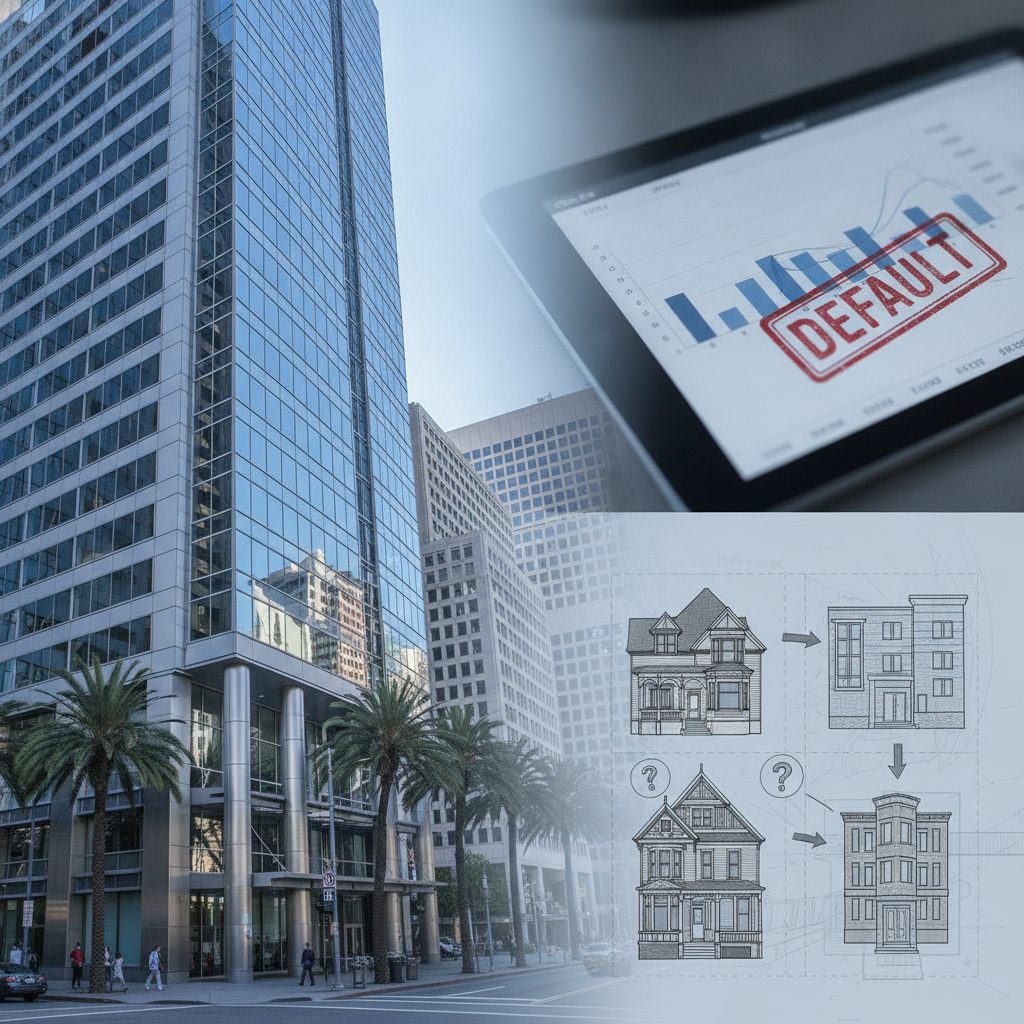
What has been reported about 1111 Broadway
Hoodline reported on October 22, 2026, citing The Mercury News and an Alameda County Recorder filing, that affiliates controlled by Swift Real Estate Partners defaulted on debt secured by the 24-story office tower at 1111 Broadway. The October 21 filing reportedly showed an unpaid principal balance of $194.1 million.Swift acquired the building in 2021 for a reported $327.5 million. In its August 16, 2021 acquisition release, Swift described 1111 Broadway as a Class A office building directly above the 12th Street City Center BART station and said it was 91% leased at acquisition. That occupancy figure is historical, not a statement about current tenancy. Published sources also use slightly different total square-footage figures, so I would describe the building as roughly 566,000 to 572,000 square feet rather than pretend one number is unquestionable.What a default does—and does not—tell us
A loan default is a credit event between a borrower and a lender. In this case, the reporting establishes a large unpaid principal balance. It does not establish which contractual trigger produced the filing.- **It is not a completed foreclosure.** A default filing can begin or document a process, but it is not the same thing as a completed transfer of ownership.
- **It is not an appraisal.** The principal balance measures debt owed; it does not state the building’s current open-market value.
- **It is not a sale price.** No new arm’s-length transaction has established a current market-clearing price for 1111 Broadway.
- **It is not a neighborhood-wide markdown.** One office tower’s debt situation does not assign the same percentage change to nearby homes, condominiums, apartments or mixed-use properties.
Why an office-loan headline is not a residential comparable
My view is direct: East Bay real estate is hyperlocal, and a commercial loan headline is not a residential comparable sale.A large downtown office tower is typically evaluated around lease income, expenses, tenant credit, vacancy, financing and the return investors require. A house, condominium or small residential income property is judged through a different set of facts: property type, legal use, condition, layout, location, insurance, current buyer demand and recent closed sales of genuinely comparable properties.Even two homes a few blocks apart can have different values. Applying a single automated estimate to both is risky; applying an office-loan balance to either makes even less sense. The 1111 Broadway filing matters as evidence about that building’s financing. It does not replace a current, property-specific valuation for a nearby residence.What nearby Oakland owners should watch
A responsible watch list is concrete and local:- later recorder filings or a verified agreement involving 1111 Broadway;
- actual sales of comparable office properties, if the question concerns office value;
- actual closed sales and days on market for the same residential property type and micro-location, if the question concerns a home or condo;
- street-level leasing and activity around Broadway, Franklin Street and nearby downtown blocks;
- the condition, legal use, income and operating costs of the specific property being evaluated.