
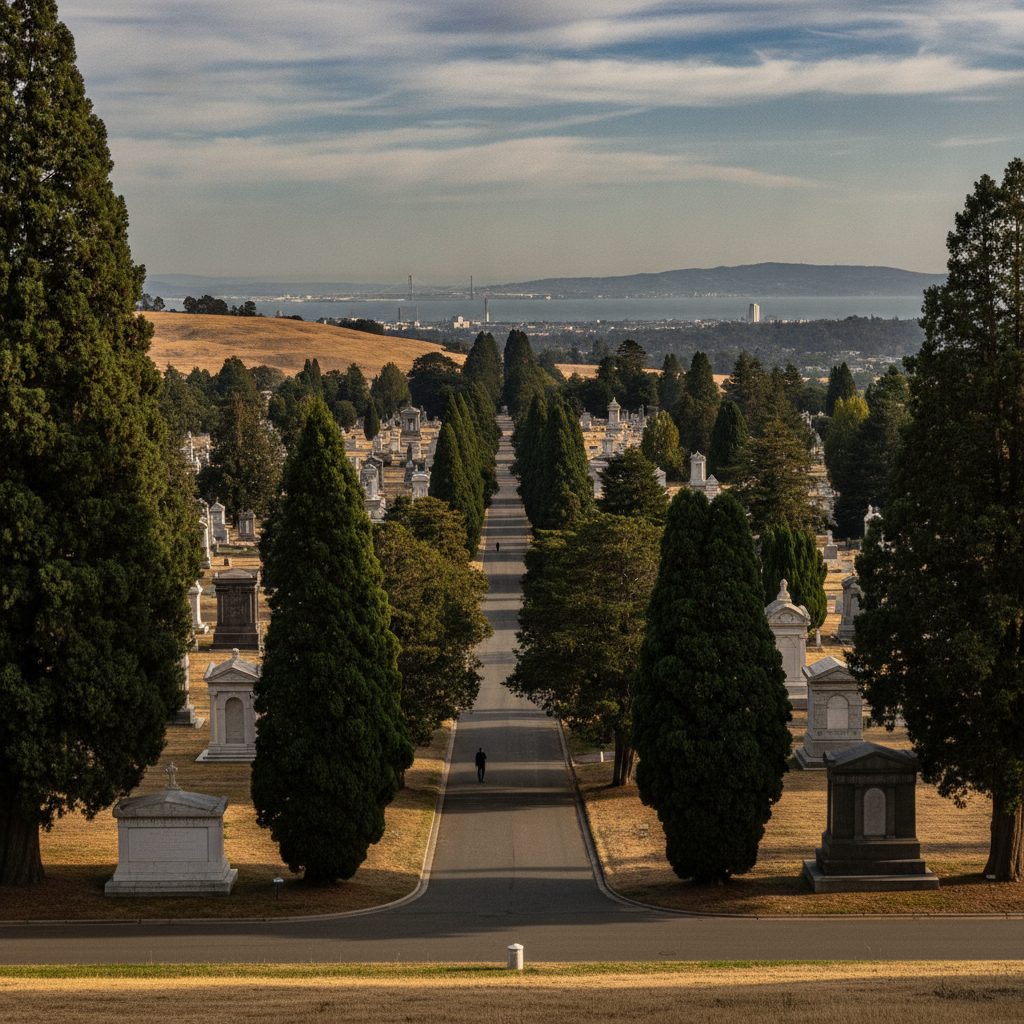
Why the landscape feels like a park
Mountain View’s park-like character is not accidental. According to the National Park Service, prominent Oakland citizens began organizing the cemetery in 1863 and asked Frederick Law Olmsted to design the hillside property. He produced his initial plan in 1864, his first work in California.Olmsted is best known for New York’s Central Park, but the Oakland site gave him a very different climate and terrain. The original property covered 209 acres. Rather than forcing a rigid grid across the hills, his plan used curving uphill paths, plants suited to dry conditions and trees that could shape views while offering protection from wind. The cemetery later expanded beyond 226 acres.That design explains the experience residents notice today: the road bends with the topography, the view appears in stages, and the planting frames rather than hides the Bay. The beauty is intentional, but it was created for remembrance and contemplation—not as an ordinary municipal recreation space.An Oakland history told through landscape and memorials
The cemetery was dedicated in 1865, when Oakland was still a young and rapidly growing city. KQED’s October 29 report explains that older burial grounds near downtown had filled and that civic leaders wanted a new location outside the built-up city of the time.The memorials now hold many layers of California history. KQED documented the monumental architecture along what is often called Millionaire’s Row, including the Ghirardelli family’s Egyptian Revival mausoleum, Samuel Merritt’s large memorial and Charles Crocker’s temple-like monument. Those structures are visually striking, but they are only one part of the story. The grounds also hold generations of Oakland families from very different backgrounds and circumstances.That is why I would not treat the cemetery simply as an architectural backdrop. It is a historical landscape, but every marker also represents a person and a family.What to confirm before you go
Mountain View Cemetery is at 5000 Piedmont Avenue in Oakland. Its current locations, hours and directions page lists recreational visits on Wednesdays, Saturdays and Sundays and requires visitors to sign in at the gate.The cemetery’s public recreation rules provide more detail. They direct recreational visitors to enter through the Piedmont Avenue gate, stay on paved roads and paths, and follow the posted dog rules. Those rules currently limit visitors to two dogs per person or family, require leashes no longer than eight feet, and prohibit dogs from plots and indoor areas.The two official visitor pages display different grounds hours, so I would not rely on a map app or an old social post for the closing time. Check the cemetery’s current website on the day of your visit and follow the gate staff’s instructions.- Choose a designated recreation day: Wednesday, Saturday or Sunday.
- Enter at the Piedmont Avenue gate and sign in.
- Stay on paved roads and paths rather than walking across plots.
- Give funeral services and individual mourners generous space.
- Keep dogs leashed, clean up after them and follow every posted restriction.
- Check the current official hours before leaving home.