
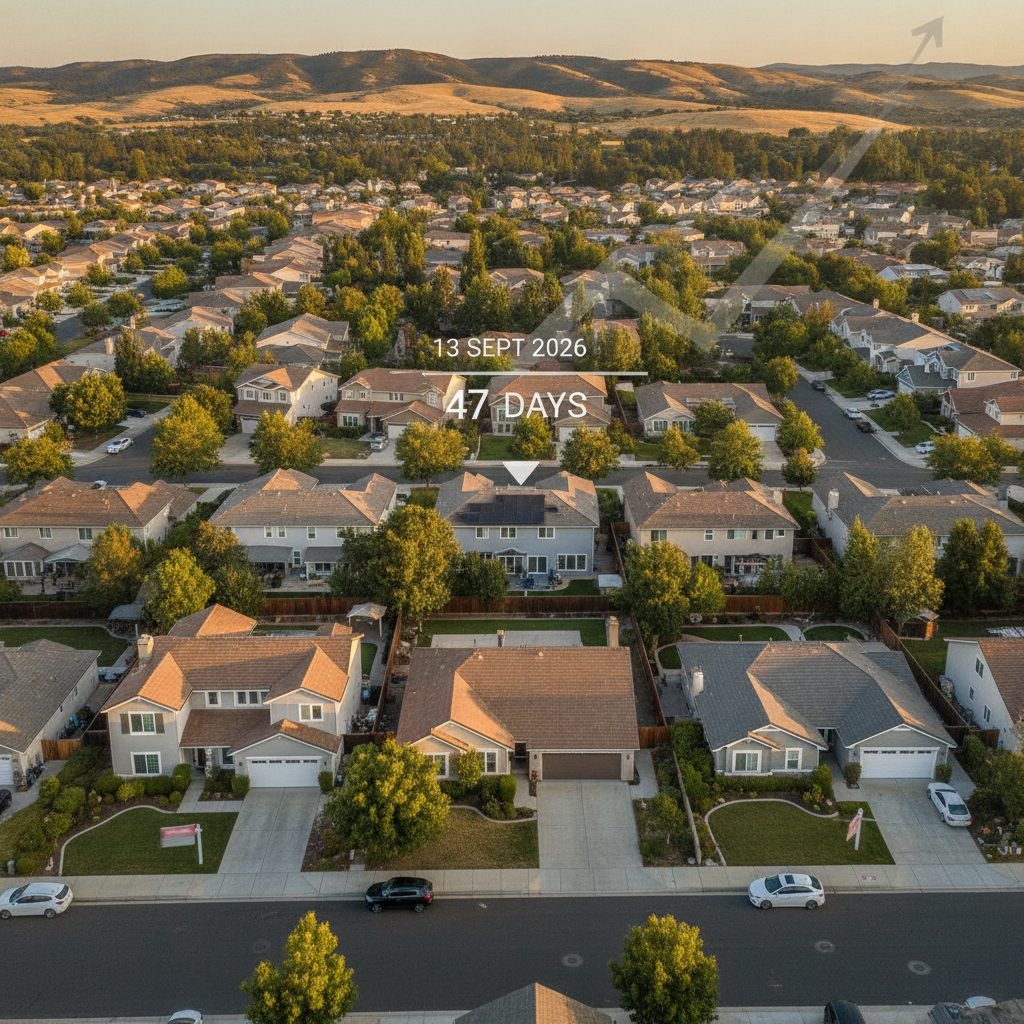
Twelve weeks ending September 13, 2026: median days on market across the Roseville territory fell to 47 days, down from 54 days a year earlier, with the biggest ZIP market leading the shift.
If you've owned your place in Roseville for a while and you're wondering whether a listing today would just sit there, the short answer is: less than it used to.
Across the whole Roseville territory, homes that sold in the twelve weeks ending September 13, 2026 spent a median of 47 days on the market. A year earlier, over the same stretch of the calendar, that number was 54 days. That's not a rounding blip. The gap held up under statistical testing, which means it's a real shift in how long a typical sale is taking, not noise from a handful of unusual deals.
The clearest version of that story shows up in the largest of the three Roseville ZIP markets, the one covering the western part of the territory. There, median days on market fell to 49 days this period, down from 59 days the same period a year earlier, on a sample of 323 sales. That's a big enough pool of sales that the pattern is hard to argue with, and it moved in the same direction as the territory overall.
The other two Roseville ZIP markets tell a smaller version of the same picture without carrying their own confirmed year-over-year read. One of them posted a median of 42 days on the market for homes that sold this period. The other also posted a median of 42 days on the market for homes that sold this period. Both are faster than the territory's overall 47-day median, though neither has the same statistical backing on the year-over-year comparison that the largest market does.
Here's the part that keeps this from being a simple "everything is speeding up" story. Homes sold were actually up 12% in one of the smaller ZIP markets compared with a year earlier, even as days on market there sat well below the territory median. Meanwhile the other two Roseville markets saw homes sold dip slightly, down roughly 1% in one and down roughly 4% in the other. So the volume of sales didn't move the same way in every corner of Roseville, even while speed improved almost everywhere. Faster sales and fewer sales can happen in the same market at the same time, and that's exactly what's playing out here.
What does 47 days instead of 54 actually feel like for someone with a house to sell? It's roughly a week less of showings, a week less of keeping the place tidy for last-minute walkthroughs, a week less of wondering if the phone is going to ring. It's not a dramatic change. It's the difference between a listing that drags into a second month and one that mostly wraps up inside the first.
For a seller, that's a genuinely good sign. A shorter typical time on market usually means less carrying cost, less stress, and less second-guessing your list price. It doesn't mean every home moves fast. It means the middle of the pack moved faster than it did a year ago, and that middle is where most homes actually sit.
For a buyer, the same numbers are a nudge to move with a bit more intention. If homes are leaving the market sooner than they were last year, waiting to make a decision costs more than it used to. That doesn't mean rushing into an offer. It means being ready when the right one shows up.
What would change this read going forward is simple: watch whether the days-on-market number keeps falling, holds steady, or starts drifting back up in the coming months. One good twelve-week stretch is a real data point. Two or three in a row is a trend worth planning around.
If you've been sitting on the sidelines wondering what your home would actually list for in this kind of market, that's a fair question to have answered before you decide anything. A current home value estimate can give you a real number to start from, no obligation attached.