
Why the $600,000 threshold commands the strongest competition
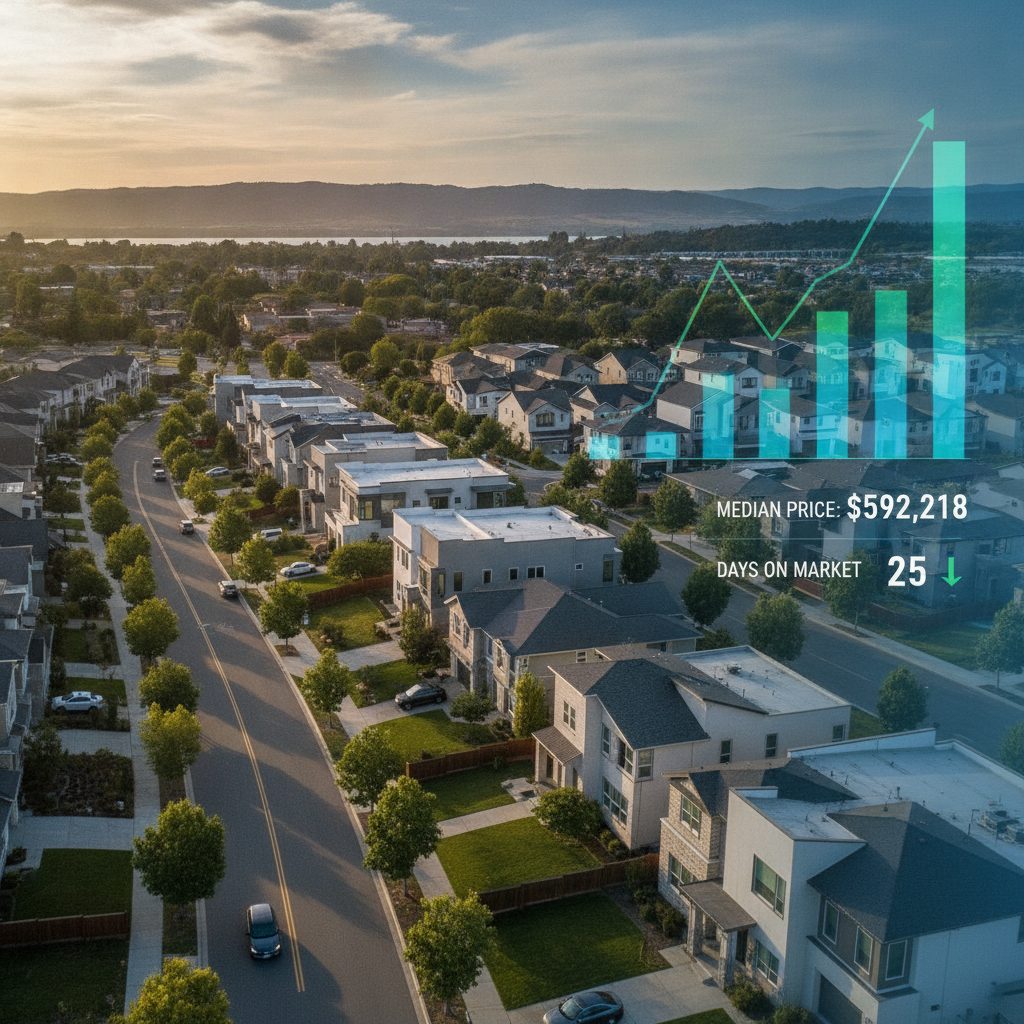
Antioch occupies a specific economic slot along the Highway 4 corridor that neighboring East Contra Costa towns do not mirror. When buyers look east toward Brentwood, entry-level detached single-family homes routinely trade closer to $750,000 or higher, often weighted with substantial Mello-Roos community facility district fees. Westward in Concord or Walnut Creek, finding a detached property with a two-car garage under $800,000 is virtually impossible. Antioch serves as the regional bridge where buyers can still secure functional, three- and four-bedroom detached houses under the $600,000 benchmark.Because the median sold price of $592,218 sits just beneath that psychological line, buyer activity concentrates aggressively around properties listed between $525,000 and $585,000. When a home in an established pocket like Mira Vista or near Contra Loma Regional Park hits the market at $540,000 in clean condition, it frequently pulls multiple offers within its first ten days. Buyers qualified with conventional and FHA financing have sharp payment caps tied to prevailing interest rates. They can stretch by $15,000 to $25,000 to win a home, which explains why 61.1 percent of homes closed above list price in September. Moving past the $650,000 mark in Antioch, however, shrinks that buyer pool dramatically. Once listings cross $700,000, they compete head-to-head with newer Brentwood construction, where buyers often decide they prefer newer infrastructure despite higher tax bills.How Highway 4 and the BART extension split buyer demand
Commute patterns dictate property values in Antioch more sharply than in interior Bay Area suburbs. The Antioch eBART station at Hillcrest Avenue reshaped transit reliability when it opened, but its practical influence drops off quickly as you move south toward Deer Valley Road. Commuters working in San Francisco, Oakland, or the Walnut Creek business centers will pay a direct premium for proximity to the Hillcrest corridor or quick access to Somersville Road and A Street on-ramps.Properties located north of Highway 4, including the historical pockets near the San Joaquin riverfront, carry far lower square-footage pricing than south-of-the-freeway subdivisions. A 1,400-square-foot home built in the 1950s near G Street may trade around $475,000, offering substantial lot sizes but requiring older-system maintenance and lacking homeowner association amenities. Contrast that with properties in Prewett Ranch or near Dallas Ranch Road, built primarily during the 1990s and early 2000s. There, similar square footage commands well over the $590,000 mark because buyers gain modern copper plumbing, dual-pane vinyl windows, and direct vehicle routing down Lone Tree Way toward commercial centers like Slatten Ranch.If you are balancing commute trade-offs as a buyer, prioritize access over cosmetic finishes. A house ten minutes closer to the Hillcrest BART station saves roughly 50 hours of gridlock each year along Highway 4 through Pittsburg, where morning slowdowns routinely choke traffic before Railroad Avenue.Contract structure matters more than listing price
With 25 median days on market and the average home selling for 101.7 percent of list, sellers frequently make the mistake of overestimating their leverage during negotiations. An accepted offer that sits 2 percent over asking can unravel quickly if the appraisal returns at the original list price. In Contra Costa County, the standard purchase contract defaults to an appraisal contingency unless expressly waived, and buyers using 5 percent down payments rarely have the cash reserves to bridge a $20,000 valuation gap out of pocket.The cleanest sales in Antioch right now involve sellers who secure partial appraisal gap coverage during counteroffers rather than pushing for an extra $5,000 in top-line price. When evaluating offers, look closely at financing terms: a buyer offering $605,000 on a $589,000 list price with an agreement to cover up to $10,000 in appraisal discrepancy represents a far safer closing than a buyer offering $620,000 with a standard appraisal contingency and minimal earnest money deposit.Practical seller-tips for navigating local transfer taxes and disclosures
Preparing a property for sale in Antioch requires an understanding of municipal requirements that differ from nearby cities. Contra Costa County charges a documentary transfer tax rate of $1.10 per $1,000 of property value, and unlike cities such as Richmond, Antioch does not impose an additional municipal real property transfer tax. This keeps standard seller closing costs comparatively predictable. However, property inspections present other localized hurdles.The clay soil prevalent across Antioch, especially stretching from the foothills of Black Diamond Mines Regional Preserve downward toward Wilbur Avenue, moves considerably between wet winters and dry summers. Foundation settling and hairline exterior stucco cracking are common discussion points on property disclosures. Smart sellers address these structural realities upfront rather than waiting for buyer inspections to raise red flags.- Order a pest and dry-rot inspection before listing, focusing on roof eaves, fascia boards, and exterior patio structures exposed to intense summer heat.
- Obtain a private sewer lateral camera inspection to confirm line integrity out to the municipal connection under the street, which prevents costly escrow holdbacks.
- Compile documentation for any permitted improvements, such as solar installations or HVAC upgrades, including current utility true-up statements for prospective buyers.
- Clear city code compliance inquiries early, ensuring unpermitted garage conversions or side-yard sheds are addressed prior to opening escrow.