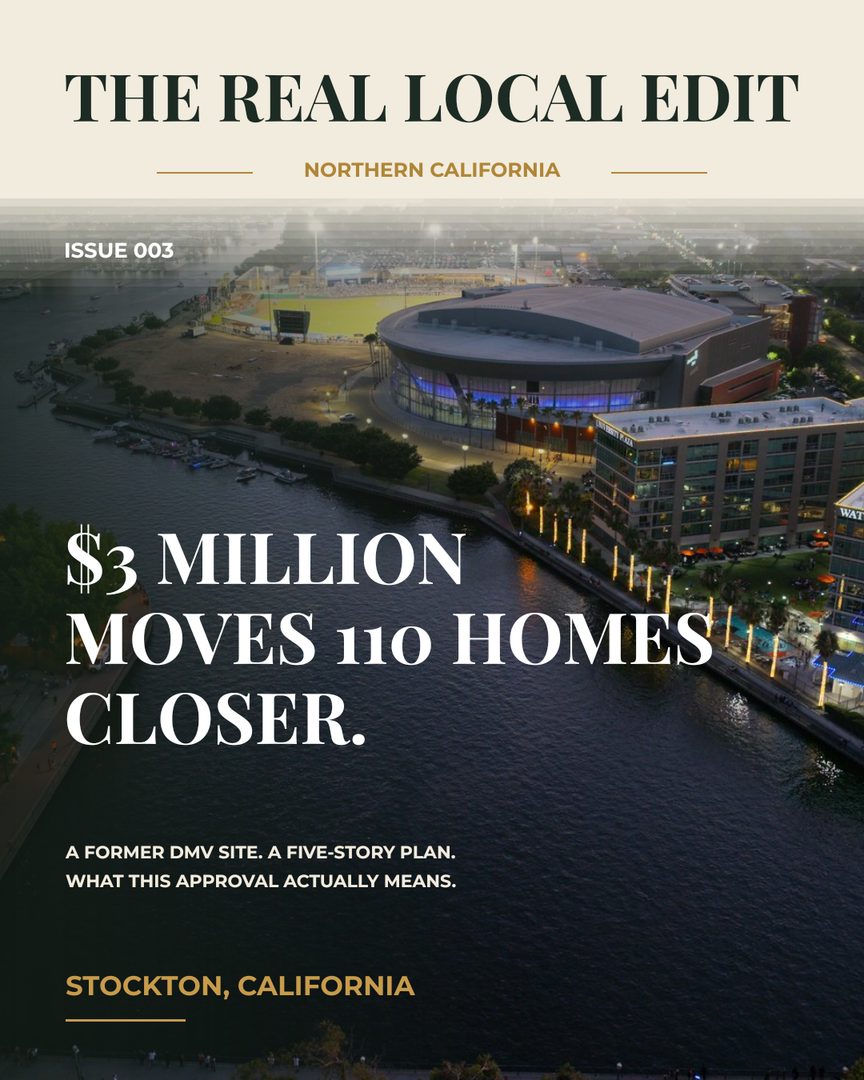
Stockton Just Moved 110 Homes Closer to Reality. Here’s Why That Matters.In order to understand a housing market, you have to look beyond what is currently listed for sale.It also means paying attention to what a city is building, where investment is going and how neighborhoods are changing.After a $3 million local loan commitment was approved for The Don Shalvey Apartments, I wanted to look past the funding headline and explain what this proposal could actually mean for Stockton.This is Issue No. 003 of The REAL Local Edit.
The $3 Million Is a Milestone, Not the Entire Project
Visionary Home Builders secured a $3 million construction and permanent loan commitment from the San Joaquin Regional Housing Fund for The Don Shalvey Apartments.The commitment was approved on August 24, 2026.That is meaningful progress, but it does not mean construction begins tomorrow.The full development plan is estimated at $86.8 million. The remaining financing is expected to include low-income housing tax-credit equity, tax-exempt bonds and other public and private funding.In other words, the $3 million matters because it helps move the project forward. It is still only one piece of a much larger financing plan.The remaining entitlements and financing have to come together before construction can begin. A groundbreaking date and completion date have not been announced.The local money is committed. The project is not finished being funded.
What Is Actually Being Planned
The Don Shalvey Apartments are proposed for a 1.46-acre former State of California DMV parcel at North American Avenue and Park Street.The plans call for a five-story building with parking, commercial and community-serving space on the ground floor and four residential floors above it.The project would include 110 total apartments.Sixty-eight would have two bedrooms and 42 would have three. Two apartments would be reserved for on-site managers, leaving 108 income-restricted homes.The plans also include 92 parking spaces.This is not a studio-heavy building designed around the smallest possible units. Every apartment would have either two or three bedrooms.That detail matters because it makes the development more relevant to families who need affordable housing without giving up the space required for children, multigenerational households or working from home.
Who the Homes Would Serve
The 108 income-restricted apartments would be divided across five income levels.Twenty-nine homes would serve households earning up to 30 percent of the area median income. Another 24 would serve households at 40 percent, 14 at 50 percent, 28 at 60 percent and 13 at 80 percent.Area median income, usually shortened to AMI, is an eligibility benchmark. It is not one fixed rent amount.The actual income limits depend on household size and the official program limits in effect when leasing begins.That distinction is important. Affordable housing is not one category serving one type of household. The income bands are designed to reach people with very different financial realities.
Why the Bedroom Mix Matters
As a REALTOR®, I spend a lot of time talking about homeownership. But the health of a housing market is not measured only by the number of homes available to purchase.People need housing at every stage of life.Some households are preparing to buy. Some are rebuilding financially. Some need to remain close to work, school or family. Others may simply need a stable rental with enough room for the people they already support.Adding 108 income-restricted apartments will not solve Stockton’s housing shortage by itself. But adding family-sized homes creates options that are often much harder to find than studios and one-bedroom apartments.Housing supply works as a system. When one part of that system is missing, the pressure does not disappear. It simply moves somewhere else.
This Is More Than an Apartment Building
The plans go beyond housing.The ground floor is expected to include a 2,000-square-foot Head Start classroom, a 1,500-square-foot teen center, a 1,500-square-foot community center and a 1,000-square-foot leasing office.Another 6,500 square feet is planned for community and commercial use.That means early-childhood education, youth programming, community services and neighborhood activity could be built into the same place where families live.That kind of planning matters because daily life is shaped by more than the walls of a home.It is shaped by what families can reach, where children can learn, where young people can spend time and whether a neighborhood gives residents reasons to participate in it.
Why This Site Matters
The project is planned for a former state DMV parcel that has been vacant for years.No occupied homes have to be demolished. No current residents have to be displaced to make room for the development.Stockton could gain housing and neighborhood-serving space on land that is currently providing neither.That does not eliminate every question about the project. Traffic, parking, financing and the construction timeline still matter.But there is a meaningful difference between replacing occupied housing and putting a long-vacant public parcel back into use.This proposal is an example of infill development, which means adding housing within an existing part of the city instead of continuing to push growth farther outward.Done well, infill can make better use of existing streets, services and public investment while bringing new activity to an underused site.
What This Means for Homebuyers
Let’s be clear about what this project does not do.It does not create homes for sale. It will not lower mortgage payments. And 110 apartments will not change Stockton’s home prices by themselves.So why should a buyer pay attention?Because buying a home also means buying into the direction of a neighborhood and a city.New housing, public investment, community services and commercial activity can influence how an area functions over time. They can affect where people live, how they move through a neighborhood and what resources are available nearby.None of that guarantees higher property values. A proposed development should never be sold to a buyer as promised appreciation.But it is still information worth considering.A listing tells you what you can buy today. A city’s development pipeline helps you understand what may surround that home tomorrow.Buyers should know which projects are proposed, which have received funding, which are under construction and which are still years away from becoming real.That context is part of making an informed decision.
The Real Take
This story does not matter because Stockton issued another housing press release.It matters because a long-vacant public parcel may finally become family-sized housing, education, youth programming and community space.It also matters because there is still a long distance between a funding commitment and a finished building.As a REALTOR®, my job is not to treat every announcement like guaranteed growth. It is to help people understand what is real, what is proposed and what still has to happen.The $3 million commitment is real.The 110 homes are still proposed.The next meaningful milestones will be the remaining financing, finalized entitlements and an announced groundbreaking date.The announcement puts this project on the radar.What happens next will determine whether it becomes part of Stockton’s future.