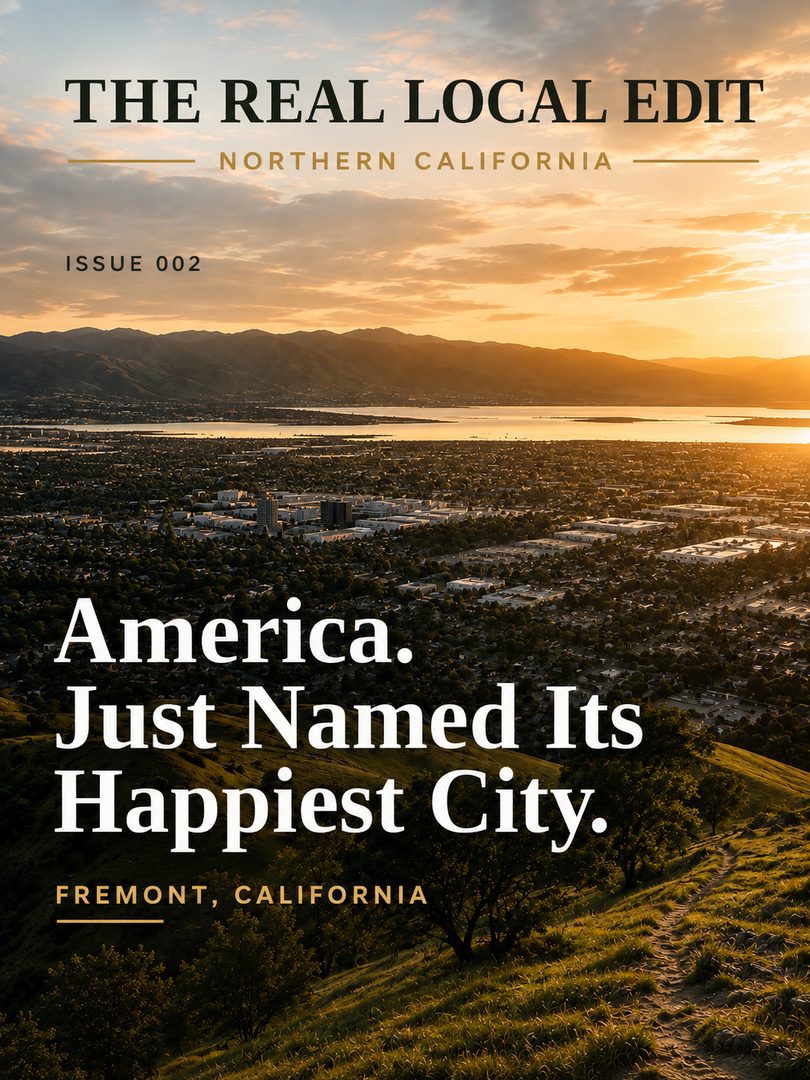
America’s Happiest City Is in the Bay Area. Again.
Fremont was just named the happiest city in America for the seventh year in a row. But if you’re thinking about actually living there, the headline only tells part of the story.
Fremont has once again been named the happiest city in the country, extending a streak that has now lasted seven consecutive years.For anyone familiar with the Bay Area, the recognition probably isn’t that surprising. Fremont has long combined strong schools, access to major employment centers, established neighborhoods, outdoor space and relatively high household incomes.But there’s something the national rankings tend to miss.Fremont isn’t really one housing market.It’s a city built from five original towns: Mission San Jose, Warm Springs, Irvington, Centerville and Niles. Fremont was incorporated in 1956 when those communities came together, but decades later, their individual identities are still very much intact.And so are the differences in their housing markets.
Five neighborhoods, very different price points
Mission San Jose sits at the upper end of Fremont’s market, with homes often approaching or exceeding the $2 million mark. Its highly regarded schools are a major driver of demand, and buyers routinely pay a significant premium to live within the area.Warm Springs and Irvington generally occupy the next tier, where homes can range roughly from $1.3 million to $1.8 million depending on property type, size and exact location.Both offer something particularly valuable to Bay Area commuters: access.Warm Springs has its own BART station and sits near the southern end of Fremont, making it especially appealing to buyers commuting toward Silicon Valley. Irvington offers a more central Fremont location while keeping residents connected to the broader Bay Area.Then there are Centerville and Niles.These areas can offer a lower entry point into Fremont compared with Mission San Jose, while also having some of the city's strongest neighborhood character.Niles, in particular, feels distinctly different from much of Fremont. Its historic commercial district, older homes and connection to the early film industry give it an identity that is difficult to replicate in newer Bay Area communities.Centerville has its own history as one of Fremont’s original towns and offers a mix of older neighborhoods, established homes and newer development.
Why the citywide median doesn’t tell you enough
This is where looking at Fremont through a single median home price becomes misleading.A buyer searching in Mission San Jose isn't necessarily shopping in the same market as someone considering Centerville. Their budgets may be different. Their priorities may be different. Even the types of homes and neighborhoods they encounter can be different.One buyer may be willing to stretch their budget for a particular school district.Another may prioritize BART access.Someone else may care more about getting additional square footage, finding an older home with character or simply getting into Fremont at a more manageable price point.All of those buyers can say they're looking for a home in Fremont while effectively conducting completely different home searches.
So, does being America’s happiest city matter?
Rankings are fun, and seven consecutive years at the top is certainly notable.But happiness isn't something you purchase with a Fremont ZIP code.What the ranking does highlight is why Fremont continues to attract buyers despite some of the highest housing costs in the country. People aren't simply paying for the house itself. They're weighing schools, commute options, neighborhood stability, access to jobs, amenities and the broader quality of life they believe they'll have there.That calculus looks different from one part of Fremont to another.So if Fremont is on your list, the better question isn't simply whether you can afford Fremont.It’s which Fremont actually fits the life you’re trying to build.