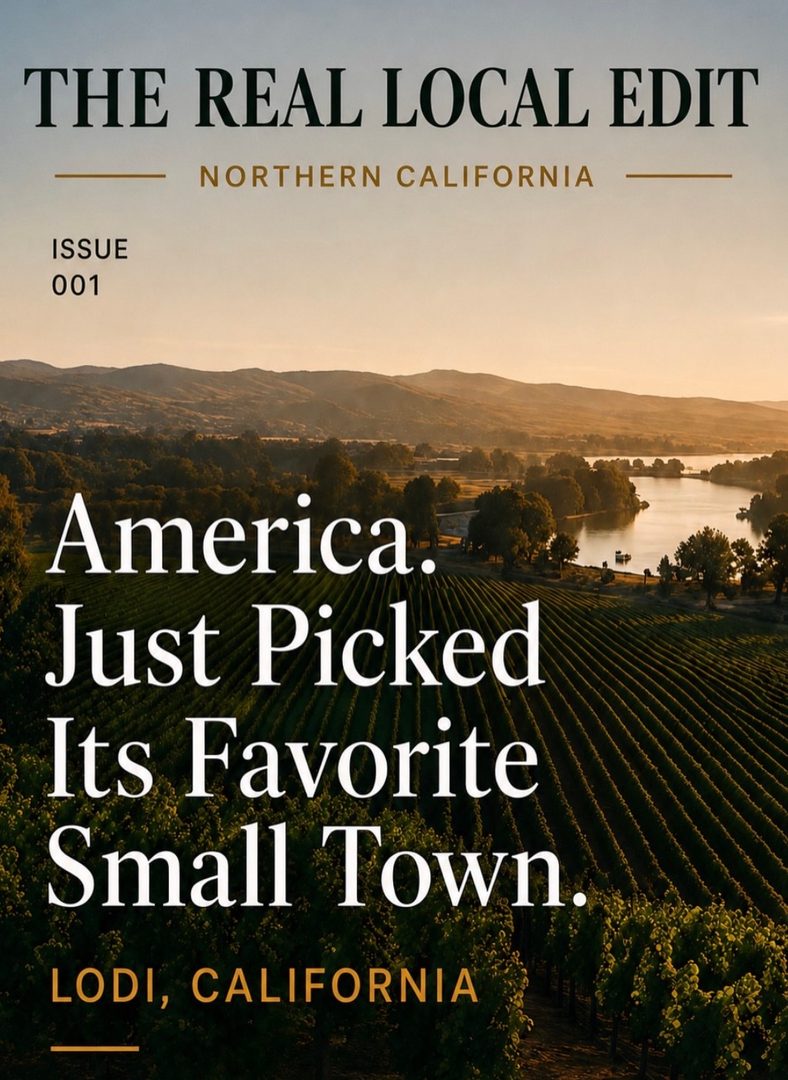
Lodi Was Named America’s Favorite Small Town. Here’s Why That Actually Makes Sense.I’ve always believed choosing where you live is about more than just the house.It’s about the community, the lifestyle, and how a place makes you feel.After Lodi was named America’s Favorite Small Town of 2026, I wanted to give you a closer look at what makes it stand out.This is Issue No. 001 of The REAL Local Edit.
This Wasn’t Just Another Best of List
Lodi competed against hundreds of communities across the country before being named the national winner of Parade and Steller’s America’s Favorite Small Towns competition.The title was decided through public voting, and honestly, that may say more about Lodi than the title itself.People showed up for their city.Residents voted. Local businesses shared it. The community rallied around the idea that Lodi deserved to be recognized.That kind of pride cannot be manufactured by a tourism campaign. It already has to exist.
Lodi Has an Actual Sense of Place
Some cities grow so quickly that they start to feel like a collection of new developments connected by the same chain restaurants.Lodi has managed to hold on to an identity.Downtown is centered around School Street, where locally owned restaurants, tasting rooms, boutiques and historic buildings create a district people actually spend time in. The Lodi Arch gives it a recognizable entrance, but what makes Downtown work is not the sign. It is the fact that the area still feels connected to the community around it.It is compact, walkable and active without feeling overly curated.Lodi is also thinking about what comes next. The city adopted a new Downtown Specific Plan in June 2026 focused on improving walkability, public spaces, housing opportunities and connections across the railroad corridor while protecting the character that already exists.Growth is coming. The real challenge will be allowing Lodi to evolve without sanding away everything that makes it feel like Lodi.
Wine Country Without the Performance
Lodi is known as the Zinfandel Capital of the World, but the wine culture here feels very different from what people usually picture when they hear “California wine country.”It is less formal. Less crowded. Less interested in proving something.The region has more than 85 wineries and grows more than 135 grape varieties, many of them connected to farming families who have worked this land for generations.You can visit a tasting room without planning the entire day around a reservation, and there is a good chance the person pouring your wine knows exactly where the grapes came from.That accessibility is part of what makes Lodi work. Wine is not a separate attraction built for visitors. It is tied to the land, the local economy and the families who have shaped the region.
But Lodi Is More Than Wine
The wineries get most of the attention, but they are not what daily life revolves around.Lodi Lake gives residents a place to walk, kayak, picnic or simply get outside without leaving town. Downtown hosts community events throughout the year. Established neighborhoods have mature trees, and local businesses still feel local.There is a slower rhythm here, but slower does not mean disconnected.Highway 99 provides a direct route toward Stockton and Sacramento, while Interstate 5 is close enough for people traveling throughout Northern California.Still, let’s be honest. Lodi is not going to make sense for everyone.If you want a major nightlife scene, endless new development or the energy of a larger city, it may feel too quiet. Summers are hot, and commuting toward the Bay Area every day would be a serious commitment.But if you want a city with local character, access to outdoor space and a community that still feels invested in itself, Lodi deserves a closer look.
What Living Here Actually Looks Like
Lodi is often described as one housing market, but the experience changes depending on where you are.Near Downtown, buyers can find Craftsman homes, cottages and older properties with details you will not get in newer construction. You may gain charm, mature landscaping and better walkability, but older homes can also come with older-home problems. Character is beautiful. Deferred maintenance is not.Other parts of Lodi offer established suburban neighborhoods, larger lots, lakefront properties and newer communities with more modern layouts.That is why looking at the city’s median home price only tells you so much.Someone who wants to walk to dinner and community events may be drawn toward Downtown. Someone prioritizing a newer home, more space or a quieter residential setting may prefer another part of the city entirely.The right question is not simply, “Do I want to live in Lodi?”It is, “Which version of Lodi fits the life I’m trying to build?”
Why Lodi Stands Out
Lodi did not become special because it won a national title.It won because the things people are looking for already exist here.A real downtown. Deep agricultural roots. Approachable wine country. Local businesses people genuinely support. Neighborhoods that feel established rather than manufactured.Lodi is growing, and that will bring both opportunity and change. But for now, it still offers something that has become harder to find in California: a place with its own identity that has not completely priced out the possibility of building a life there.The national recognition may be what puts Lodi on someone’s radar.The way the city feels is what could make them stay.