
For years, we've heard some version of the same Bay Area housing story:
People are leaving.
It's too expensive.
Buyers are moving inland.
The market has changed.
Some of that is true.
But then Alameda County gives us this number:
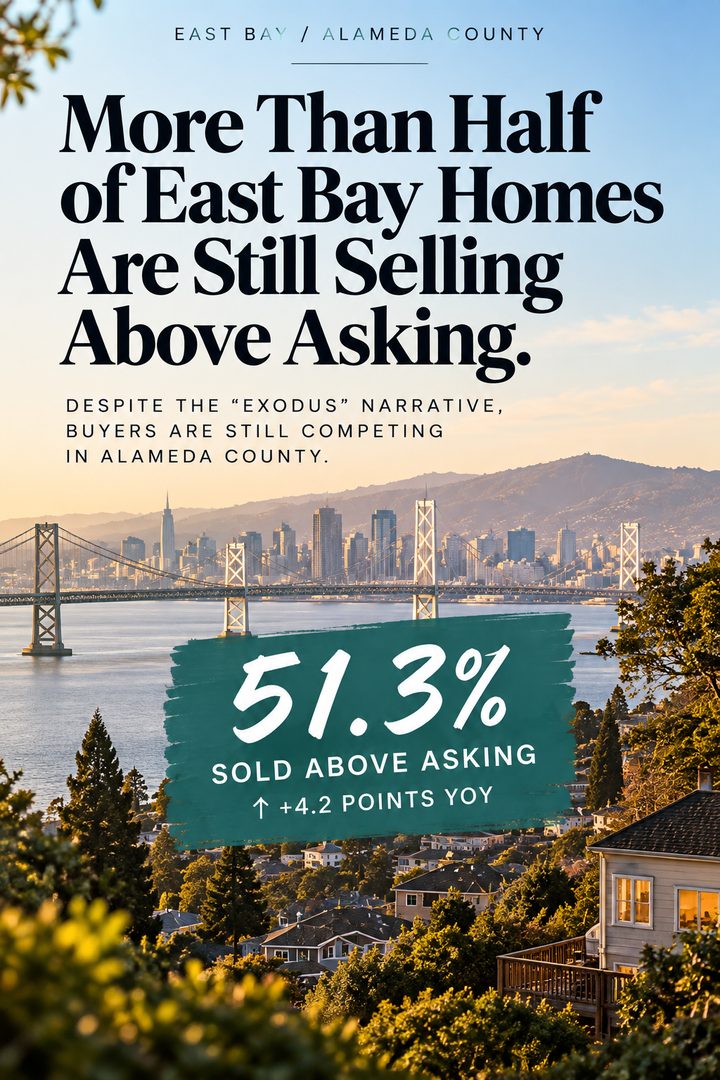
51.3% of homes sold above asking price.
More than half.
And that's actually up 4.2 percentage points from a year ago.
Apparently, somebody forgot to tell East Bay buyers they were supposed to stop competing.
The East Bay Is Still Moving
Across Alameda County, including Oakland, Hayward, Fremont and Union City, the median sale price is approximately $1.07 million.
That's up 4.1% year over year.
Homes are also moving faster than they were last year.
Median days on market dropped from 28 days to just 22 days.
And the sale-to-list ratio?
105.7%.
In other words, the typical closed sale is landing above its final asking price.
Meanwhile, only 15.6% of listings recorded a price reduction, down from last year.
Those aren't exactly the numbers you'd expect from a market where supposedly nobody wants to buy anymore.
The "Bay Area Exodus" Story Was Always More Complicated
Yes, people have left the Bay Area.
I've watched plenty of people look toward places like Stockton and the Central Valley because they want more house, more space or a different monthly payment.
But migration doesn't automatically mean demand disappears from the place people are leaving.
The East Bay still has major employment centers, established neighborhoods, transit connections and access to the broader Bay Area.
And there are still buyers willing to compete for the right property.
Both realities can exist at once.
Some households are leaving.
Other households are fighting over houses.
Housing markets are annoyingly capable of holding two thoughts at the same time.
Asking Price Doesn't Always Mean Market Value
This is especially important for buyers.
If more than half of homes are selling above asking, searching exclusively by your maximum budget can create problems.
A home listed at $950,000 isn't necessarily a $950,000 home.
Depending on the neighborhood, property and recent comparable sales, that asking price may have been intentionally positioned to generate competition.
That's why the question shouldn't only be:
"What's the list price?"
It should also be:
"What are comparable homes actually closing for?"
Those are not always the same number in the East Bay.
But Not Every House Is Getting Multiple Offers
This is where buyers shouldn't panic either.
A 51.3% over-asking rate also means plenty of homes aren't selling above asking.
Condition matters.
Location matters.
Pricing matters.
How long the property has been sitting matters.
The market isn't uniformly competitive across every neighborhood and every price point.
A beautifully prepared home in a desirable pocket of Fremont can behave very differently from an overpriced property sitting elsewhere in the county.
County-level numbers give us the direction of the market.
The individual property tells us how to approach the offer.
What Sellers Should Take From This
Strong market statistics aren't permission to overprice your house.
The East Bay is still producing competition, but buyers have access to more information than ever.
If comparable properties don't support the number, buyers notice.
The goal isn't necessarily to start with the highest possible asking price.
It's to position the property in a way that attracts the strongest response from the buyers currently in the market.
There is a difference.
The East Bay Didn't Stop Being Competitive
Mortgage rates are hovering around 6.8%.
Affordability remains difficult.
Some Bay Area households are absolutely choosing to relocate.
And yet:
51.3% of Alameda County homes are selling above asking.
Median prices are up.
Homes are selling faster.
Price reductions are down.
The East Bay housing story in 2026 isn't simply that people are leaving.
It's that even with higher borrowing costs and more households considering alternatives outside the Bay Area, competition for desirable homes hasn't gone away.
For anyone deciding between staying in the East Bay or moving farther inland, that's a much more useful starting point than another headline declaring the Bay Area dead.
"Market data reflects the latest figures available as of September 15, 2026. Alameda County figures are based on Redfin's three-month period ending August 2026. Mortgage-rate context is from Freddie Mac."