
What a Buyer Reads First on Your Rent Roll
A serious buyer (and their lender) will go through your rent roll line by line. Here's what they're really looking for:- **Unit mix.** How many bedrooms and baths per unit, parking, storage, in-unit laundry. A 2BR/1BA over a 2BR/1BA reads very differently from a 3BR flat over a garage studio.
- **Move-in dates and current rents.** This is how a buyer estimates the gap between what you collect today and what each unit could rent for on the open market. A long-term tenant paying well below market isn't a flaw, but it changes the math.
- **Rent increase history.** Buyers want to see that annual increases were actually taken, or whether there are banked increases still available. Under the Rent Ordinance, an owner who skips an annual increase can bank it and apply it later.
- **Your Rent Board compliance.** Here's one a lot of small-building owners miss! Since March 1, 2023, owners of buildings with 1–9 units need a rent increase license from the Rent Board before any annual or banked increase can take effect, and that license only comes from reporting your units into the Housing Inventory. No license on the effective date of the notice means the increase isn't enforceable. A savvy buyer will check.
- **Security deposits.** Buyers take over your deposits and the interest owed on them. For March 1, 2026 through February 28, 2027, the Rent Board's deposit interest rate is 4.2%.
- **Estoppel certificates.** Expect the buyer to ask your tenants to sign one. It's a short statement confirming each tenant's rent, deposit and lease terms in their own words. If the estoppels don't match your rent roll, deals get renegotiated (or fall apart), so make sure your records are tight before we go to market.
Rent Control and the Buyer's Math
Most of the classic 2–4 unit buildings I sell here are Edwardians and Victorians split into flats, which means most of them are rent controlled. In San Francisco, many units in buildings built on or before June 13, 1979 have both rent control and just-cause eviction protection. That one date shapes almost every offer you'll get.Here's how it plays out:- **Rents grow slowly while tenants stay.** For rent-controlled units, the annual allowable increase is 1.6% for March 1, 2026 through February 28, 2027 (it was 1.4% the year before). A buyer can't count on much more than that from a sitting tenant.
- **Rents reset when a unit turns over.** Under the state's Costa-Hawkins Act, when the last original tenant moves out, the owner can set a new rent at market. So buyers look hard at *when* each unit might realistically turn over.
- **Your property tax isn't their property tax.** This is the one that surprises owners most! If you've owned for 20 years, Prop 13 has kept your tax bill low. A buyer gets reassessed at their purchase price, at roughly 1.18% in San Francisco. On a $2.5M purchase, that's about $29,600 a year. If your bill today is $6,000, the buyer's net income is already about $23,600 lower than yours before anything else changes.
Vacant or Occupied? Who Your Buyer Will Be
One of the biggest questions in any multifamily sale: will any unit be vacant when the building hits the market?It matters because it decides *who* can buy your building.- **Fully occupied buildings sell to investors.** They price off the income, the expenses and the upside. They're analytical, they're patient, and they'll underwrite every line we talked about above.
- **A building with a vacant unit opens the door to owner-occupants.** Think of the buyer who wants to live in one flat and rent the others, using owner-occupant financing that investors can't get. (I wrote about why that's such a smart move in The Benefits of Investing in a Duplex in San Francisco.) These buyers often compete harder, because they're buying a home *and* an investment at the same time.
Before We List: The Paperwork That Protects Your Price
The rent roll gets a buyer interested. These items keep them from renegotiating later.- **Your 3R report.** San Francisco law requires the seller to get a Report of Residential Building Record from the Department of Building Inspection and deliver it to the buyer before the sale. It shows the building's authorized use and permit history. The first thing a buyer checks is whether the 3R says "two-family dwelling" or "three-family dwelling" to match what you're selling. If that garage unit isn't on there, we need to talk about it *before* we go live, not in escrow. (The 3R costs $379 per residential building on the lot.)
- **Your Rent Board records.** Housing Inventory filings, rent increase license, any buyout agreements, past petitions. Buyers and their attorneys will look these up, so we should look first.
- **Your leases and estoppels.** Copies of every lease, plus any side agreements (parking, storage, pets, utilities). Whatever a tenant writes on their estoppel needs to match.
- **Your sewer lateral.** San Francisco sellers deal with this one constantly, and storm season makes it worse. Here's my take on why your sewer lateral matters for your sale.
- **Your transfer tax number.** San Francisco's transfer tax is customarily paid by the seller, and the rate applies to the *whole* price. Right now it's 0.75% from $1 million to $5 million, then jumps to 2.25% from $5 million to $10 million. On a $4.9M sale, that's about $36,750. On a $5.1M sale, it's about $114,750! If your building is anywhere near that line, we price with it in mind.
Where the Market Is Right Now (Q3 2026)
Good news for sellers: small San Francisco buildings are selling, and selling fast. In Q3 2026, 144 duplexes, triplexes and fourplexes closed in the city, and the median one sold after just 14 days on market.
Frequently Asked Questions
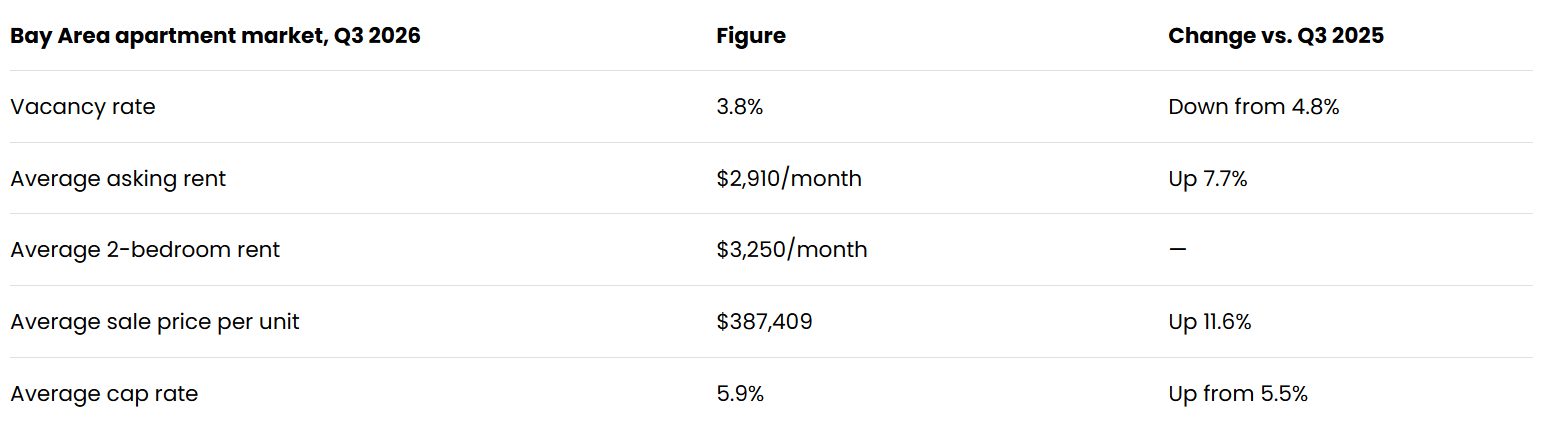
**Can I sell my San Francisco duplex or triplex with tenants in place?** Yes. Tenants' leases and rights stay in place after a sale, and the buyer takes over the tenancies. Expect the buyer to review your rent roll and leases and to ask tenants for signed estoppel certificates.**Does rent control lower my building's value?** It changes how buyers value it. Rent-controlled units can only go up by the annual allowable amount while tenants stay (1.6% for March 2026–February 2027), so buyers focus on today's income and when units might turn over. Below-market rents usually mean a lower price than a similar building with market rents.**Do I need a 3R report to sell a multifamily building in San Francisco?** Yes. San Francisco law requires the seller to get a Report of Residential Building Record from the Department of Building Inspection and give it to the buyer before the sale. It shows the building's authorized use and permit history.**What is a rent increase license, and why does a buyer care?** Since 2023, owners of small SF buildings must report their units to the Rent Board's Housing Inventory to get a rent increase license. Without one, annual and banked rent increases aren't enforceable, which a buyer will factor into the income.**What are cap rates for apartment buildings in the Bay Area right now?** The Bay Area multifamily average was 5.9% in Q3 2026, according to Kidder Mathews (CoStar data). Small San Francisco buildings vary widely by neighborhood, unit mix and vacancy.**Who pays San Francisco transfer tax when I sell?** In San Francisco, the seller customarily pays. The rate is 0.75% on sales from $1 million to $5 million and 2.25% from $5 million to $10 million, applied to the full price.Thinking About Selling Your Building?
*If you're planning to sell a 2–4 unit building in San Francisco, reach out to me directly. I know these buildings inside and out, from rent rolls and Rent Board records to permit history, and I'll help you get yours to market the right way and get it DONE. You can also learn more about how I work with San Francisco investors.**Cheers,* *Lisa Z***Sources**- SF Rent Board: Annual Rent Increase for 3/1/26–2/28/27 Announced
- SF Rent Board: Current Rates, Including Rent Increase, Relocation and Security Deposit Interest
- SF.gov: Learn About Rent Increases in San Francisco
- SF.gov: The Rent Board Housing Inventory
- SF.gov: Learn About San Francisco Rental Laws
- SF Rent Board: Pre-Buyout Negotiations Disclosure Form (Section 37.9E)
- SF Department of Building Inspection: Request a Report of Residential Building Record (3R Report)
- California Apartment Association: Residents' Certification of Terms (Estoppel Certification)
- Greenberg Traurig: San Francisco's BUILD Act and Current Transfer Tax Rates (March 2026)
- The Property Tax Almanac: Property Tax in San Francisco County, 2026
- Kidder Mathews: Bay Area Multifamily Market Report, Q3 2026