
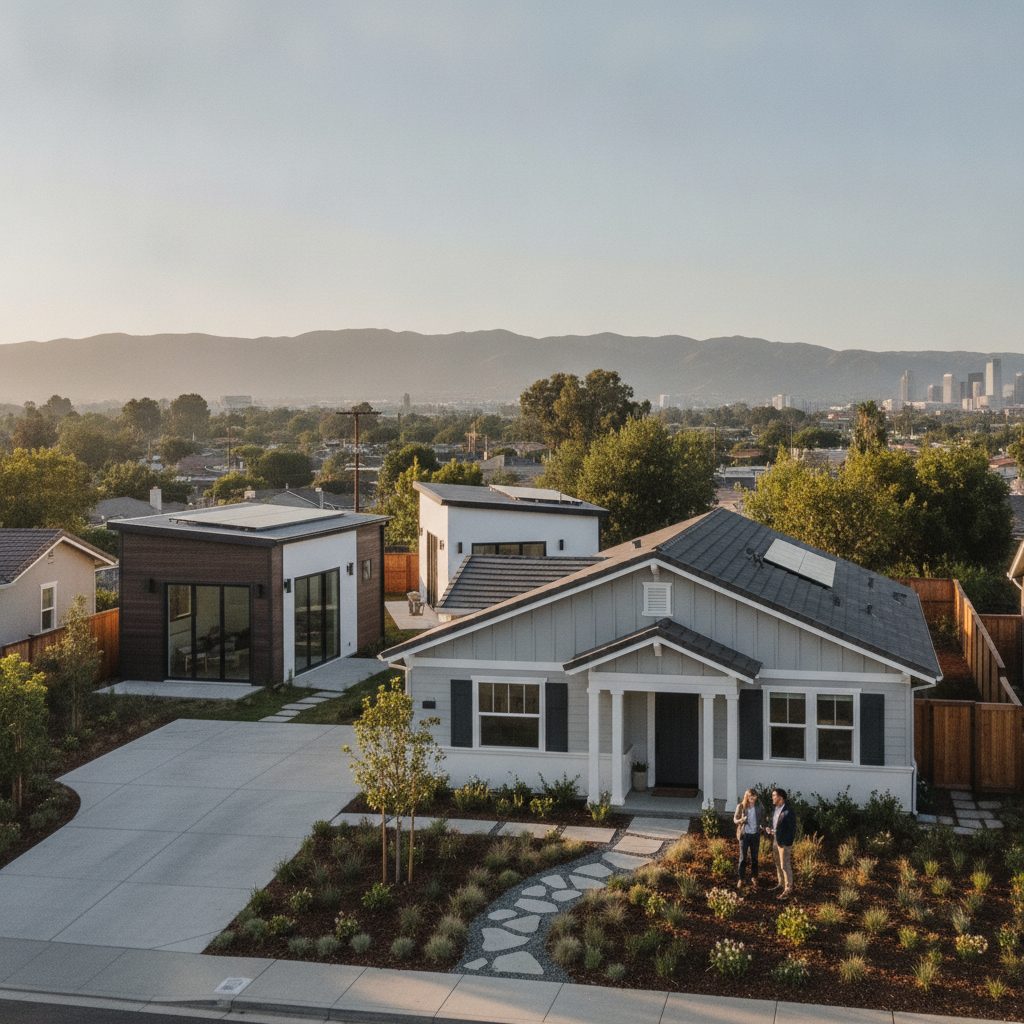
What AB 956 changes
Under current state law, a city has to give "ministerial" approval (a yes based on set rules, with no hearing) to one detached, new-construction ADU on a single-family lot. AB 956 raises that number to two.The bill text lets a city put a few conditions on each of those detached units:- Up to 800 square feet of livable space
- The state's height limits for ADUs
- Side and rear setbacks of no more than 4 feet
- One converted ADU, one JADU, and one detached ADU, or
- One converted ADU and two detached ADUs
What SB 1117 changes about fees
ADUs of 750 square feet or less already pay no impact fees under state law. For larger ADUs, cities could charge a share of the fee based on the ADU's full size compared with the main house.SB 1117 changes that math for lots with up to two ADUs. The fee is now based only on the square footage above 750.Best Best & Krieger gives this illustration: if the impact fee for a 2,000-square-foot house is $20,000, a 1,000-square-foot ADU would have owed $10,000 under the old formula. Under SB 1117 it would owe $2,500, because only the extra 250 square feet counts. That is an example, not a quote for any San José or Milpitas project.Two limits to know:- The new math only applies when a lot has two ADUs or fewer. With three ADUs (for example, a garage conversion plus two detached units), fees on any ADU over 750 square feet go back to the old full-size formula.
- "Impact fees" in the bill do not include utility connection fees or capacity charges. Those follow separate rules.
What it means in San José and Milpitas
Both cities already run pre-approved ADU plan programs. San José says its Preapproved ADUs program can issue a permit the same day as the plan review meeting when the site documents are complete and the lot meets its criteria, including having an existing single-family home or duplex and not sitting in a geohazard, landslide, flood or wildland-urban interface zone. Several of the plans on the city's list are under 750 square feet. Milpitas describes its own pre-approved program on its ADU page.What isn't known yet: how each city will update its ADU ordinance, fee schedule and pre-approved plan rules for January. Best Best & Krieger notes that cities whose ADU rules don't match state law still have to follow state law starting January 1. I could not find a San José or Milpitas announcement about this yet. It's also not clear how applications filed before January 1 will be handled, so ask the city before you submit.Don't forget property taxes
A new ADU adds to your property tax bill. The Santa Clara County Assessor says new ADU construction is assessed at market value as of the date it's finished, or as of January 1 if it's only partly built by then. Only the new part gets a new base value, not the whole property. A CPA can help estimate the effect on your bill.If you're buying
Backyard depth, side access and utility lines can decide whether two detached units would fit. A listing description doesn't settle that; the city's permit center can.What you can check yourself
- Read AB 956 and SB 1117 on the state's legislative site.
- Look up your address on Sjpermits.org (San José) to see whether it's in a geohazard, flood or wildland-urban interface zone.
- Ask San José's ADU Ally team or the Milpitas Office of Building Safety when their updated ADU rules and fees take effect.
- Ask whether each fee is an impact fee or a utility connection charge.
- Ask the county assessor or a CPA how a new ADU may change your tax bill.
Linh Tran
REALTOR®
Area served: San Jose, Santa Clara County, CA, Milpitas, Santa Clara County, CA, Fremont, Alameda County, CA, Newark, Alameda County, CA, Santa Clara, CA, Cupertino, Santa Clara County, CA
Expertise: FHA Financing, First-Generation, Fix-and-Flip Investor, First-Time Buyer, Tech Relocation