
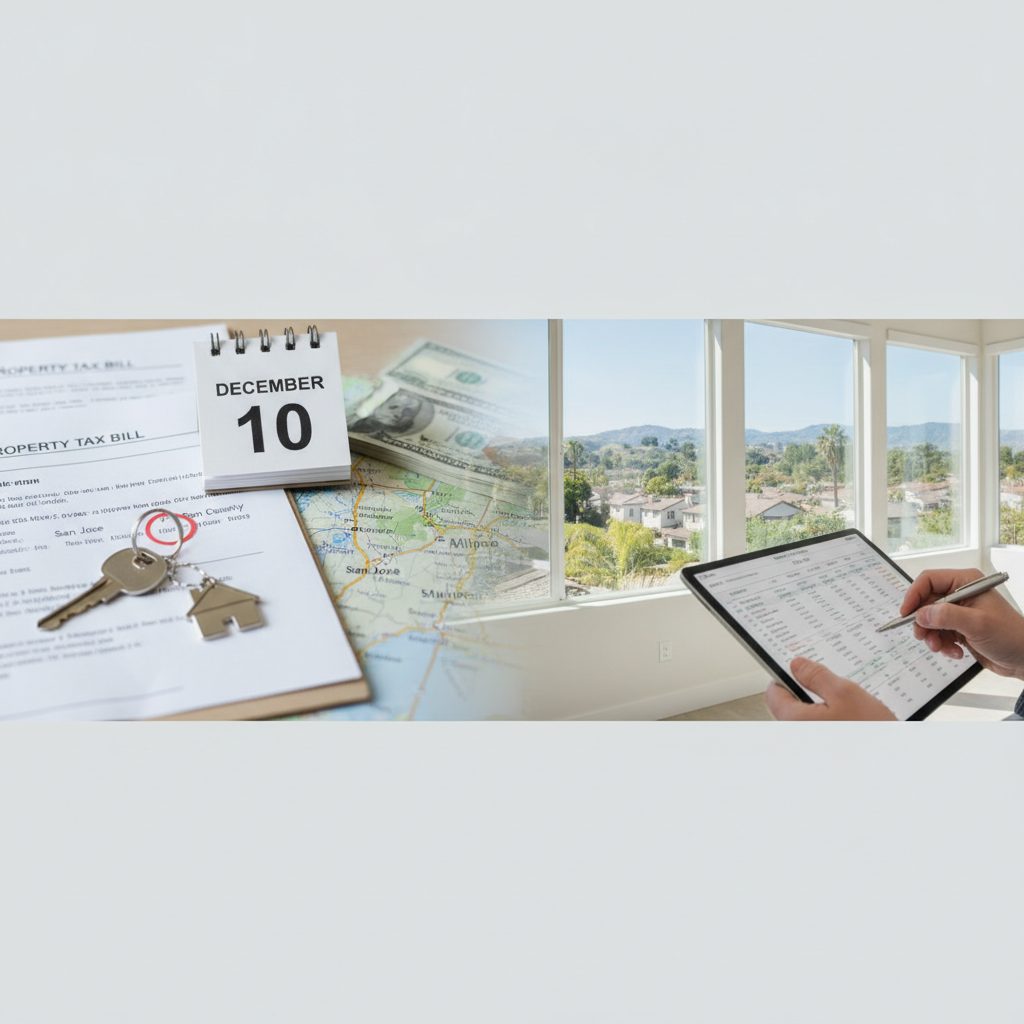
The December 10 deadline
The Santa Clara County Department of Tax and Collections says the first installment of the 2026/27 secured property tax must be paid, or carry a valid U.S. Postal Service postmark, by December 10, 2026 to avoid penalties. That date comes from state law: Revenue and Taxation Code section 2617 makes taxes due November 1 delinquent at 5 p.m. on December 10.The county's property tax FAQ lists the penalty for a late first installment as 10% of that installment plus a $20 cost. The second installment is due February 1 and becomes late after April 10. April 10, 2027 falls on a Saturday, and the county says a weekend deadline moves to the next business day."The bill isn't in my name." Does that matter?
It can. The annual bill shows the owner of record as of the January 1 lien date, according to the county. If you closed after January 1, 2026, this year's bill may list the seller.The county also says not receiving a bill does not excuse penalties. Recent buyers can call (408) 808-7900 for a duplicate bill or look up the parcel on the county's payment portal.Whether you owe this installment depends on your closing. Your closing statement shows what escrow paid or credited for property tax, and your escrow officer can explain it.Will my lender pay it?
If you have an impound (escrow) account, your lender may pay the annual bill. If you're unsure, the county suggests asking the lender, and if you still don't know, paying it yourself; it says duplicate payments are refunded to the last payer.Supplemental bills are different. The county says lenders don't get a copy, so contact your lender when one arrives. A mix-up with your lender is not accepted as a reason to waive a penalty.What is a supplemental bill?
When a home changes hands, the County Assessor must reassess it. The new value takes effect the first day of the month after the sale. The supplemental bill charges tax on the difference between the old value and the new one, for the months left in the fiscal year (July 1 to June 30).The assessor says this bill usually isn't prorated in escrow or paid through an impound account. The county says a Notice of Supplemental Assessment comes about 60 days before the bill, most bills go out within nine months of the sale, and some buyers get two.An illustration only, with made-up numbers. Say the old assessed value was $600,000 and you bought for $1,400,000 in August 2026. The new value starts September 1, which leaves 10 of 12 months in the fiscal year. Using a 1.2% rate as an example: $800,000 x 10/12 x 1.2% = $8,000. Your real bill depends on the assessor's values and your area's rate, which you can look up in the County Controller's tax rate book.Due dates depend on when the bill is mailed. The county's example: a bill mailed in February has a first installment that is late after March 31. Read the dates printed on yours.Have you filed the homeowners' exemption?
If the home is your main residence, the Assessor's Office says you may qualify to take up to $7,000 off its assessed value, which it estimates saves about $70 to $80 a year. You file once, not every year.If you live there on January 1, 2027, the full exemption is available for a claim filed by 5 p.m. on February 15, 2027. The state Board of Equalization says it may also apply to a supplemental bill if the prior owner didn't have it and you moved in within 90 days; for the full amount, file within 30 days of the date on the supplemental notice.Paying and other counties
The county takes eCheck online with no fee; cards carry a 2.22% fee. Mailed payments need a USPS postmark, not a private meter date.If you live in Fremont, Newark, Union City or Hayward, you're in Alameda County. The December 10 date is set by state law, but check the Alameda County Treasurer-Tax Collector for bills, portals and local details.This is general information from the county and state. For questions about your own taxes, talk with a CPA, and for your loan's impound account, talk with your lender.Your checklist
- Look up your parcel on the county payment portal and confirm whether the first installment shows as paid.
- Find the property tax lines on your closing statement.
- Ask your lender in writing whether your impound account covers the annual bill.
- Watch your mail for a Notice of Supplemental Assessment and check the dates printed on any supplemental bill.
- Check that your mailing address with the Assessor is correct.
- If it's your main home, confirm your homeowners' exemption is on file.
Linh Tran
REALTOR®
Area served: San Jose, Santa Clara County, CA, Milpitas, Santa Clara County, CA, Fremont, Alameda County, CA, Newark, Alameda County, CA, Santa Clara, CA, Cupertino, Santa Clara County, CA
Expertise: FHA Financing, First-Generation, Fix-and-Flip Investor, First-Time Buyer, Tech Relocation