
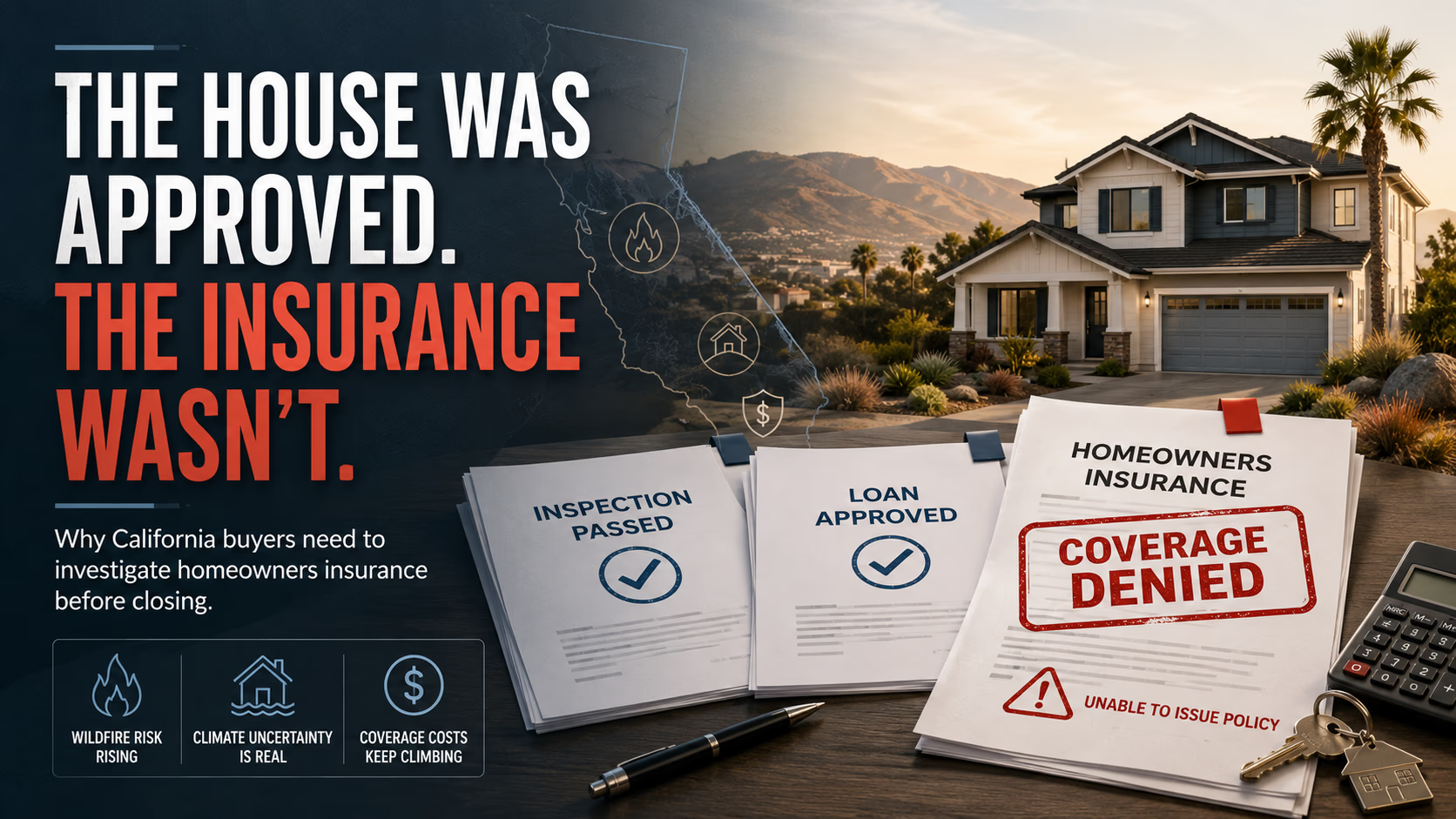
California buyers are focused on mortgage rates and home prices. A rapidly rising expense can still change the payment, delay closing or make the home impossible to insure.
Imagine finding the right home after months of searching.Your offer gets accepted.The inspection goes well.The appraisal supports the purchase price.Your lender says the loan is moving toward final approval.Then you call for homeowners insurance.One company declines the property.A second insurer will not provide coverage.A third offers a policy, but the premium is thousands of dollars higher than you expected.Suddenly, the monthly payment no longer works.In some cases, the lender cannot fund the mortgage without acceptable insurance coverage.The house did not fail the inspection.The buyer did not lose their job.The loan did not fall apart because of bad credit.Insurance became the problem.For California homebuyers, homeowners insurance can no longer be treated like routine paperwork completed a few days before closing.It needs to be part of the property investigation from the beginning.California Insurance Costs Have Risen Dramatically
Average homeowners insurance premiums for California single-family homes increased 84% between the end of 2020 and March 2026, according to research from Stanford University.During the same period, average deductibles increased from approximately $1,813 to $2,553.The research also found that the California FAIR Plan covered roughly 5% of the state’s single-family homes by March 2026, up from approximately 1.5% in December 2020. It supported about 6% of new single-family mortgage originations.These figures do not mean every California home is difficult or expensive to insure.Insurance availability and pricing can vary significantly based on the property, location, insurer, coverage limits and risk profile.But the broader trend is clear:Insurance is becoming a larger part of California’s homeownership cost.Buyers who calculate affordability using only principal, interest and property taxes may be working with an incomplete number.Why Insurance Can Affect Your Closing
Most mortgage lenders require buyers to secure homeowners insurance before the loan can be funded.The Consumer Financial Protection Bureau states that buyers generally need to show proof of homeowners insurance as part of the mortgage closing process.That means an insurance problem can become a financing problem.A buyer may encounter difficulty when:- No standard insurer will cover the property.
- The available policy does not meet the lender’s requirements.
- The premium increases the total monthly payment beyond the buyer’s comfort level.
- The deductible is substantially higher than expected.
- Additional coverage must be purchased separately.
- The insurance quote arrives too late to explore alternatives.
- The home requires repairs before an insurer will issue coverage.
The Lowest Premium Is Not Automatically the Best Policy
Buyers naturally want the lowest possible insurance cost.But comparing policies based only on the annual premium can create a dangerous blind spot.Two policies with similar prices may provide very different protection.Buyers should compare:- Dwelling coverage
- Replacement-cost assumptions
- Deductibles
- Personal-property coverage
- Loss-of-use coverage
- Liability protection
- Water-damage limitations
- Wildfire-related conditions
- Building-code upgrade coverage
- Exclusions and endorsements
Wildfire Exposure Is Only Part of the Conversation
Wildfire risk receives most of the attention, particularly in California.It deserves that attention.However, insurance availability may also be influenced by the condition and characteristics of the property.An insurer may evaluate factors such as:- Roof condition
- Electrical systems
- Plumbing
- Prior claims
- Building materials
- Property maintenance
- Replacement cost
- Surrounding vegetation
- Access for emergency response
- The insurer’s existing concentration of risk in the area
"“This neighborhood looks safe, so insurance should be easy.”"The only reliable answer comes from obtaining actual quotes for the specific property.
What Is the California FAIR Plan?
The California FAIR Plan provides a coverage option for homeowners who cannot obtain insurance through the traditional market.It can be an important safety net.But buyers should understand that it is not necessarily the equivalent of a standard comprehensive homeowners policy.The California Department of Insurance describes the FAIR Plan as a last-option form of coverage. Its basic policy provides limited protection, primarily for losses connected to fire, lightning, internal explosion and smoke. The department recommends that consumers consider supplemental coverage for risks not included in the FAIR Plan policy.That can mean purchasing more than one policy to build broader protection.As a result, buyers need to calculate:- The FAIR Plan premium
- The cost of supplemental coverage
- Broker fees, when legally applicable
- Deductibles
- The total combined annual cost
- Whether the complete package satisfies the lender
There Are Early Signs of Improvement
The situation is not entirely negative.The California Department of Insurance reported that the FAIR Plan added approximately 16,000 residential policies during the first quarter of 2026, representing about 2.4% growth from the previous quarter.That was a meaningful slowdown from periods in 2024 and 2025 when quarterly additions ranged from approximately 35,000 to 50,000 policies.The department described the slower growth and expanding insurer participation as early indicators that the market may be beginning to stabilize. It also cautioned that additional data would be needed to determine whether the improvement will continue.Buyers should not panic.They should prepare.The market may improve, but that does not eliminate the need to investigate the specific home they are purchasing.The Insurance-First Buyer Strategy
Here is the process I recommend buyers discuss with their real estate agent, lender and insurance professional.1. Investigate Insurance Immediately
Begin contacting insurance professionals as soon as your offer is accepted, or earlier when possible.Do not wait until the lender requests the final insurance binder.The earlier you start, the more time you have to compare insurers and resolve property-related concerns.2. Request More Than One Quote
One declined application does not always mean the home is uninsurable.Different insurers evaluate risk differently and may have different levels of exposure within the same area.The California Department of Insurance recommends contacting multiple insurers, agents and brokers rather than relying on one source. It also provides tools to help consumers find insurance professionals and compare available options.3. Provide Accurate Property Information
Insurance quotes are only as reliable as the information used to generate them.Be prepared to provide details about:- Roof age
- Square footage
- Construction type
- Renovations
- Electrical upgrades
- Plumbing updates
- Heating systems
- Fire-safety improvements
- Prior losses
- Pools, detached structures or additional units
4. Ask Whether an Inspection Is Required
Some insurers may require photographs, documentation or an inspection before finalizing coverage.Ask what conditions must be satisfied and whether any repairs could be required.This is especially important for older homes or properties with deferred maintenance.5. Send the Quote to Your Lender
The lender should confirm that the policy and coverage satisfy the loan requirements.Do not assume that every policy will automatically qualify.6. Recalculate the Real Monthly Payment
Add the verified insurance premium to:- Principal and interest
- Property taxes
- HOA dues
- Special assessments
- Mortgage insurance, when applicable
- Expected utilities and maintenance
"Does the complete payment still fit comfortably within my budget?"An accepted loan amount is not the same thing as an affordable lifestyle.
7. Review the Coverage, Not Just the Cost
Ask what would happen if the home suffered a total loss.Would the dwelling limit realistically support rebuilding?Are building-code upgrades covered?How much would you pay before coverage begins?Where are the exclusions?The Department of Insurance warns that comparing price without comparing coverage can leave homeowners inadequately protected.Sellers Need an Insurance Strategy Too
Insurance is not only a buyer issue.A seller can prepare for this concern before listing.Depending on the property, useful preparation may include:- Gathering roof and renovation records
- Documenting electrical or plumbing upgrades
- Completing defensible-space or vegetation work
- Repairing visible hazards
- Keeping current insurance information available
- Addressing deferred maintenance
- Providing permits and contractor invoices when available
New Construction Is Not Automatically Exempt
Some buyers assume that new construction will always be easier to insure because the home has a new roof, new electrical systems and modern building standards.New construction may offer advantages.But insurance still depends on the home’s location, replacement cost, community exposure and the underwriting rules of the insurer.A brand-new home can also carry a high replacement value because of its size, construction cost and finishes.Buyers should obtain a real insurance quote even when purchasing directly from a builder.Never rely exclusively on an estimated number in a sales worksheet.The Question Buyers Must Ask Before Falling in Love
Most buyers begin with:"“Can I afford the mortgage?”"California buyers now need to ask an additional question:
"“Can I obtain adequate insurance for this specific home at a cost that fits my budget?”"That question should be answered before the buyer removes important protections, spends significant money preparing to move or reaches the final days before closing.The home’s location, layout and purchase price still matter.The mortgage rate still matters.The inspection still matters.But none of those answers are complete until the insurance has been investigated.