
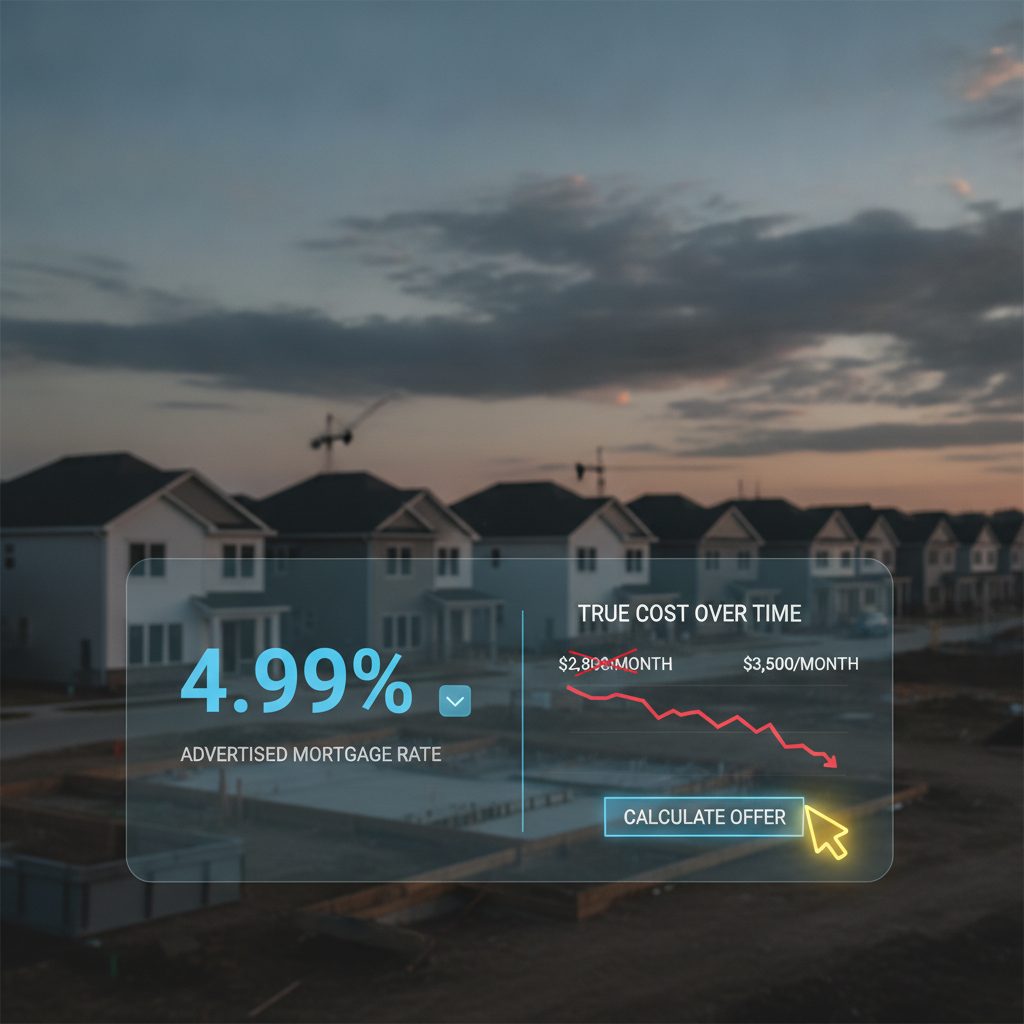
A low advertised mortgage rate can look irresistible. Before you sign, calculate what the builder’s offer is really worth—and what the home will cost after you receive the keys.
Homebuilders have a problem.Mortgage rates remain elevated, affordability is strained and many prospective buyers are sitting on the sidelines.Unlike an individual homeowner, however, a builder cannot simply decide to wait indefinitely.Builders have construction loans, completed inventory, sales targets and new phases that need to keep moving. When demand slows, they have a strong reason to create urgency and make their homes look more affordable.That is why buyers are seeing offers such as:- Below-market mortgage rates
- Tens of thousands of dollars toward closing costs
- Paid discount points
- Free upgrades
- Reduced prices on move-in-ready homes
- Appliance packages
- Temporary mortgage-rate buydowns
"“Which builder is offering the lowest rate?”"The better question is:
"“Which home gives me the best total value after price, financing, taxes, upgrades and future expenses are included?”"That distinction could be worth tens of thousands of dollars.
Builders Are Feeling the Pressure
In July 2026, 37% of builders reported cutting home prices, up from 35% in June. The average reduction was approximately 6%.At the same time, 63% of builders were using sales incentives, marking the 16th consecutive month in which at least 60% of builders reported offering incentives. Builder confidence also declined as high mortgage rates and economic uncertainty continued to weigh on buyer demand.Those numbers do not mean every builder is desperate.They do mean buyers should not assume that the advertised price and terms are final.Builders may have more flexibility than their marketing suggests, particularly on:- Completed inventory homes
- Homes approaching completion
- Less desirable lots
- Homes with preselected upgrades
- The final homes in a community or phase
- Purchases near a monthly or quarterly sales deadline
Why Builders Prefer Incentives Over Major Price Cuts
A builder may be willing to contribute $20,000 toward financing while resisting a $20,000 reduction in the purchase price.Why?Because a recorded price reduction can affect future sales in the community.If one home closes for substantially less, that sale may influence appraisals and buyer expectations for the next homes. A financing credit allows the builder to improve the buyer’s monthly payment without publicly lowering the base value of the property by the same amount.This is not necessarily bad for the buyer.A well-structured financing incentive can create meaningful savings.But it explains why the builder’s best offer may come through its preferred lender rather than through a dramatic reduction in the advertised price.The Low-Rate Offer Can Be Powerful
Imagine a builder advertising a mortgage rate well below the broader market.That lower rate could reduce the monthly payment by hundreds of dollars and improve the buyer’s purchasing power.Depending on the loan amount and how long the buyer owns the home, that benefit may be worth significantly more than a modest price reduction.But buyers must determine whether the advertised rate is:- Fixed for the entire loan term
- Temporary for the first one, two or three years
- Available only on certain homes
- Available only through the builder’s preferred lender
- Based on a specific credit score or down payment
- Tied to a fast closing date
- Funded by discount points paid by the builder
- Accompanied by higher lender fees elsewhere
Temporary and Permanent Buydowns Are Not the Same
A permanent rate buydown uses upfront funds to reduce the interest rate for the life of the loan.A temporary buydown lowers the effective payment for a limited period, often during the first one to three years. After that period, the payment rises to the loan’s full note rate.Temporary buydowns can help a household manage the first years of ownership.But the buyer must qualify for and be financially prepared to handle the full payment.Do not judge affordability based only on the first-year promotional payment.That is the real estate equivalent of evaluating a subscription by looking only at the free trial.The Costs New-Construction Buyers Commonly Miss
A new home may have lower immediate repair costs than an older resale property, but that does not mean it is fully finished.Depending on the builder and community, buyers may need to pay for:- Backyard landscaping
- Window coverings
- A refrigerator
- Washer and dryer
- Ceiling fans
- Pendant or decorative lighting
- Garage storage
- Closet organization
- Water treatment equipment
- Security cameras
- An EV charger
- Additional concrete or patio work
- Furniture for larger rooms
- HOA dues
- Special assessments or Mello-Roos taxes, where applicable
The Model Home Is Not the Base Home
Model homes are designed to create an emotional reaction.The flooring, lighting, built-ins, wall treatments, landscaping, furniture and structural options may represent tens or even hundreds of thousands of dollars in upgrades.A buyer may fall in love with the model and then discover that the base home looks and feels very different.Before comparing a new home with a resale property, ask the builder for a written breakdown of:- Standard features
- Included structural options
- Design-center upgrades
- Lot premiums
- Solar terms
- Landscaping included
- Appliance package
- Warranty coverage
- HOA dues
- Estimated property taxes and assessments
Resale Sellers May Be Negotiable Too
New construction is not the only place where buyers may find leverage.Elk Grove’s median sale price was approximately $626,625 during the three months ending May 2026, down 5.1% from the same period a year earlier. Homes sold in approximately 19 days on average, and the average sale-to-list ratio was 99.4%.That tells us two things.First, Elk Grove is not one uniform market where every seller is desperate.Well-priced, desirable homes can still sell quickly and may receive multiple offers.Second, buyers should not assume every resale property will sell above asking with no concessions.A home that has been sitting, needs cosmetic work or was originally overpriced may provide room to negotiate:- Seller-paid closing costs
- Repair credits
- Mortgage-rate buydowns
- A lower purchase price
- Appliances
- Home warranties
- More protective contingencies
New Construction Versus Resale: Compare the Same Numbers
When comparing two homes, build a complete side-by-side analysis.Purchase and Financing
Compare:- Purchase price
- Down payment
- Interest rate
- Whether the rate is temporary or permanent
- Monthly principal and interest
- Closing costs
- Discount points
- Lender fees
- Total cash required to close
Ongoing Ownership
Compare:- Property taxes
- Special assessments
- HOA dues
- Homeowners insurance
- Estimated utilities
- Solar payment or agreement, when applicable
- Maintenance expectations
- Commute and transportation costs
Post-Closing Expenses
Compare:- Repairs
- Remodeling
- Landscaping
- Window coverings
- Appliances
- Furniture
- Storage systems
- Immediate upgrades
Long-Term Fit
Compare:- Location
- Lot quality
- School and community considerations
- Floor plan
- Future development nearby
- Resale appeal
- Expected ownership period
Five Questions to Ask Before Accepting a Builder Incentive
1. Can I use my own lender?
You should be allowed to compare the builder’s lender with other financing options.The preferred-lender offer may still be the strongest, but it should win the comparison rather than avoid one.2. Is the rate permanent?
Ask for the note rate after any temporary buydown ends.Make sure the full payment fits your budget.3. What happens if I take a price reduction instead?
The builder may offer different combinations of price cuts, closing-cost credits and financing incentives.Ask the sales representative to show you the available structures.4. What is not included in the home?
Get a written list.Do not rely on the appearance of the model or verbal descriptions.5. What does my own agent see that I might miss?
The builder’s sales representative works for the builder.That does not make the representative dishonest. It means the representative’s legal and business responsibility is to the seller.Your own real estate agent should help you evaluate the lot, contract, incentives, inspections, future development, comparable sales and resale implications.In many communities, the builder pays the buyer agent’s compensation, but the agent may need to accompany or register the buyer during the first visit.When New Construction May Be the Better Choice
New construction may provide stronger value when:- The builder is offering a substantial permanent rate buydown
- The buyer wants lower near-term maintenance
- The included floor plan fits without major renovations
- Energy efficiency and solar provide meaningful value
- The warranty reduces uncertainty
- The buyer has enough reserves for landscaping and setup costs
- The lot and location support long-term resale appeal
- The total monthly payment is better than comparable resale options
When Resale May Be the Better Choice
A resale home may provide stronger value when:- It is in a more established or preferred neighborhood
- Landscaping and window coverings are already complete
- The lot is larger or more private
- The seller is willing to offer meaningful concessions
- The property includes upgrades that would be expensive to add later
- Special taxes or HOA costs are lower
- The buyer values mature trees, established amenities or a shorter commute
- The home’s total first-year cost is lower despite a higher mortgage rate
The Biggest Mistake Buyers Make
The biggest mistake is allowing one attractive number to control the decision.For new construction, that number is often the advertised mortgage rate.For resale, it may be the reduced asking price.Neither tells the full story.A home with a lower rate can still cost more.A home with a lower price can require extensive repairs.A brand-new home can create major post-closing expenses.An older home can already include improvements that would cost far more to reproduce today.The smartest buyer does not chase the largest incentive.The smartest buyer determines which home creates the strongest combination of affordability, quality of life and long-term value.The Bottom Line
Yes, builders are cutting prices and offering incentives.For financially prepared buyers, this may be one of the better windows in recent years to negotiate on selected new-construction homes.But an incentive is not automatically a bargain.Before signing, calculate:- The real purchase price
- The permanent monthly payment
- The full cash required to close
- The property taxes and assessments
- Everything excluded from the home
- The cost of completing the property
- The value of comparable resale alternatives