
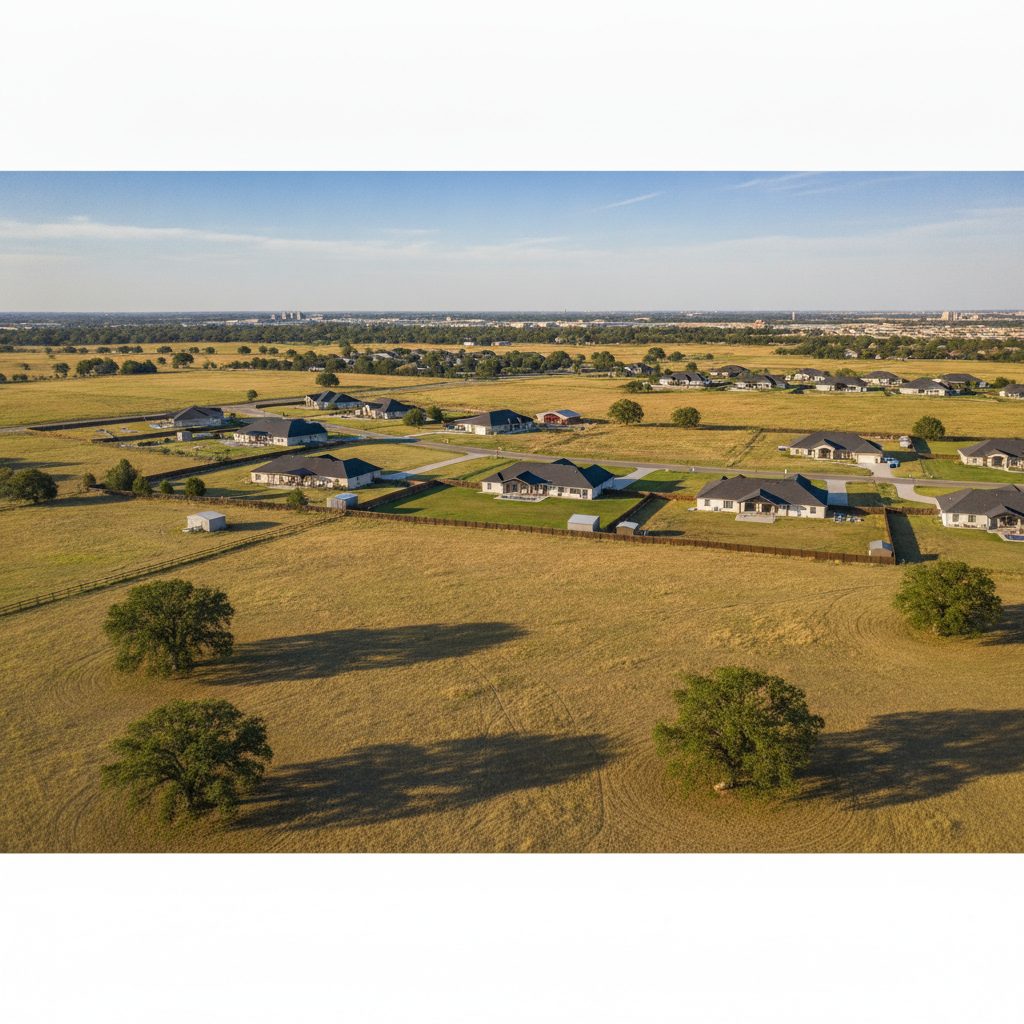
Real Estate and Acreage Realities in McSwain

Real Estate and Acreage Realities in McSwain
Evaluating McSwain real estate reveals an environment distinctly separated from standard municipal tracts in Merced County. Situated directly south of downtown Atwater and just west of Merced, this unincorporated community trades municipal density for private acreage. Buyers shopping the Central Valley corridor along Highway 99 frequently compare McSwain against standard residential tracts in northern Atwater, but the two settings share very little common ground in zoning, infrastructure, or daily operation.

Why McSwain properties command larger parcel sizes than northern Atwater

The primary operational difference between McSwain and northern Atwater is parcel density. While subdivisions north of Bellevue Road and near Castle Commerce Center feature standard 6,000 to 8,000 square foot lots tied to municipal utility grids, McSwain is platted almost entirely on expansive ground. The median lot size across this neighborhood is one full acre, with many residential parcels extending across two or more acres.According to Norma Lopez, a REALTOR® with Keller Williams Property Team who has worked in the local market for over a decade, that extra ground is the primary draw for incoming buyers. Residents look for room to operate without direct neighbor oversight, whether that involves storing work trailers, planting private almond or fruit orchards, or keeping livestock. Because the area is entirely residential and sits south of the commercial core, there are no shopping plazas, retail centers, municipal parks, or civic plazas within its borders. Residents make the drive north across Highway 99 into Atwater or east along Highway 140 into Merced for groceries and community services, deliberately taking on travel time in exchange for rural space.

How three distinct architectural zones define local price brackets

Inventory across McSwain is not uniform. The community breaks down into three distinct sectors based on build era, acreage utility, and price ceiling:
  • Midcentury ranch homes: Situated primarily across the central section of the community, these properties offer single-story layouts on one-acre parcels, with transaction prices typically ranging from $600,000 to $800,000.
  • Turn-of-the-century contemporary builds: Located along the western edge, these homes date from the 1990s through the 2000s, featuring four-bedroom footprints, stone walkways, and palm landscaping, trading between $900,000 and $1,200,000.
  • Equestrian spreads and farmhouses: Clustered along the eastern perimeter and rural edges, these holdings feature multi-acre pastures, functional outbuildings, and barns, with pricing reaching $1,300,000 to $1,800,000.
When buyers compare a contemporary build on the west side with a midcentury ranch in the central district, purchase strategy depends on renovation capacity. A midcentury home priced near $700,000 occupies an identical one-acre parcel footprint to a neighboring $1,000,000 contemporary build. However, assuming that modernizing the older home will automatically yield instant equity is a mistake. Upgrading aging roofs, heating and cooling units, structural framing, and plumbing fixtures involves substantial capital, and supply chain constraints can rapidly inflate budgets. Buyers evaluating this trade-off should commission independent contractor estimates and consult certified valuation professionals before assuming any post-renovation profit margin.

Navigating USDA zero-down financing on rural Merced County parcels

A distinct financing mechanism in McSwain that is unavailable in incorporated Atwater or central Merced is access to the USDA Rural Development Guaranteed Housing Loan program. Under federal program maps, McSwain carries an unincorporated rural classification, allowing eligible borrowers who meet income restrictions to purchase real property with zero down payment. In incorporated subdivisions along Winton Way or Buhach Road, standard Fannie Mae, Freddie Mac, or FHA guidelines govern purchases, requiring minimum cash down payments ranging from 3 percent to 3.5 percent.Zero-down rural lending serves as a substantial catalyst for transactions across the community, but property condition rules under federal rural underwriting remain specific. Detached agricultural barns, workshops, perimeter fences, and accessory structures must meet general habitability, sound construction, and safety criteria. When an older property along Buhach Road or Scott Road shows deferred maintenance on outbuildings or damaged roofs, underwriters may require repairs before clearing the loan for closing. Because underwriting determinations depend on individual property conditions and loan guidelines, prospective buyers should consult a qualified mortgage professional to verify program eligibility and review specific lender escrow or repair requirements.

The operational realities of private wells and septic systems

Relocating from an incorporated subdivision to McSwain requires a major operational adjustment regarding utility infrastructure. Homes inside Atwater city limits connect directly to municipal water and sewer lines administered by the City of Atwater Public Works Department, which handles regional water treatment, pipeline repairs, and discharge capacity. In McSwain, every single-family parcel functions as an isolated utility island, depending solely on a private domestic water well and an on-site septic tank with dedicated leach fields.This operational division places mechanical and financial responsibility onto the property owner. Well pumps, pressure tanks, filtration systems, and septic distribution boxes require direct monitoring and maintenance. Before removing inspection contingencies on any parcel along Gurr Road, McSwain Road, or Moran Way, hiring a licensed hydrogeological technician to run a multi-hour well production test and perform a down-hole camera diagnostic provides valuable insight into casing integrity, total depth, and static water levels. Central Valley aquifer elevations fluctuate according to regional agricultural pumping cycles and seasonal precipitation. Buyers should work directly with licensed pump contractors, certified septic inspectors, and the Merced County Department of Public Health Division of Environmental Health to evaluate well capacity and confirm that leach lines and septic systems adhere to applicable local health regulations.

Why county zoning code limits commercial development in McSwain

Unlike northern Atwater, where city planners routinely rezone parcels near Applegate Road to accommodate retail strip centers, warehouse distribution nodes, and multi-family apartment complexes, McSwain remains subject to Merced County rural residential zoning designations. These county designations restrict land uses primarily to low-density single-family dwellings, agricultural production, and limited home-based occupations, preventing the commercial development seen along regional transit corridors.For property owners, this legal framework preserves expansive parcel layouts and low traffic counts. However, it also means municipal services like public curbs, storm sewer gutters, and street lighting are not provided by county public works agencies. Property owners maintain their private road aprons, drainage swales, and culverts along street frontages. Understanding these county governance boundaries helps buyers evaluate whether unincorporated acreage matches their long-term maintenance expectations.
#RealEstate#Neighborhood#RealEstateAcreage#Estate#Acreage#Realities#Mcswain#RealEstateInsights#Insights#MarketUpdate#JustSold#HomeBuying