
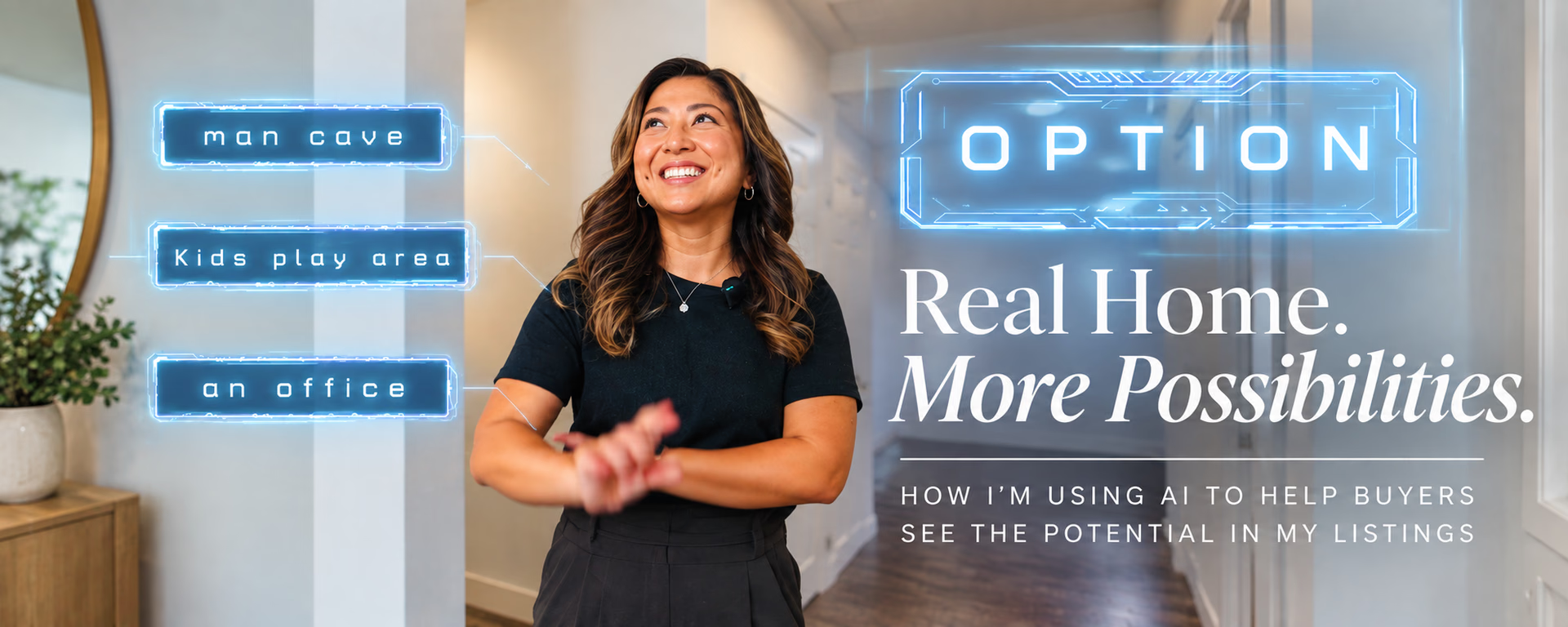
AI is changing the way we market homes, and I’m here for it. But I also believe there’s a right way to use it.
For my most recent listing video, I worked with my videographer to incorporate virtual staging into select rooms of the home. The goal wasn’t to make the house look completely different. It was to help buyers better understand how they could actually use the space.
Sometimes, an empty room can be difficult to visualize.
You might walk into a flex space and think, “Okay… but what would I actually do with this?”
Is it an office? A playroom? A workout space? A guest room?
That’s where AI can be incredibly helpful.
Helping Buyers See the Possibilities
With virtual staging, we can take a real room and thoughtfully show different ways the space could function.
In my latest listing video, we used AI to virtually furnish certain areas so buyers could get a better sense of scale, layout and potential.
And I think that distinction is important: AI should enhance the home—not misrepresent it.
The bones of the home, the layout, the windows, the finishes and the actual space are still what buyers are seeing. We’re simply giving them another visual tool to help them imagine their life there.
AI Can Also Help Buyers Find Their Style
As a Zillow Showcase agent, there are additional features available on my listings that allow buyers to digitally remove the seller’s furniture and explore the space with a style that better fits their taste.
Maybe you love Scandinavian design.
Maybe you’re more farmhouse.
Maybe you’re a modern minimalist.
There are so many different ways people envision their future home, and being able to see a space through different design perspectives can make the home feel much more approachable.
Because sometimes the biggest obstacle isn't that a buyer doesn't like the house.
They just can't see themselves in it yet.
But I Don't Want Everything to Be AI
This is where I’m pretty intentional.
As much as I love what AI can do, I don't want my listing to feel like one giant AI-generated fantasy.
There is so much value in seeing the real home.
The natural light.
The actual finishes.
The backyard.
The way the kitchen connects to the living space.
The little details that make the home unique.
Those things shouldn't be replaced by technology.
Instead, I see AI as one more tool in the marketing toolbox.
Professional photography, video, drone footage, 3D tours, virtual staging and AI-enhanced visualization can all work together to tell a more complete story about a property.
Yes — I think this section is important because it gives the article some balance. Your message isn't “AI is amazing, use it everywhere.” It's more nuanced: AI can help buyers visualize potential, but it should never blur the line between the home as it exists today and what it could become.
I’d add this section right after “But I Don’t Want Everything to Be AI.”:
There’s a Responsibility That Comes With Using AI
As excited as I am about the possibilities of AI in real estate marketing, I also think there’s a responsibility that comes with it.
I recently came across a TikTok from a Bay Area buyer who had seen a home listed on Zillow for over $1 million. The photos looked okay, and based on the listing, it appeared to be a home that needed some work, which, let's be honest, isn't exactly an unusual story for Bay Area real estate.
But when the buyer saw the property in person, the condition was dramatically different from what the photos had portrayed.
There was a missing roof in one of the rooms, the carpet was in terrible condition, and the property was, by all accounts, a true fixer just not priced as one.
What stood out to me wasn't that the home needed work. Fixers are real, and there is absolutely a place in the market for them.
It was that the marketing apparently didn't give buyers a clear picture of the home's current condition. The buyer also noted that the photos weren't labeled as digitally altered or enhanced, nor was there an explanation in the listing description.
And that's where I think we need to draw the line.
Show Me the Reality. Then Show Me the Possibility.
If I were marketing that fixer, I would want buyers to see the home exactly as it is today.
Show the dated carpet.Show the condition of the kitchen.Show the room with the missing roof.Show the work that needs to be done.
And then, once we've established that reality, I'd show them the potential.
Maybe that's where AI and video become incredibly powerful.
You can show a room in its current condition and then visually communicate what that same space could become with some imagination, elbow grease and investment.
I've done something similar with my previous listing videos—using video to help buyers understand not only what they're seeing, but what they could do with it.
That's a very different message from making a fixer look move-in ready.
One says:
“Look at this beautiful room.”
The other says:
“Here's the room as it exists today. And here's what it could become if you're willing to put in the work.”
That distinction matters.
AI Should Enhance the Story, Not Rewrite It
As real estate professionals, I believe we have a responsibility to be transparent about how we're using these tools.
If an image has been virtually staged, enhanced or digitally altered, buyers should be able to understand that.
And most importantly, AI should never change the structural reality of a property.
It shouldn't add a room that doesn't exist, remove a major structural issue, change the layout, hide damage or make a property appear substantially different from what a buyer will experience when they walk through the front door.
Because eventually, the buyer is going to see the house in person.
And when they do, the house needs to match the story we told online.
That's the standard I want to hold myself to.
I'm all for using technology to make real estate marketing more creative, engaging and helpful. But the goal isn't to sell a fantasy.
It's to help buyers see the home clearly—and then give them the opportunity to imagine what's possible.
That, to me, is where AI adds real value.
Real Home. More Possibilities.
At the end of the day, my job isn't just to put a house online.
It's to help buyers understand what they're looking at and, hopefully, make it easier for them to picture their life there.
AI gives us another way to do that.
But the home itself will always be the star of the show.
Real home. Real details. Real possibilities, with a little help from AI.