
Why artificial intelligence liquidity concentrates in select pockets
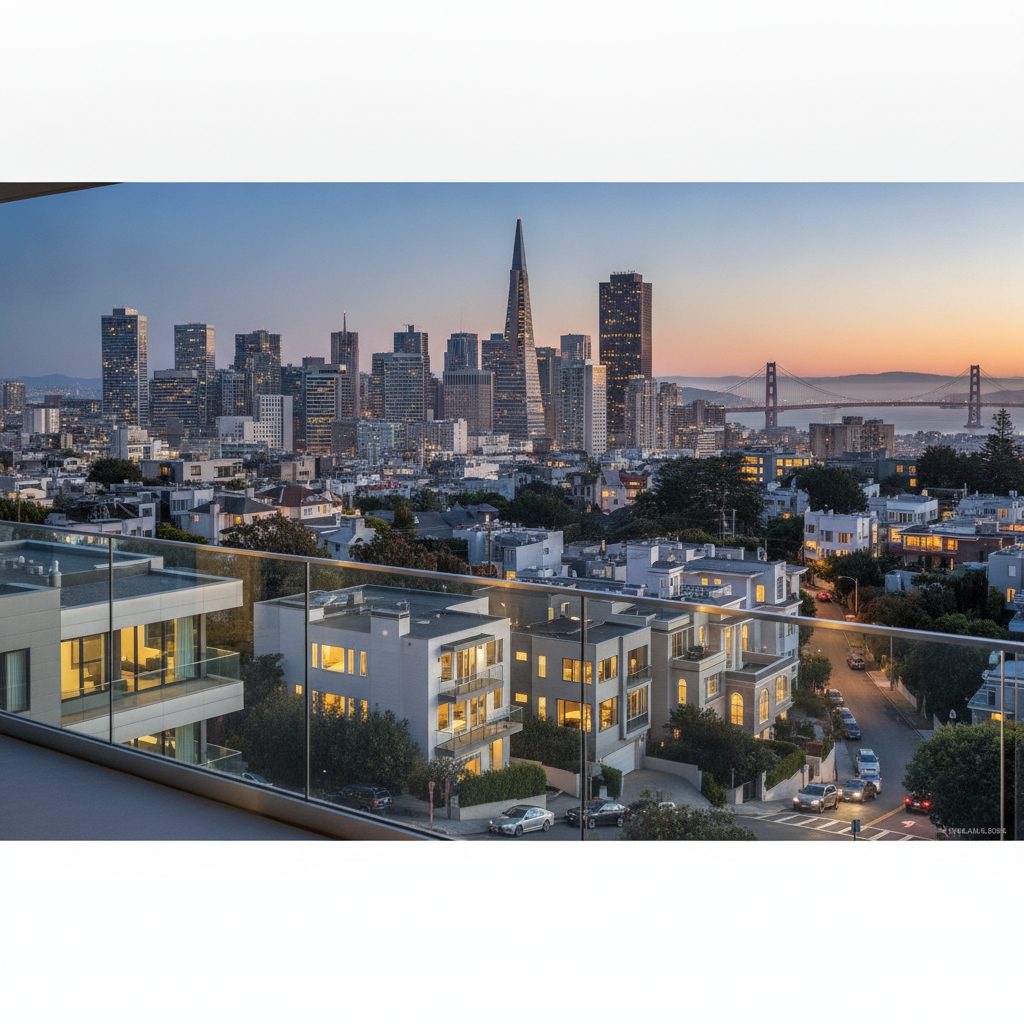
Much of the renewed momentum at the upper edge of the market connects directly to the expansion of the artificial intelligence sector in the Bay Area. Significant equity liquidity and startup valuations have generated substantial purchasing power for founders, senior technical talent, and early investors. These buyers operate with distinct financial parameters compared to conventional purchasers. Because many transact in cash or secure asset-backed credit lines against equity holdings, elevated mortgage interest rates do not determine their timeline or purchasing capacity.This liquidity does not spread evenly across the municipal grid. It concentrates in neighborhoods that offer architectural distinction, privacy, and clear commuting logistics. In Glen Park, for example, the modern hillside home at 233 Laidley Street sold for $7.2 million, which was more than $1.2 million above its $5.995 million asking price. Glen Park attracts technology buyers who require direct access to the Interstate 280 corridor for Peninsula commutes alongside immediate proximity to the Glen Park BART station for downtown transit. Further north, the home of interior designer Ken Fulk at 176 Palo Alto Avenue on the edge of Clarendon Heights closed at $9.99 million, roughly $2 million over its $7.9 million guide price.How intentional underpricing distorts San Francisco list values
Looking at list prices to gauge property value in San Francisco consistently produces errors. Unlike neighboring Peninsula enclaves such as Hillsborough or Atherton, where properties frequently list at aspirational top-of-market targets and endure extended negotiation periods, San Francisco listing agents often practice transparent underpricing. A seller and their listing agent will deliberately set the initial list price 15% to 25% beneath their actual valuation reserve. The goal is simple: trigger multiple competitive bids within an initial eight- to twelve-day marketing window.When 233 Laidley Street closed at $7.2 million, or 176 Palo Alto Avenue fetched $9.99 million, the spread between list and contract did not indicate an unexpected panic among buyers. It reflected deliberate underpricing executing exactly as designed. Conversely, when a seller prices at what they actually expect to receive, the property behaves differently. At 3221 Washington Street in Presidio Heights, the transaction completed at its exact $8 million asking price. In Pacific Heights, the grand residence at 2090 Vallejo Street originally came to market at $25 million before ultimately trading on November 2 for $19.53 million. An aspirational starting price forced a multi-million-dollar downward adjustment, demonstrating that luxury buyers will compete fiercely on strategically priced inventory but firmly reject arbitrary pricing.San Francisco building restrictions elevate turnkey properties
A key factor separating San Francisco from suburban markets in Marin or Contra Costa counties is the extreme difficulty of expanding or substantially altering an existing home. The San Francisco Planning Code enforces strict controls regarding neighborhood notification, historic preservation review, and residential demolition restrictions. Securing permits through the Department of Building Inspection to add square footage, dig out a lower level, or alter a street-facing facade can take eighteen to thirty-six months, with public Discretionary Review hearings capable of stalling projects indefinitely.Because undertaking an extensive architectural overhaul carries unpredictable timelines and carrying costs, buyers assign a massive valuation premium to move-in ready residences. A finished property on Vallejo Street or Washington Street command far higher square-foot pricing than a comparable structure requiring foundation alterations or floorplan restructuring.What transfer tax brackets mean for multimillion-dollar offers
Anyone acquiring prime residential property in San Francisco must calculate the impact of the city's progressive real property transfer tax rates. In most California counties, documentary transfer taxes sit at a nominal rate of $1.10 per $1,000 of assessed consideration (0.11%). San Francisco, by contrast, taxes high-value transactions through aggressive tiers enacted by local voters. For properties transferring between $5 million and $9.99 million, the tax rate is 2.25%. Once a sale reaches $10 million and stays below $25 million, Proposition I sets the transfer tax at 5.5%. Above $25 million, the rate climbs to 6%.On a transaction like 2090 Vallejo Street at $19.53 million, the municipal transfer tax alone represents over $1.07 million. In local custom, the seller customarily pays the transfer tax, but in competitive negotiations or non-standard contracts, parties frequently negotiate this expense. Understanding the exact bracket thresholds prevents surprises during escrow and explains why properties priced immediately above $10 million often encounter stiff price resistance from sellers conscious of the tax bracket jump from 2.25% to 5.5%.Due diligence steps before entering a competitive bidding situation
When luxury inventory trades in under two weeks, buyers often feel pressured to waive contingencies entirely. Rushing into an offer without verifying physical and title constraints can result in substantial post-closing liabilities. Preparing an offer in this market requires completing technical analysis before offer day rather than relying on standard purchase contract contingencies.You can protect your financial position by resolving several specific items before participating in a competitive review:- Pull full permit histories directly from the San Francisco Department of Building Inspection online portal to confirm that past kitchen expansions, deck additions, or structural alterations were properly finalized with completed certificates of final inspection.
- Commission private sewer lateral scans, slope stability assessments, and retaining wall evaluations, particularly on steep topographical parcels found in Glen Park, Clarendon Heights, and hillside Pacific Heights blocks.
- Analyze the last six months of closed sales within five blocks, isolating transactions that used deliberate underpricing from those that sat on the market after pricing above true comparable benchmarks.
- Calculate complete closing obligations, explicitly verifying whether the purchase contract assigns the city's graduated transfer tax to the seller or requests a buyer contribution.